

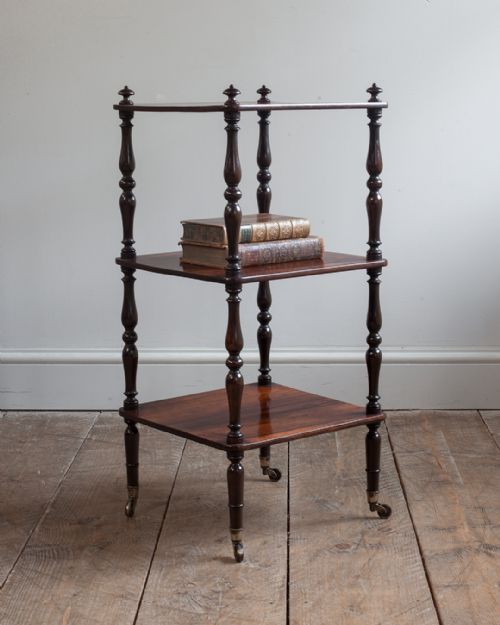


Three Tier Rosewood Stand
A three tier rosewood stand brings tiered elegance to a room, offering practical display surfaces in rich tropical timber.
Three Tier Rosewood Stand
A three tier rosewood stand belongs to a versatile family of open shelving furniture historically known as whatnots, etageres, and dumb waiters. These pieces provide graduated tiers supported by upright columns or slender legs, designed to hold books, decorative objects, or serving items.
The pieces appearing under this search phrase span the Regency, Victorian, and William IV periods, alongside Chinese Qing style examples. You will most frequently encounter nineteenth century rosewood whatnots and etageres featuring three distinct shelves.
Materials and construction
Makers utilised dense rosewood, often applied as fine veneers over secondary timbers like mahogany or hardwood, supplemented by marquetry decoration and mother-of-pearl inlay. The natural grain of the rosewood provides deep colour variation across the tiers.
Structural integrity relied on turned upright supports and secure corner posts, whilst finer examples integrated brass casters, marble inserts, or intricate fretwork galleries. Cabinetmakers balanced the weight of multiple shelves to ensure stability without heavy framing.
One exceptional piece transforms its function entirely, appearing as a rosewood metamorphic three tier table ready for unexpected guests.
Distinctions in quality
Quality rests in the crispness of the turning on the upright supports and the selection of the rosewood veneer. Superior examples show careful grain matching across the shelves and precise joinery where the uprights meet the platforms.
The inclusion of decorative elements such as marquetry veneers, brass mounts, or inset marble tops elevates a piece beyond utilitarian storage. Finer proportions and smaller, more adaptable scales also distinguish the best examples from standard production.
Samson and Son London
The Three Tier Rosewood Stand Glossary
- Whatnot
- A piece of furniture with multiple open shelves for displaying ornaments or books. It gained popularity during the Georgian and Victorian eras for parlour use.
- Etagere
- A French term for a set of open shelves or tiers used for display. These pieces function similarly to whatnots but often lean towards decorative elegance.
- Regency
- A British design period spanning the early nineteenth century. It is characterised by classical restraint, inspired by ancient Greek, Roman, and Egyptian motifs.
- Marquetry
- The art of applying pieces of veneer to a structure to form decorative patterns. Makers used contrasting timbers to create floral or geometric designs on the shelf surfaces.
Three Tier Rosewood Stand: Frequently Asked Questions
What is a three tier rosewood stand used for?
These stands served traditionally to hold books, small ceramics, and decorative objects in principal rooms. Their multiple tiers allowed owners to display collections without cluttering table surfaces.
Today, they function well in modern interiors as lamp tables, bedside units, or plant stands. Their compact footprint makes them suitable for corners and narrow spaces.
How do I date a rosewood whatnot?
Dating relies on stylistic clues and construction methods observed across the Regency, William IV, and Victorian periods. Regency examples often display classical restraint, whilst Victorian pieces can feature heavier turning or elaborate marquetry.
Turned column styles, edge mouldings, and the presence of brass castors also help narrow down the decade of production. Comparative examination of past and present listings reveals typical design evolution.
Are these stands stable enough for daily use?
Original nineteenth century stands were built to hold substantial decorative objects, books, or tea wares. Their tiered construction distributes weight downwards through the upright supports.
Placement on level flooring ensures standard stability for everyday display purposes. Avoiding excessive loads on the upper tiers preserves the antique joints.
What is the difference between a whatnot and an etagere?
The terms largely overlap in British furniture history, though etagere often implies a French influence and a lighter, more decorative character. Both describe multi-tiered open shelving units.
Makers used whichever term suited the prevailing fashion of the workshop or retailer. Both forms appear frequently in rosewood across the nineteenth century.