
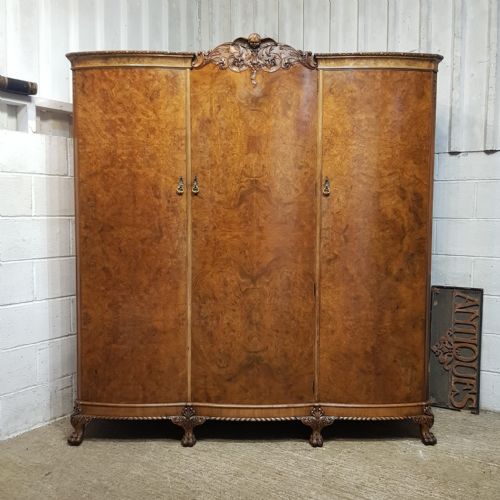


Three Door Walnut Wardrobe
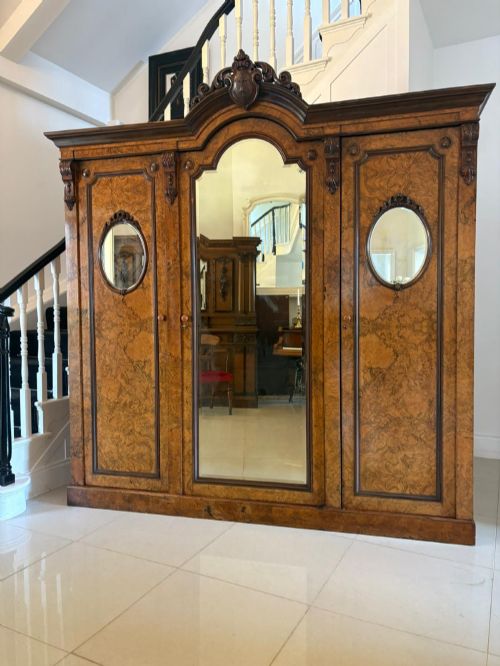
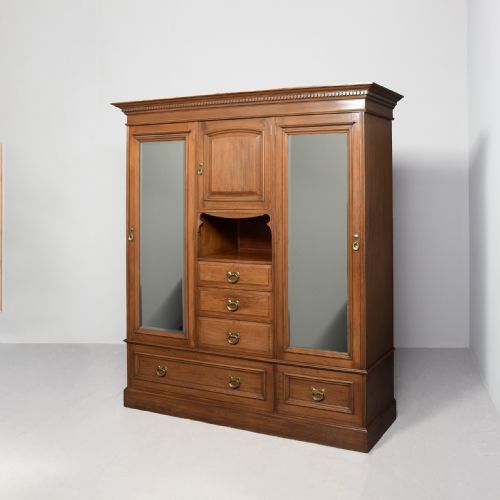
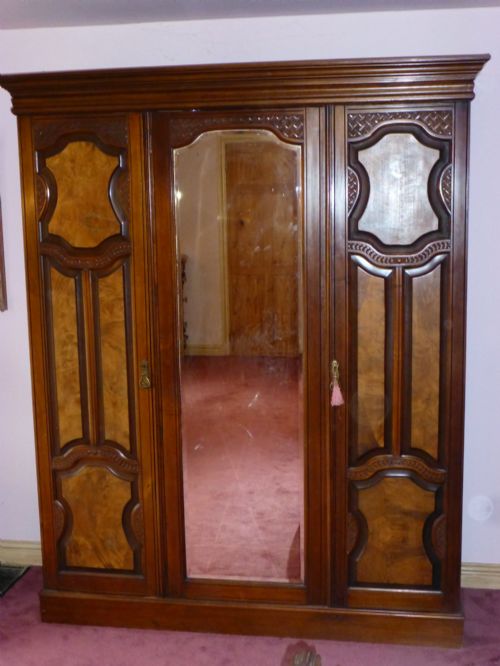
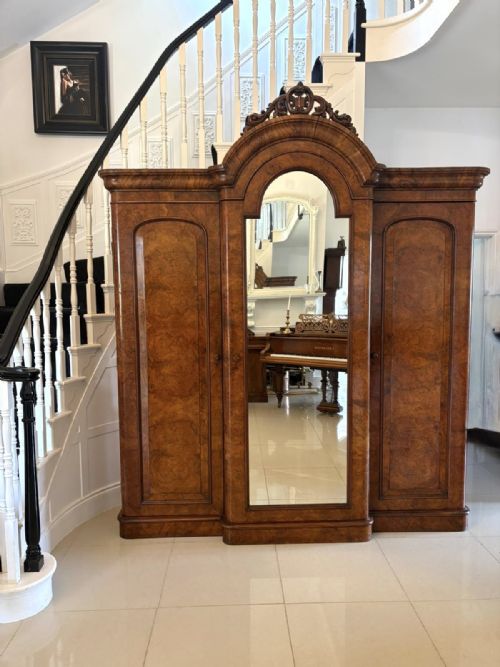
A three door walnut wardrobe provides substantial presence and clothes storage, uniting generous hanging space with drawers and shelving.
Three Door Walnut Wardrobe
When you search for a three door walnut wardrobe, you encounter large storage furniture spanning the nineteenth century, the Victorian era, the Edwardian period, and the nineteen-twenties. These substantial pieces typically incorporate a central section flanked by two full-length wings, often arranged as a combination compactum with internal drawers and hanging compartments.
You meet Victorian and nineteenth-century examples alongside Edwardian designs and nineteen-twenties Art Deco pieces. The most frequent iteration on this page is the Victorian or early twentieth-century burr walnut triple wardrobe featuring figured grain and breakfront or serpentine silhouettes.
How they were made
Cabinet makers utilised walnut timber and walnut veneer, frequently selecting burr walnut for its rich, swirling patterns on the primary display surfaces. Solid walnut and straight-grained walnut formed the structural carcasses and framing, whilst secondary woods provided interior linings.
Workshops integrated brass hardware, glass panels, and mirror glass into the doors, alongside inlaid satinwood stringing on specific Victorian and Edwardian examples. Carved ornamentation decorated the cornices and door panels of mid-nineteenth-century and Victorian pieces.
Several wardrobes hide internal linen slides so deep they could comfortably swallow an entire winter wardrobe in one go.
What varies in quality
The standard of a three door walnut wardrobe rests primarily upon the choice and matching of the veneer. Superior pieces display carefully figured burr walnut symmetrical across the three doors, whereas simpler variants utilise plain straight-grained walnut or standard timber.
Construction depth and interior fitting complexity further distinguish the range. Combination compactums with sophisticated internal drawer arrangements and signed maker attribution stand apart from standard hanging wardrobes.
Holland and Sons·JEAN FAURE·Maple and Co
The Three Door Walnut Wardrobe Glossary
- Burr walnut
- A veneer taken from the warted excrescences of walnut trees, prized for its intricate swirling patterns. It forms the primary decorative surface on finer Victorian and twentieth-century wardrobes.
- Compactum
- A large wardrobe fitted with internal compartments, drawers, and shelves alongside hanging space. This multi-functional design became popular during the nineteenth century.
- Breakfront
- A cabinet design where the central section projects forward from the flanking wings. This architectural arrangement creates depth and shadow on larger wardrobes.
- Serpentine
- A front contour characterised by a convex central section flanked by concave curves. This fluid line appears on select twentieth-century wardrobes.
- Combination wardrobe
- A piece uniting hanging space with internal drawers and clothes press compartments. It offers versatile storage within a single carcass.
Three Door Walnut Wardrobe: Frequently Asked Questions
How do I dismantle a three door walnut wardrobe?
These large wardrobes typically separate into distinct sections consisting of a central carcase, two side wings, a heavy cornice, and a plinth base. Dismantling requires releasing internal securing bolts and sliding the components apart rather than attempting to move the complete assembly.
Care must be taken with mirror glass and heavy panel doors during disassembly to prevent twisting the walnut frame.
What is a compactum wardrobe?
A compactum is a multi-functional storage piece that combines traditional hanging space with banks of internal drawers, linen slides, and shoe compartments. These units offered comprehensive wardrobe solutions for Victorian and Edwardian bedchambers.
The internal configuration distinguishes a compactum from a standard triple hanging wardrobe.
How do I tell Victorian from Art Deco walnut wardrobes?
Victorian examples display rich burr walnut, breakfront proportions, carved details, and mirrored doors with architectural cornices. They emphasise traditional revival styles and heavy timber presence.
Art Deco pieces from the nineteen-twenties feature streamlined surfaces, geometric straight-grained walnut veneers, and minimal ornamentation reflecting modern design shifts.
Will a three door walnut wardrobe fit modern rooms?
These wardrobes are substantial items designed for high-ceilinged period properties, requiring careful measurement of both floor space and ceiling clearance before placement. The three-section construction means they demand a wide wall allocation.
Ceiling height is particularly critical when positioning the heavy projecting cornices found on Victorian and Edwardian examples.
How do I care for walnut veneer?
Walnut veneer requires stable room conditions away from direct sunlight and heat sources to prevent the wood from drying and lifting. Regular dusting with a dry, soft cloth maintains the polished surface.
Avoid liquid cleaners and excessive moisture, which can penetrate older polished finishes and damage the underlying timber.