
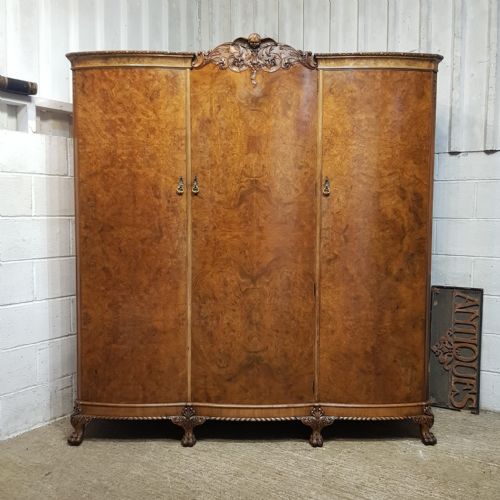


Three Door Fitted Wardrobe
A three door fitted wardrobe gives you serious hanging space and internal drawers without dominating the room.
Three Door Fitted Wardrobe
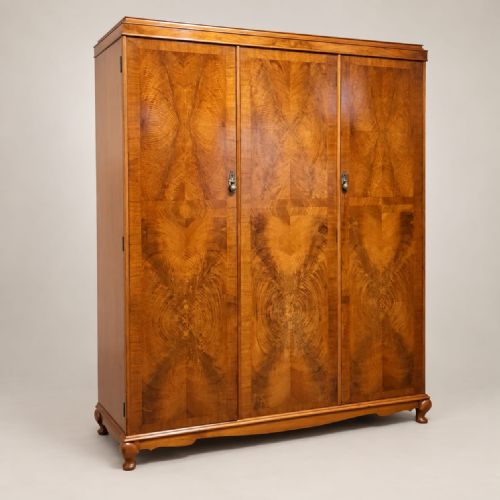
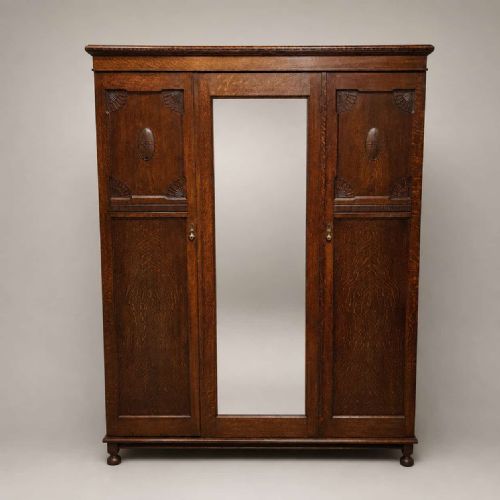
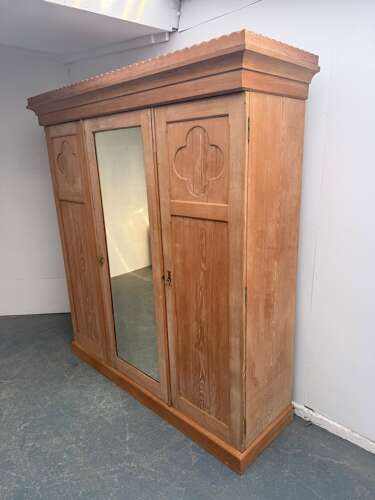
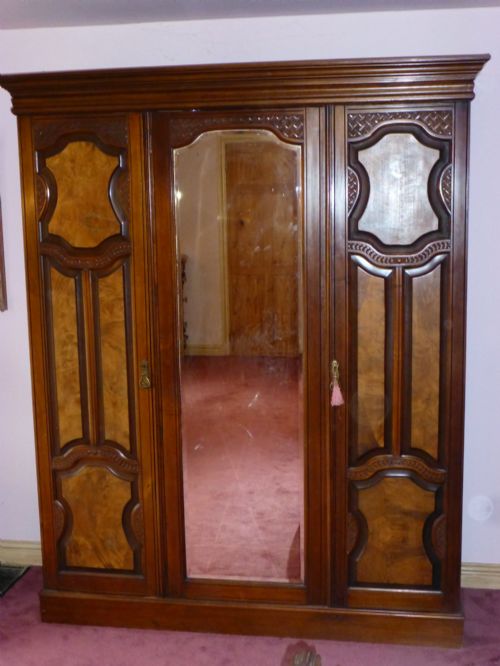
A three door fitted wardrobe is a substantial piece of bedroom furniture designed to provide extensive storage through a central section flanked by two side bays, frequently configured as a compactum with internal drawers and hanging compartments. When you search for this phrase, you will encounter grand examples spanning the Victorian, Edwardian, and Art Deco periods, alongside pieces dating into the early twentieth century.
The most common formats on this page combine mirror doors with timber panels, often utilising rich timbers such as burr walnut, mahogany, and oak. These larger wardrobes frequently separate into modular sections for transport and installation, maintaining a solid architectural presence once assembled in the home.
Stylistic influences range from the clean lines of the Arts and Crafts movement and Art Deco up to heavier Jacobean and Queen Anne revivals. You will also find specialised variations like Gentleman's compactums and combination wardrobes that integrate linen presses or sliding internal trays alongside standard hanging space.
How they were made
Cabinet makers constructed these large carcases using solid timbers for structural frames combined with matched veneers on the visible exterior panels. Burr walnut, mahogany, and oak provide the primary structural and decorative surfaces, enhanced by satinwood or marquetry inlays on Edwardian pieces.
Internal components typically feature secondary timbers such as oak or mahogany for drawer linings and sliding trays. Brass hardware, bevelled glass mirror doors, and bronze mounts complete the construction, demonstrating traditional joinery methods designed to support heavy timber doors.
Some gentlemen's compactums hide sliding trays behind mirrored doors, ready to store starch collars and folded cravats.
What varies in quality
The distinction between standard production pieces and superior examples lies in the selection of timber veneers and the intricacy of the cabinetwork. High quality pieces exhibit carefully matched burr walnut or figured mahogany grains across the full width of the three doors, rather than random or mismatched cuts.
Construction details such as dovetailed drawer boxes, solid brass fittings, and sophisticated internal configurations like linen slides or fitted drawers elevate a wardrobe above basic utility furniture. The integration of architectural mouldings, serpentine fronts, and fine marquetry inlay further marks out the work of premier workshops.
Holland and Sons·Harry and Lou Epstein·Jenners of Edinburgh
The Three Door Fitted Wardrobe Glossary
- Compactum
- A multi-compartment wardrobe that combines hanging space with banks of internal drawers, shelves, and sometimes a linen press. These fitted interiors maximise storage efficiency within a single large carcase.
- Serpentine front
- A furniture front that curves outward in the centre and concavely at the sides. This fluid shape requires advanced woodworking skill to construct and fit.
- Marquetry
- The art of applying decorative veneer pieces of different woods to a structure to form intricate pictorial or geometric patterns. Edwardian pieces frequently employ this technique on mahogany surfaces.
- Pollard oak
- Oak timber taken from trees that have been pollarded, producing wood with a dense, clustered grain pattern full of small knots. It was prized for decorative panels in Victorian and Edwardian cabinetmaking.
Three Door Fitted Wardrobe: Frequently Asked Questions
How do I dismantle a three door wardrobe?
These wardrobes typically dismantle into separate components consisting of a cornice, a base, two outer hanging robes, and a central section. The side bays and central section usually unbolt from one another, allowing the heavy carcase to be moved and reassembled in rooms with standard ceiling heights.
Care should be taken to label internal fittings and screws during disassembly to ensure the doors hang correctly when put back together.
Will a three door wardrobe fit in a modern bedroom?
These pieces require a substantial amount of unbroken wall space and sufficient ceiling height to accommodate the projecting cornice. You must measure both the floor footprint and the clearance needed to swing large timber doors open fully.
Consider whether internal drawers require extra pull-out clearance inside the room, particularly if the central section contains a pull-out compactum unit.
How do I care for antique wood finishes?
Maintain the timber by dusting regularly with a soft, dry cloth and applying traditional beeswax sparingly to nourish the grain. Avoid placing these wardrobes near direct heat sources or in strong sunlight, which can dry out burr walnut and mahogany veneers.
Treat mirror glass and brass hardware with specialised non-abrasive cleaners, taking care not to splash cleaning fluids onto the surrounding polished wood.
What is the difference between an armoire and a wardrobe?
An armoire traditionally refers to a grand, freestanding cupboard with origins as a movable closet for armour or garments, often featuring deep proportions. A wardrobe is specifically designed for hanging clothes, and larger three door versions frequently incorporate fitted internal drawers and shelving.
In British cabinetmaking terminology, large nineteenth and twentieth-century triple door pieces are frequently described interchangeably as wardrobes, compactums, or armoires.