




Thatched Cottage Watercolour
A thatched cottage watercolour captures the nostalgic charm of rural life through delicate pigment on paper.
Thatched Cottage Watercolour
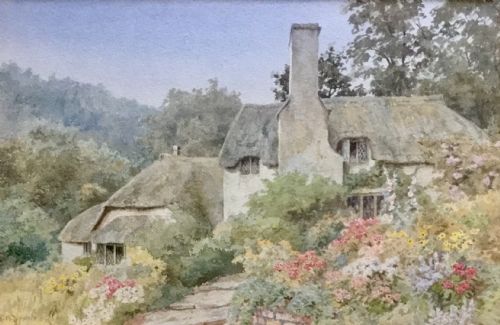
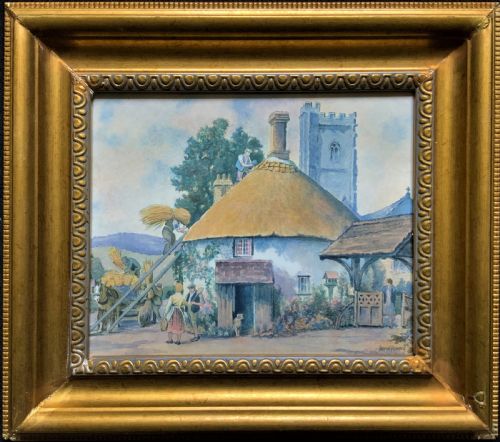
A thatched cottage watercolour depicts traditional rural dwellings, often surrounded by country gardens or pastoral landscapes. These works frequently record regional English scenes from Devon, Somerset, and Warwickshire.
The pieces on this page span from the Georgian period through the Victorian era into the 1900s, 1910s, 1920s, 1930s, and 1940s. Most examples met here date from the late nineteenth century and the early decades of the twentieth century.
Buyers encounter subjects ranging from quiet village paths to detailed garden settings featuring figures, children, and animals. The prevailing styles draw upon English pastoral realism and Edwardian pastoral traditions.
How they were made
Artists applied watercolour pigment and paint directly onto paper supports, often using graphite underdrawings to outline the cottages and landscapes. Pigments varied in transparency, allowing painters to build up delicate washes for skies and textured details for the thatched roofs.
Finished works were typically mounted behind glass within wood frames, frequently complemented by gilt liners that enhanced the illumination of the painting.
The listings span the Victorian and Edwardian eras, incorporating paper, watercolour pigment, glass, wood, and gilt.
What varies in quality
The distinction between standard works and finer examples lies in the precision of the brushwork and the handling of atmospheric light. Superior pieces capture subtle tonal gradations in the thatch and surrounding foliage rather than relying on heavy outlines.
Compositional complexity also marks the upper range of these watercolours, where populated scenes featuring gardens, figures, or animals demonstrate greater technical command than simpler landscape studies.
John McDougal·Harry Sylvester Stannard·Robert Hollands Walker·Thomas James Lloyd·Joseph Kirkpatrick·Arthur Claude Strachan·Walter Henry Sweet·Thomas Nicholson Tyndale·David Heward·Yeend King·Joseph Hughes Clayton·Alfred Leyman·Thomas Rowlandson·David Woodlock·Peace Sykes·Sidney Valentine Gardner·Stanley Herdman·Henry Charles Fox·John Abernethy Lynas-Gray
The Thatched Cottage Watercolour Glossary
- Watercolour
- A painting method in which the paints are made of pigments suspended in a water-based solution. The paper support remains partially visible beneath translucent washes.
- Wash
- A thin, fluid layer of transparent watercolour paint spread across the paper. Artists use washes to create uniform areas of sky or soft background depth.
- Gilt
- A thin layer of gold leaf or metallic gilding applied to wooden frames. This finish adds brightness and separates the painting from the surrounding wall.
- Pastoral
- An artistic style depicting rural life and idealized country landscapes. These scenes emphasise simplicity, agriculture, and harmonious natural settings.
Thatched Cottage Watercolour: Frequently Asked Questions
What periods do these watercolours come from?
The available pieces originate primarily from the nineteenth and early twentieth centuries, spanning Victorian, Edwardian, and later periods up to the 1940s.
Earlier works from the Georgian era also appear occasionally, showcasing evolving approaches to British landscape painting over two centuries.
How should I frame and display a watercolour?
Watercolours require protection behind glass and acid-free mounts to prevent the paper and pigments from degrading over time.
Display them away from direct sunlight to preserve the delicate tones of the washes and the integrity of the paper.
What subjects usually appear alongside the cottages?
Common companion elements include cottage gardens, country lanes, streams, and coastal settings in regions like Devon, Somerset, and Warwickshire.
Many compositions also feature human activity, such as children playing, figures tending gardens, or livestock near the dwellings.
How do I identify a regional English school painting?
Regional works often include specific topographical details in their titles, naming villages and counties across England.
The style typically reflects local pastoral traditions, focusing on the distinct architectural forms of regional thatched roofing and stone or timber walls.