


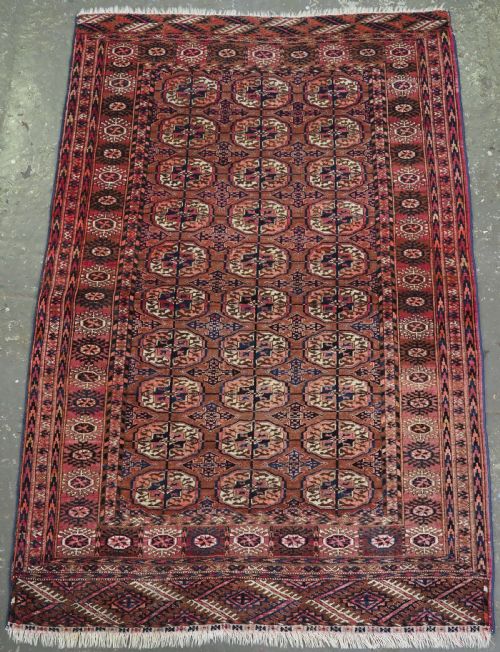


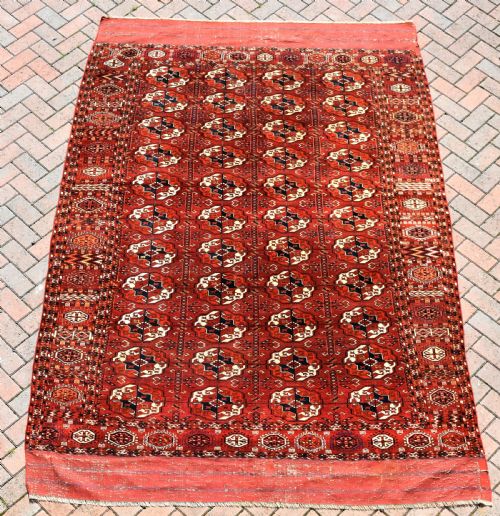
Tekke Main Carpet
A tekke main carpet is a tribal floor covering from Central Asia defined by precise guls and deep red wool.
Tekke Main Carpet
A tekke main carpet forms the cornerstone of Turkmen tribal weaving, originating from Central Asia during the nineteenth and early twentieth centuries. These large floor coverings display an orderly field of primary octagonal guls arranged in strict rows across a rich red ground. Most examples encountered date from the middle of the nineteenth century up to around nineteen hundred.
The format typically spans substantial dimensions, though smaller room sizes and square variations appear regularly in the record. Weavers structured the field with geometric precision, framing the central motifs with intricate borders and distinctive elem panels at each horizontal end.
Materials and construction
Every piece relies entirely on wool for the foundation, pile and knotting, chosen for its durability and tactile quality. Artisans worked sheep wool to achieve a dense, low pile that could withstand heavy daily use while retaining suppleness.
Natural dye stuffs produced the characteristic soft pinks, deep reds and cochineal highlights seen across the palette. The knotting technique secured the dense pile firmly to the wool warp and weft threads, creating a sturdy textile structure.
Tekke Main Carpet Retail Price Guide 2026
Typical asking prices for tekke main carpet among the pieces listed under this phrase on Sellingantiques today, from the lower quarter to the upper quarter. They describe what is for sale here now, not the wider market.
Listings feature wool tekke main carpets spanning periods from eighteen sixty to nineteen twenty, originating from Central Asia.
Distinguishing quality in weaving
Quality rests upon the handle of the wool, the depth of the pile and the saturation of the colour palette. Finer examples display softer wool fibres that yield a pleasing tactile response alongside rich, nuanced shades of red.
Design clarity and proportion dictate the upper tier of pieces, where guls remain crisp and borders maintain balanced geometry. Variations in knot density and the complexity of subsidiary elem end panels also separate standard furnishing examples from exceptional works.
The Tekke Main Carpet Glossary
- Gul
- The primary octagonal medallion motif repeated across the field of the carpet. These motifs identify the specific tribal group responsible for the weaving.
- Warp
- The vertical threads stretched tightly on the loom that carry the weight of the textile. The pile knots are tied around these stationary foundation threads.
- Weft
- The horizontal threads passed back and forth through the warp to lock the rows of knots in place. This contributes to the structural firmness of the rug.
- Cochineal
- A natural red dye source producing distinctive purplish-pink highlights within the wool pile. It adds optical depth to the dominant red ground.
Tekke Main Carpet: Frequently Asked Questions
What is a tekke main carpet?
A tekke main carpet is a traditional tribal floor covering woven by Turkmen artisans in Central Asia. These textiles feature structured rows of octagonal guls set against a red wool ground.
Historically used within large tents and dwellings, these carpets functioned as significant possessions and dowry items. They combine dense wool construction with precise geometric layouts characteristic of nineteenth-century tribal weaving.
How do I date a tekke main carpet?
Dating relies on examining the wool quality, natural dye palette, and structural characteristics. Pieces originating from the mid-nineteenth century often exhibit softer wool and deeper cochineal tones.
Later examples from around nineteen hundred tend to show slight shifts in chemical dye use and tighter, more commercial knotting. Comparing the structural proportions and border complexity provides further chronological context.
How should I live with a tekke main carpet?
Living with a wool carpet requires placing it in low-moisture areas away from direct, harsh sunlight to protect the natural dyes. Regular gentle vacuuming without a rotating brush roll helps maintain the low wool pile.
Using a breathable underlay prevents slipping and cushions the foundation fibres against hard flooring surfaces. Proper placement allows the rich red ground and geometric guls to anchor a room's decorative scheme.