




Tapestry Fireplace Screen
A tapestry fireplace screen keeps the heat of an open grate off a seated face while filling a room with needlework and carved timber.
Tapestry Fireplace Screen
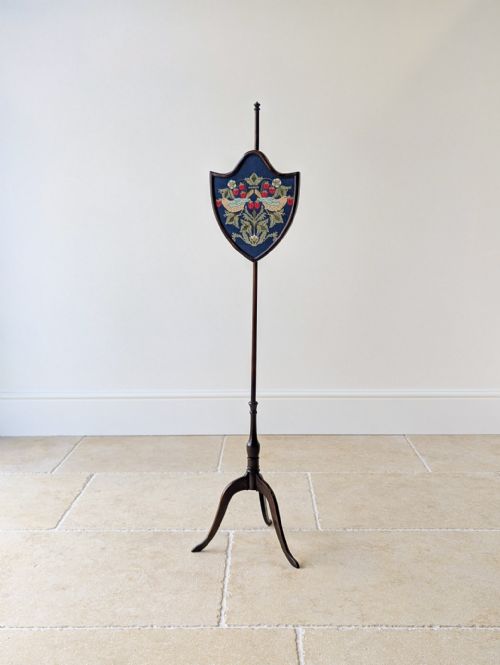
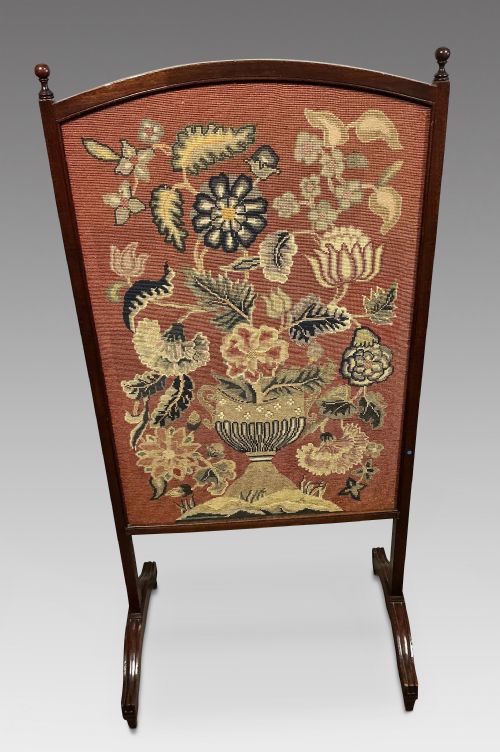
A tapestry fireplace screen stands before a hearth to block radiant heat when a coal or wood fire burns too fiercely in the grate. These pieces take two principal forms on this page: the vertical pole screen with an adjustable panel sliding on a turned wooden shaft, and the cheval or floor frame resting on feet.
The materials span George III, Regency, and Victorian periods, bringing timbers like mahogany, rosewood, walnut, and satinwood together with woolwork, needlepoint, and silk embroidery. Many examples feature tripod bases with carved legs, whilst others use heavy trestle supports or metamorphic tables.
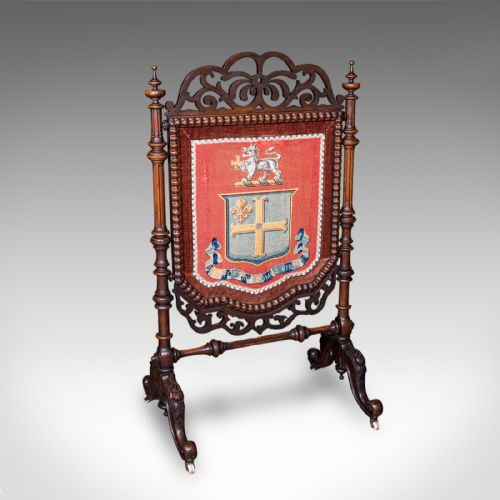
Most entries belong to the nineteenth century, reflecting the Victorian taste for domestic needlework displayed on functional furniture. Surviving panels depict pastoral scenes, armorial bearings such as the Clan Maclellan coat of arms, and floral compositions worked by hand.
Carving and needlework density
The quality of a tapestry fireplace screen rests on the crispness of the timber carving and the complexity of the wood turning on the base and stem. Superior examples display deeply sculpted tripod legs, well-proportioned columns, and substantial secondary timbers rather than plain turned sticks.
Needlework panels separate ordinary items from finer ones through the density of the stitching and the variety of the colour palette used in the wool or silk. Tightly executed pictorial scenes, heraldic coats of arms, and undamaged silk embroidery indicate superior workshop production.
Needlework panels preserve domestic patience, depicting everything from pastoral sheep to clan coats of arms and parrots.
The Tapestry Fireplace Screen Glossary
- Pole screen
- A freestanding furniture piece featuring a vertical wooden shaft and a sliding panel designed to block radiant heat from a fireplace. The panel usually moves up and down on a brass collar or friction clip.
- Cheval screen
- A floor-standing frame supported by two vertical pillars and feet, holding a fixed or pivoting needlework panel that is wider than a pole screen.
- Needlepoint
- A form of counted or uncounted thread embroidery stitched over a stiff canvas mesh to form pictorial or floral designs.
- Tripod base
- A three-legged support system commonly found beneath the upright shaft of Georgian and Victorian pole screens.
- Palisander
- A dense, dark tropical timber similar to rosewood, utilised in fine Regency cabinet work for its striking grain patterns.
Tapestry Fireplace Screen: Frequently Asked Questions
How do you use a pole screen?
You slide the embroidered panel up or down the vertical wooden stem to align it with your face when seated near a lit hearth.
The screen blocks the intense radiant heat of an open coal fire without requiring you to move your armchair away from the warmth.
What is the difference between a pole screen and a cheval screen?
A pole screen uses a single central shaft with an adjustable panel that moves vertically on a tripod or weighted base.
A cheval screen rests on two side supports with a larger, wider panel that typically tilts rather than sliding up and down.
Are these panels hand-stitched?
The textile panels on these pieces generally feature hand-worked needlepoint, woolwork, or embroidery on canvas mesh.
Victorian and Georgian makers often stitched these floral, pastoral, or armorial designs domestically before mounting them into timber frames.
How do I identify the period of a screen?
Dating relies on the primary timber, the turning style of the stem, and the characteristics of the base and feet.
Mahogany tripod bases with crisp carving point to Georgian origins, whilst rosewood, walnut, and bobbin turnings typically indicate Victorian manufacture.