


Tapered Leg Games Table
When you search for a tapered leg games table, you uncover pieces designed for evening entertainment across the Georgian, Regency, and Edwardian periods.
Tapered Leg Games Table
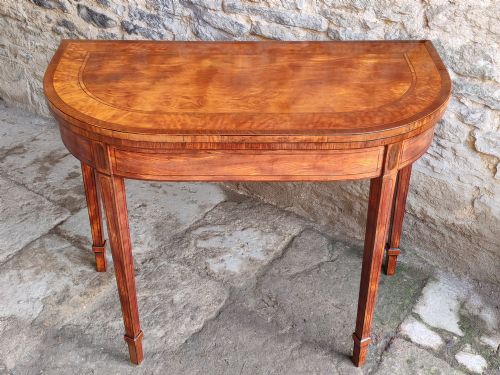
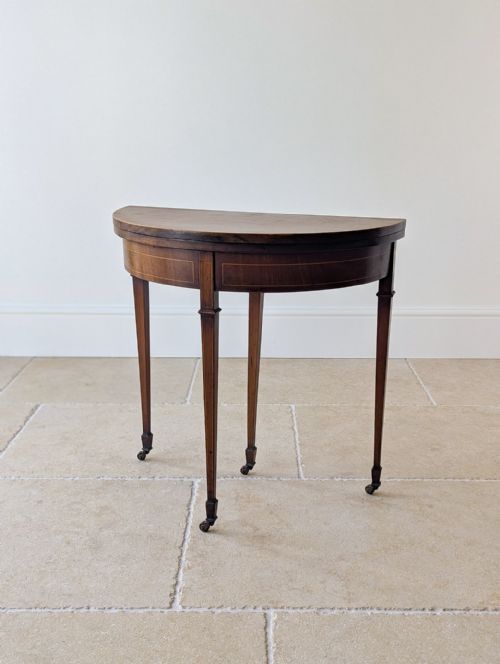
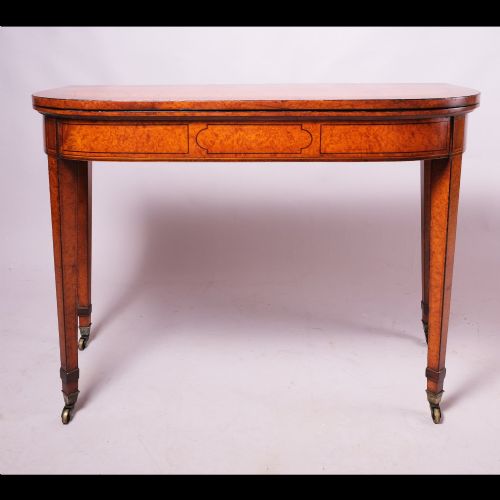
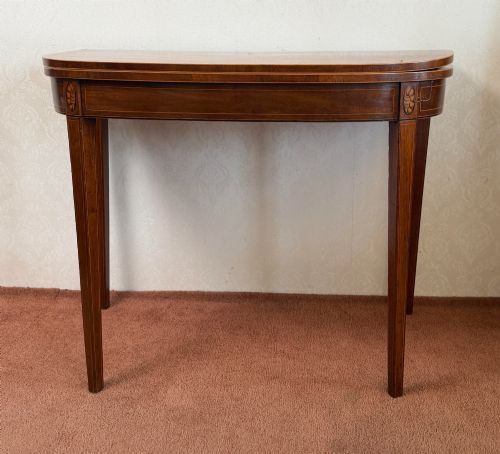
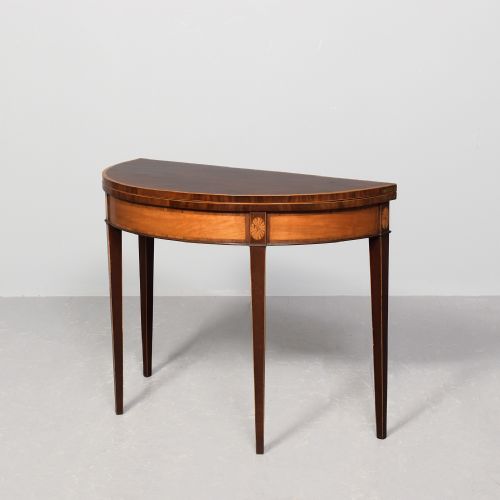
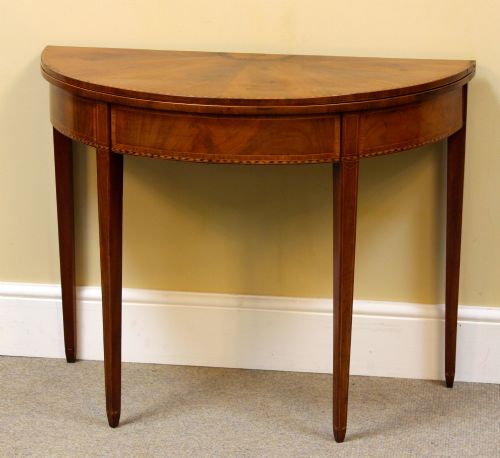
A tapered leg games table takes several forms in these listings, most frequently appearing as a fold-over card table or tea table with a demi-lune or rectangular top. These surfaces date from the 18th century through the Edwardian era, spanning Georgian, Regency, and Sheraton styles.
Makers constructed these pieces to serve multiple functions in the home, often combining card playing with tea service or side table usage. The version you are most likely to meet on this page is a mahogany card table featuring inlaid details and straight or slightly tapered supports.
Materials and Technique
Cabinetmakers utilised primary timbers such as mahogany, satinwood, walnut, and rosewood, often applying wood veneer over secondary woods. They incorporated contrasting stringing and marquetry in boxwood and fruitwood to decorate the tops and borders.
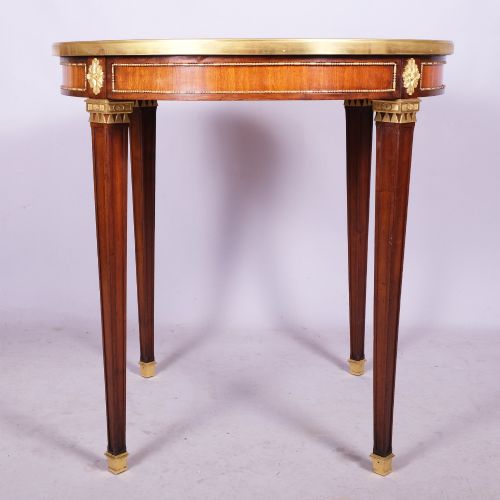
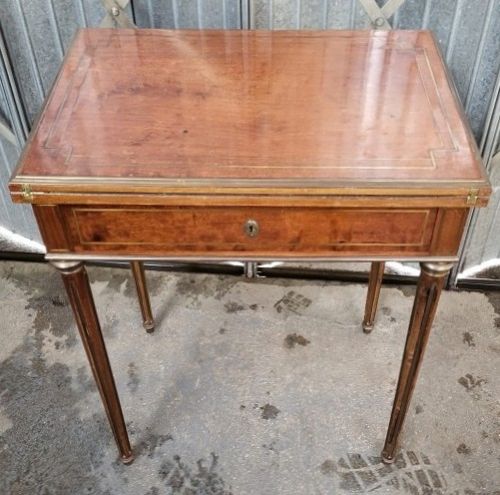
Construction relies on precise joinery to allow folding tops and pivoting mechanisms to operate smoothly. Brass hardware occasionally appears on hinges and swing legs, while marble tops feature on specific 19th-century French bouillotte tables.
Judging Quality
The distinction between tiers rests upon the choice of timber and the precision of the inlay. Pieces displaying highly figured Honduras mahogany or finely balanced satinwood panels command attention for their visual depth.
Execution of the marquetry and the crispness of the tapered leg joinery separate standard workshop output from exceptional examples. The harmony between the veneered top and the supporting frame dictates the overall merit.
Bruce and Burns of Edinburgh
The Tapered Leg Games Table Glossary
- Demi-lune
- A half-moon shape characteristic of many card table tops in this selection. This form sits flush against a wall when closed and opens to a full circle for play.
- Marquetry
- Decorative inlay work using various coloured woods to create pictorial or geometric patterns on the surface. Craftsmen assemble these veneers meticulously before applying them to the table top.
- Stringing
- Thin lines of contrasting wood inlaid into the primary timber to outline edges and panels. This technique defines the borders of many 18th-century and Sheraton style pieces.
- Bouillotte table
- A small round card table with a raised gallery rim, designed for a French card game. These often include marble tops and brass galleries.
- Metamorphic
- Describing furniture designed to transform from one function to another, such as a side table converting into a games surface. These pieces utilise clever internal mechanics.
Tapered Leg Games Table: Frequently Asked Questions
How do I use a fold-over card table?
The hinged top swings open to reveal a baize or polished wood playing surface, supported by a swing leg or a pivoting frame.
When closed, the table functions as a side or console piece against a wall.
How do I date a mahogany card table?
Examine the timber selection, secondary woods, and the style of the legs, such as Georgian straight tapered legs or Sheraton inlay patterns.
Construction methods and hinge types also provide reliable indicators of the period.
Where should I place a demi-lune table in a room?
The flat straight edge sits against a wall, making these tables suitable for hallways, drawing rooms, or landings.
Opening the top requires clearance from the wall into the room.