

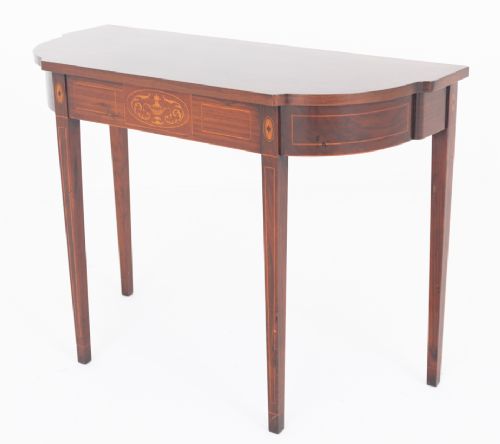


Tapered Leg Card Table
A tapered leg card table brings refined proportion and functional fold-over design to a room, drawing on Georgian, Regency and Edwardian craftsmanship.
Tapered Leg Card Table
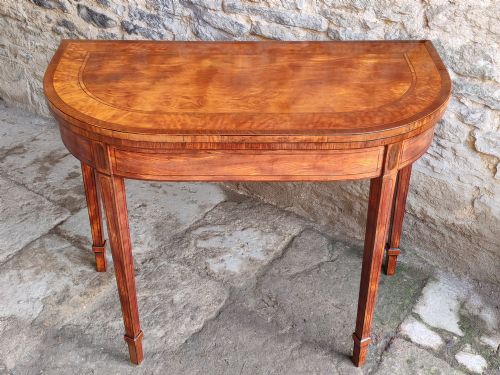
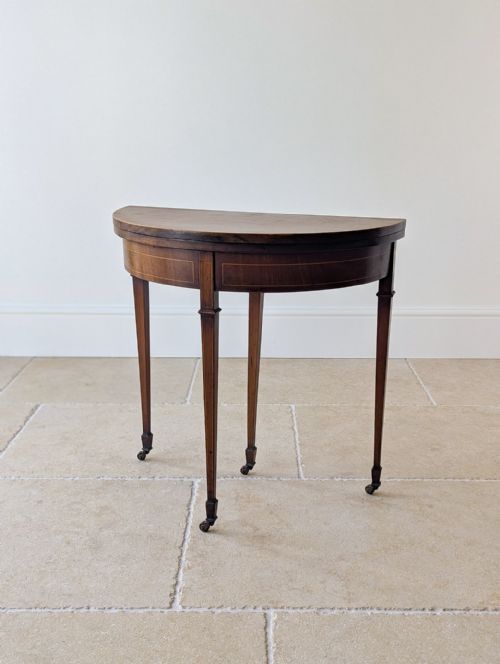
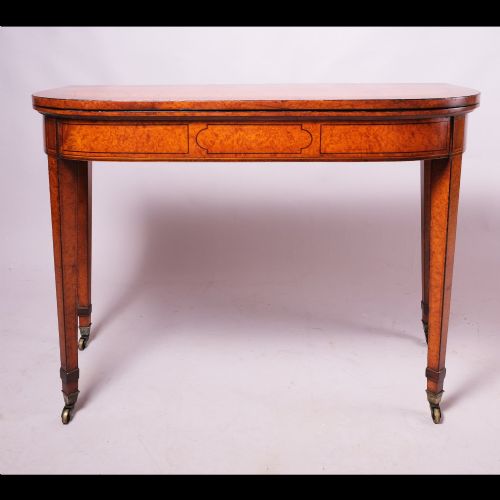
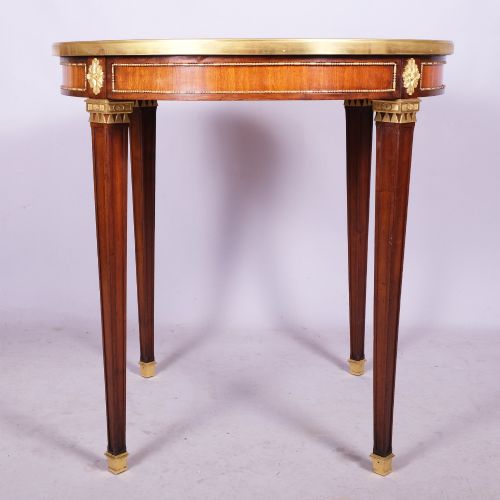
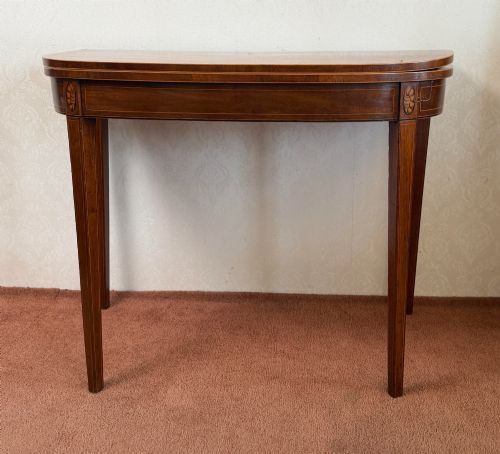
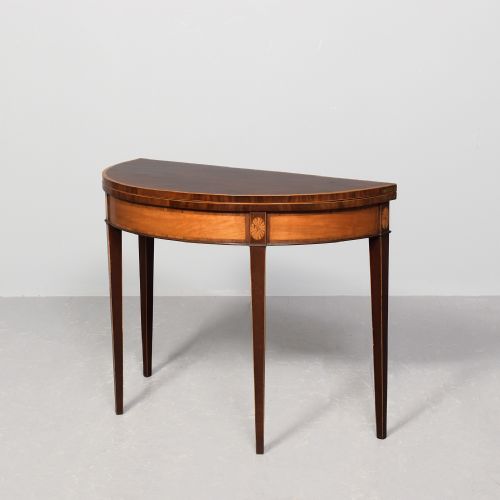
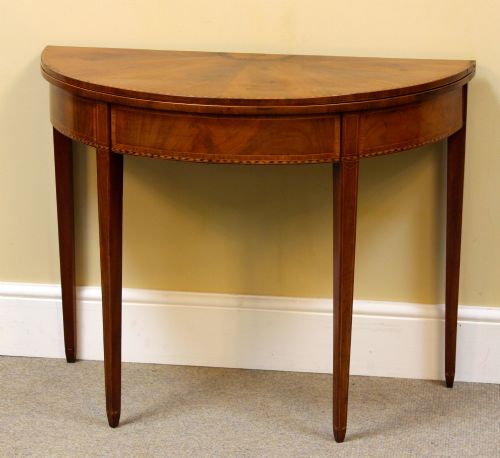
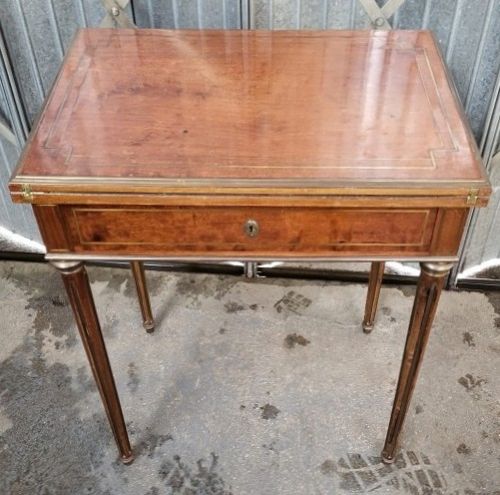
When you examine a tapered leg card table, you encounter a piece designed primarily for domestic games and tea, featuring a hinged top that opens to double the surface area. The examples you find on this page span the Georgian, Regency, and Edwardian periods, showcasing forms such as demilune, fold-over, and games tables.
Mahogany predominates among the surviving pieces, often enriched with satinwood, rosewood, and delicate marquetry or boxwood stringing. You will frequently meet the demi-lune shape alongside rectangular tops, each supported on slender, tapering legs that lighten the visual weight of the timber.
How they were made
Cabinetmakers utilised solid timbers and fine wood veneers, selecting Honduras mahogany, walnut, and fruitwood for their grain and stability. Surfaces often display intricate marquetry in satinwood and boxwood, set into the primary wood of the top and legs.
Construction relied on precise joinery to ensure the folding mechanism of the tea and card tables operated smoothly without straining the frame. Brass hinges and subtle inlay work finished the pieces, uniting structural integrity with ornamental restraint.
Tapered Leg Card Table Retail Price Guide 2026
Typical asking prices for tapered leg card table among the pieces listed under this phrase on Sellingantiques today, from the lower quarter to the upper quarter. They describe what is for sale here now, not the wider market.
The listings on this page span the Georgian, Regency, and Edwardian periods, utilising mahogany, satinwood, rosewood, and fruitwood.
What varies in quality
The degree of refinement in the timber figure and the crispness of the marquetry inlay set the standard across these pieces. A table featuring richly figured mahogany and carefully contrasted satinwood or boxwood stringing demonstrates a higher order of cabinetmaking.
Proportion and the balance between the tapering legs and the top dictate the overall elegance of the form. Finer examples maintain structural harmony when open, aligning the folding leaves precisely with the supporting framework.
Bruce & Burns of Edinburgh
The Tapered Leg Card Table Glossary
- Demilune
- Half-moon shaped, describing tables with a straight back edge designed to stand flat against a wall.
- Marquetry
- Decorative patterns formed by inserting pieces of coloured wood, shell, or ivory into a veneered surface.
- Stringing
- Thin lines of contrasting wood inlaid into the surface of a piece to create a delicate border.
- Fold-over
- A hinged top design that opens out to reveal a baize-lined surface for cards or writing.
- Satinwood
- A durable, lustrous timber with a yellowish sheen, frequently used for contrasting veneers and inlay.
Tapered Leg Card Table: Frequently Asked Questions
What is a tapered leg card table used for?
These tables served primarily for card games and social gatherings in the evening, featuring a fold-over top that doubled the surface area when needed. During the day, they stood closed against a wall as side or console tables.
The clever hinging mechanism allowed households to adapt their reception rooms quickly for entertainment without cluttering the space permanently.
How do I tell Georgian from Edwardian examples?
Georgian tables, dating from the eighteenth century, rely heavily on solid mahogany construction, restrained boxwood stringing, and heavy figuring in the timber. Edwardian revivals from around nineteen hundred often feature lighter satinwood, more extensive marquetry, and a slightly brighter overall polish.
Examining the underside and the interior framing helps reveal the age of the construction methods and the wear patterns on the timber.
Where should I place one at home?
A demilune or rectangular fold-over table sits comfortably in a hallway, drawing room, or landing against a flat wall. The closed top displays the figured mahogany or satinwood inlay as a decorative surface.
Opening the top requires a small amount of clearance behind the piece so the leaf can swing out fully on its hinged bracket.
What woods were used in these tables?
Cabinetmakers primarily worked in mahogany, supplemented by decorative veneers of satinwood, rosewood, amboyna, and fruitwood. Inlays often incorporate boxwood and darker contrasting timbers to form geometric or floral patterns.
The choice of timber shifted from the darker tones favoured in the eighteenth century to lighter exotic veneers popular during later revival periods.