
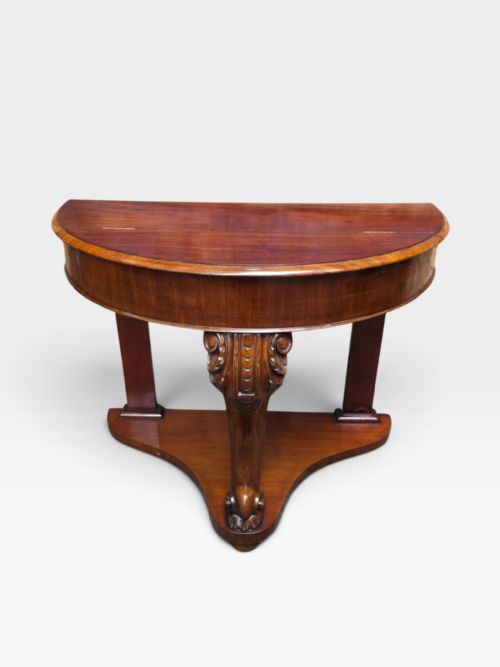
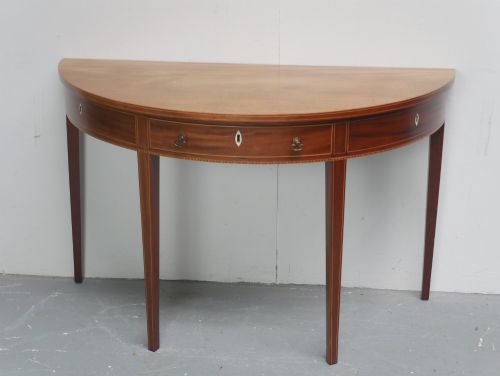
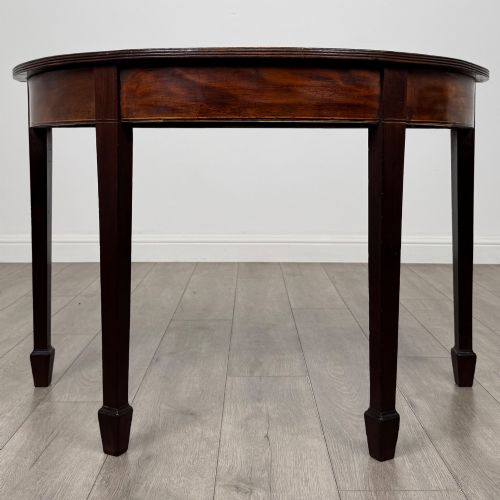
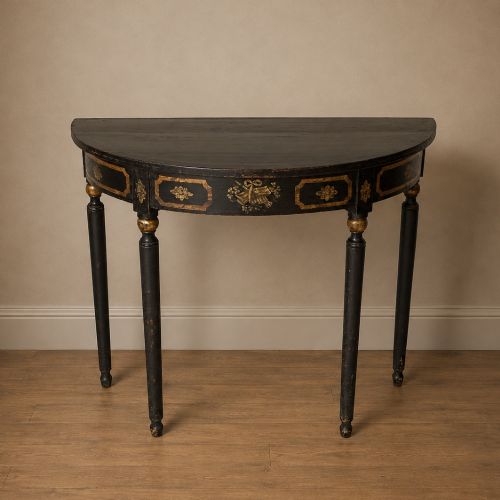

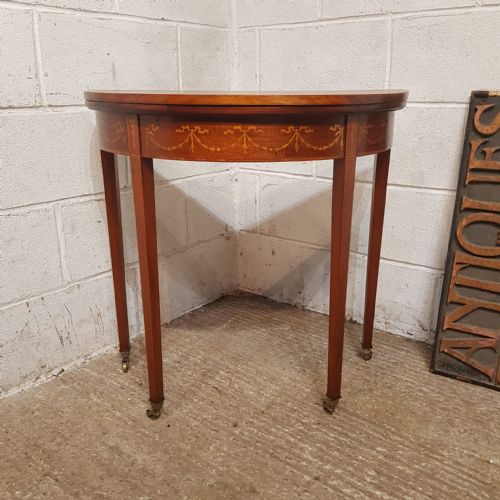
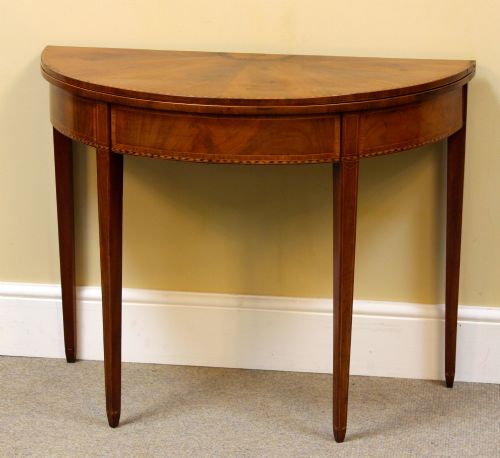
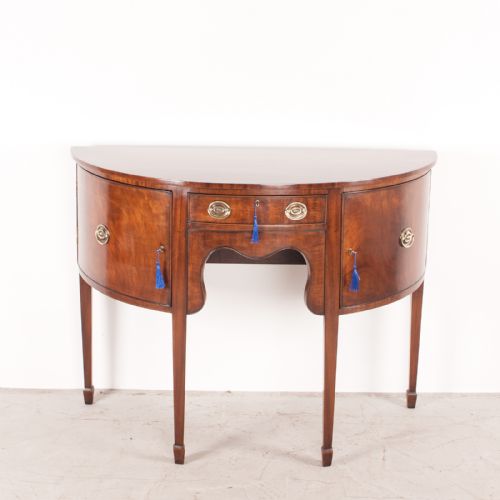


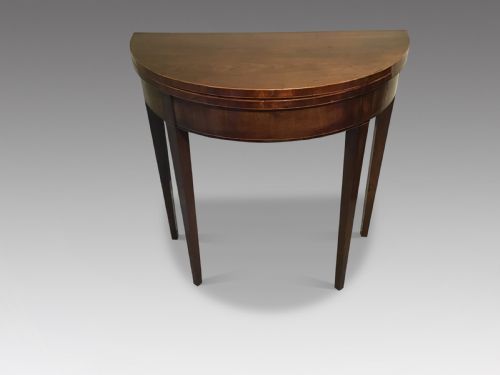


Regency Demi Lune Table
A regency demi lune table brings elegant crescent form and rich timber to a hallway or drawing room.
Regency Demi Lune Table
A regency demi lune table is a semicircular piece designed to stand flush against a wall in a hallway, reception room or dining space. These items function as console tables, card tables, tea tables or pier tables, often featuring clever folding tops for dual use as games surfaces.
The pieces appearing on this page stem predominantly from the nineteenth century, including Georgian and Regency periods alongside later revival dates such as the 1920s and 1930s. Mahogany forms the backbone of these listings, accompanied by variations in satinwood, fruitwood, rosewood and painted finishes.
Makers and cabinet makers of the era constructed these half moon items individually or in matched pairs to fit narrow architectural spaces. Buyers encounter single console versions as well as pairs capable of joining together to form a full circular dining table.
How they were made
Cabinet makers utilised solid timber frameworks overlaid with finely figured mahogany veneer, flame mahogany veneer or satinwood inlay to create decorative patterned surfaces. Timber preparation required skilled sawing to achieve thin, stable veneers that highlighted the natural grain patterns of the wood.
Inlay and stringing techniques defined the ornamentation, incorporating lighter woods into darker mahogany grounds on tops and aprons. Black painted and parcel gilt finishes also appear, providing high contrast decorative schemes popular during the Regency period.
Structural joinery supported the semicircular shapes, utilising hinged leaves for fold over card and tea tables alongside tapered or reeded legs. Secret drawers and pivoting mechanisms allowed console frames to transform securely into stable card tables.
Regency Demi Lune Table Retail Price Guide 2026
Typical asking prices for regency demi lune table among the pieces listed under this phrase on Sellingantiques today, from the lower quarter to the upper quarter. They describe what is for sale here now, not the wider market.
Some ingenious Regency tables feature secret drawers hidden beneath the apron for stoking midnight gaming debts.
What varies in quality
The grade of timber selection marks the primary tier of distinction, moving from plain utility woods to heavily figured flame mahogany and crisp satinwood inlay. Superior examples display continuous grain matching across folding leaves and balanced botanical patterning on the semicircular tops.
Construction precision dictates the longevity and mechanical success of the piece, particularly in the hinges and pivoting legs of card tables. Finely turned or reeded table legs and crisp edge mouldings separate workshop standards from simpler production.
Proportion and scale influence desirability, with country house examples offering substantial presence alongside slender, shallow hall consoles designed for tighter architectural spaces.
The Regency Demi Lune Table Glossary
- Demi-lune
- A half moon shape. This term describes console and card tables with a curved front and a flat back designed to sit against a wall.
- Console table
- A wall table supported by brackets or legs. These items stand against room panelling or hallways rather than floating centrally.
- Fold over
- A hinged table top configuration. The upper surface opens outward to double the available depth for card games or tea service.
- Reeded
- Parallel rounded mouldings carved into table legs. This decorative treatment mimics classical columns and appears frequently on Regency supports.
- Pier table
- A small decorative table positioned between windows. Such items usually match the height of adjacent window sills.
Regency Demi Lune Table: Frequently Asked Questions
What is a demi lune table used for?
These crescent shaped pieces served primarily as decorative console tables in hallways and reception rooms. Many examples included folding tops to function as card or tea tables when entertaining guests.
Their shallow depth allowed them to fit narrow architectural spaces where rectangular furniture would obstruct walkways.
How do I identify a Regency period table?
Regency pieces typically feature dark mahogany timbers, reeded legs, brass mounts and sometimes black painted surfaces with parcel gilding. Cabinet makers of this era drew heavily on classical Roman and Greek motifs.
Construction methods, hand cut joints and timber oxidation help distinguish genuine nineteenth century examples from later revival items.
Can these tables be used as dining tables?
Certain examples were constructed in pairs specifically to join together into a complete circular dining table when needed. Single tables remain too narrow for dining and function best against walls.
Buyers should check the height and stability of the folding leaf mechanisms before attempting regular use as dining surfaces.
What is flame mahogany veneer?
Flame mahogany is a highly decorative wood veneer harvested from the fork of the tree where branches join the trunk. This growth pattern creates a distinctive flickering flame effect across the surface.
Cabinet makers used this figure selectively on prominent table tops to catch the light and display wealth.