
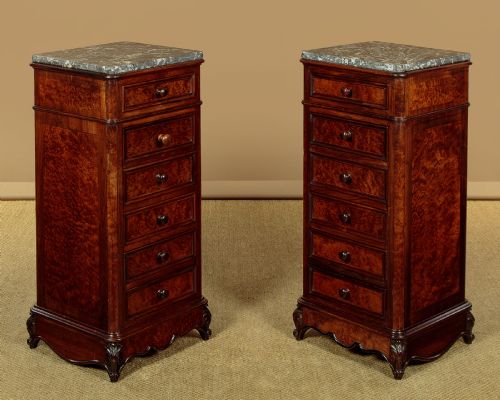


Tall Narrow Bedside Tables
Tall narrow bedside tables combine compact footprints with vertical storage, offering a practical solution for tight spaces.
Tall Narrow Bedside Tables
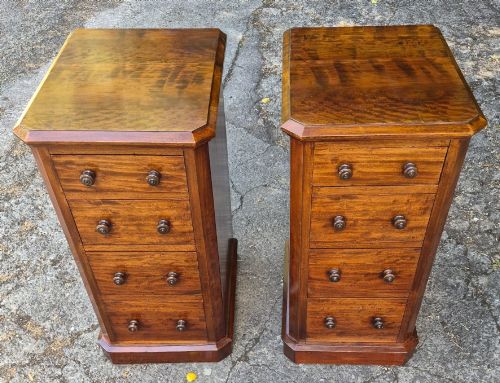
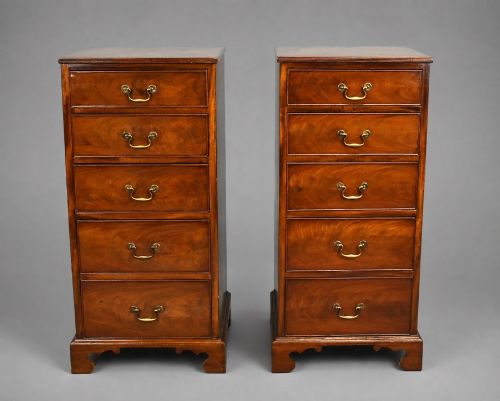
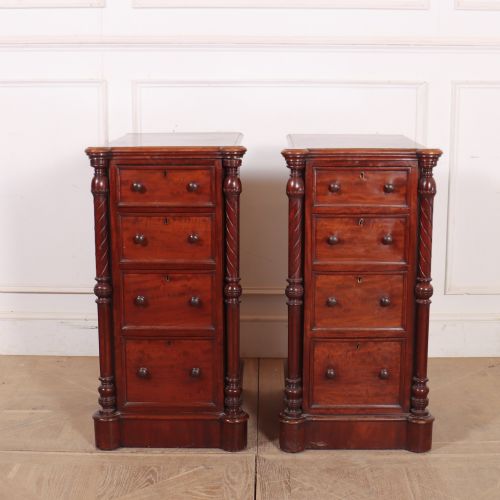
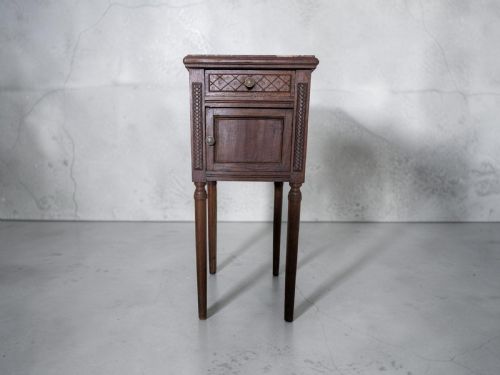
Tall narrow bedside tables appear in various forms, including bedside chests, cabinets, drawer pedestals, nightstands, and console tables. These pieces are designed to fit small bedroom footprints while providing essential surface space and storage.
Most examples found here date from the Victorian period through to the 1930s, encompassing styles such as Victorian, Late Victorian, Victorian Country, French Provincial, French Louis XV, Louis XV Revival, Georgian Style, and Art Deco.
Buyers will encounter single pieces alongside matched pairs, offering flexibility for single bed arrangements or symmetrical bedside placement.
How they were made
Construction relies heavily on traditional timber framing, utilising solid woods and decorative veneers. Mahogany, walnut, rosewood, amboyna, satin birch, pine, and general hardwoods form the primary structures of these tables.
Surface decoration and functional elements incorporate contrasting materials, including marble tops, brass hardware, and intricate parquetry veneer work. French panels and tambour fronts also appear on select cabinetry.
Joinery methods reflect the periods of manufacture, ensuring sturdy construction for daily domestic use.
One petite nineteenth-century survivor comes equipped with a tambour front, letting you slide away your midnight secrets with a satisfying wooden rustle.
What varies in quality
The choice of timber and veneer work dictates much of the visual appeal, ranging from plain pine to figured mahogany, rosewood, and amboyna. Finely executed parquetry and matched wood grains distinguish superior examples.
Hardware selection and decorative details such as marble tops or painted finishes influence the character of each piece. Construction depth, including the neatness of proportions and drawer operation, marks the distinction between standard cabinetmaking and finer workshop production.
The Tall Narrow Bedside Tables Glossary
- Parquetry veneer
- Geometric wood mosaic patterns applied to a furniture surface. This technique creates decorative geometric designs using contrasting timber tones.
- Tambour front
- A flexible sliding shutter formed from narrow slats of wood glued to fabric. It allows access to cabinet interiors without requiring swing clearance for doors.
- Demi lune
- A half-moon or semicircular shape in furniture design. Tables with this profile fit flat against walls while projecting slightly into the room.
- Pedestal
- A supporting base or column structure beneath a cabinet or chest. In bedside furniture, it often denotes a tall, slender drawer stack.
- Satin birch
- A pale, lustrous timber utilised for its distinctive grain pattern. It provides a bright, golden surface finish popular in Victorian cabinetmaking.
Tall Narrow Bedside Tables: Frequently Asked Questions
What defines a tall narrow bedside table?
These pieces are characterised by compact surface dimensions combined with elevated storage capacity. They maximise vertical space beside the bed without occupying excessive floor area.
Widths often remain restricted, such as thirty-seven centimetres, while heights accommodate raised mattress levels and provide multiple drawers or cupboards.
Are these tables usually sold in pairs?
Many listings feature matched pairs, which suit symmetrical bedroom layouts. Single items also appear for individual bed placement or alternative corner uses.
Pairs often share identical timber grains, hardware, and construction details from the same workshop or period.
What timber types are most common?
Mahogany appears frequently across Victorian and later periods, alongside walnut, rosewood, and pine. Cabinetmakers utilised both solid planks and decorative veneers.
Exotic woods like amboyna and satin birch also feature on specific decorative items from the late nineteenth and early twentieth centuries.
How do Art Deco models differ from Victorian ones?
Victorian examples typically display traditional timber moulding, turned details, and classic chest configurations. Art Deco pieces from the nineteen-thirties favour streamlined geometric forms.
Both styles maintain the tall, narrow footprint necessary for compact bedroom storage.