
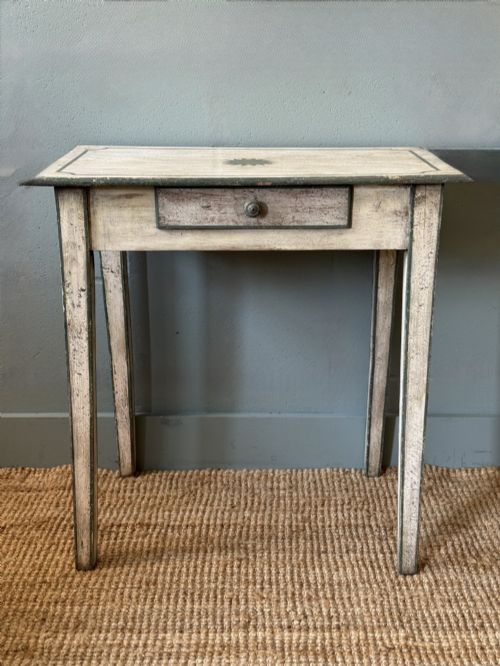

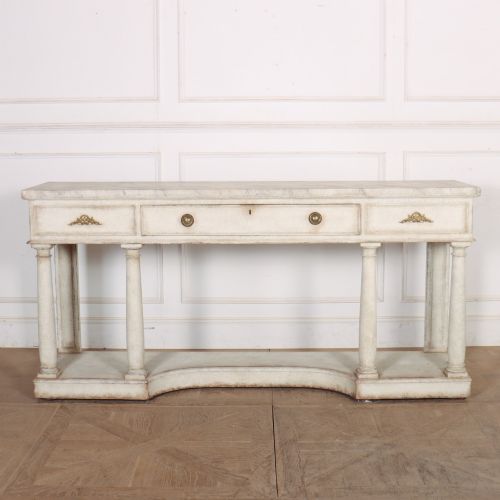
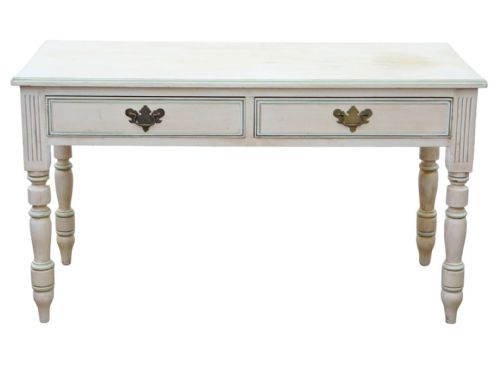


Off White Hall Tables
Off white hall tables bring restrained elegance to a narrow entrance, offering a pale surface and functional form rooted in continental and English traditions.
Off White Hall Tables
Off white hall tables encompass a variety of forms designed for narrow spaces, drawing heavily from nineteenth century and earlier domestic traditions. Console tables and side tables dominate the selection, alongside occasional desks and writing tables suited for compact hallways.
The aesthetic leans towards regional European styles, with French provincial, English country, and Dutch country models appearing frequently alongside grander neoclassical designs. These pieces often feature painted finishes or fruitwood construction, bridging the gap between utilitarian furniture and decorative console display.
Buyers will encounter items ranging from simple side tables to grand console tables with marble or slate tops. The selection favours painted wood finishes that complement both period interiors and modern neutral schemes.
How they were made
Construction relies heavily on traditional timber working, utilising fruitwood and other carved woods for structural integrity. Surfaces are frequently finished with paint or specialised painted finishes to achieve the characteristic off white appearance.
Detailing often incorporates brass hardware and inset marble or slate tops, particularly on console and demi-lune variants. Joinery methods reflect the period of manufacture, from nineteenth century workshop standards to early twentieth century production.
The listings span the eighteenth to the early twentieth centuries, featuring painted wood, fruitwood, marble, and slate.
What varies in quality
Quality in these tables is determined by the crispness of the carved wood details and the integrity of the original painted finish versus later re-painting. Pieces retaining their early or original surfaces command greater interest from discerning collectors.
The choice of secondary materials, such as genuine marble or slate tops and period brass fittings, separates standard utilitarian furniture from finer decorative consoles. Proportions and the subtlety of regional styling, whether French provincial or English country, also dictate the standing of an individual piece.
The Off White Hall Tables Glossary
- Console table
- A table designed to stand against a wall, frequently supported by wall brackets or two front legs. These items form a primary category within hall furniture.
- Demi-lune
- A half-moon shape characteristic of certain console and bedside tables in the selection. This curved form fits snugly against entrance walls.
- Fruitwood
- A dense, fine-grained timber derived from fruit-bearing trees such as pear or cherry. It provides a durable and smooth surface for cabinet work.
- Serpentine front
- A furniture front characterised by a concave central section flanked by two convex curves. This undulating profile appears on select nineteenth century side tables.
Off White Hall Tables: Frequently Asked Questions
Where should I place an off white hall table?
These tables find their natural home in narrow entrance halls, corridors, or landings where depth is limited. Their pale finishes help to bounce light into compact spaces without dominating the room.
They also serve well in living spaces as lamp tables or side tables, echoing the decorative style of the hallway.
What is the difference between a console table and a side table?
Console tables are traditionally designed to be placed directly against a wall, sometimes requiring attachment for stability. They often feature decorative front legs and ornate tops made of marble or slate.
Side tables are generally freestanding items with four independent legs, offering greater versatility for movement around the home.
How do I care for a painted wooden table?
Painted surfaces require gentle cleaning with a soft, dry cloth to remove dust. Avoid harsh chemical cleaners that might degrade the finish over time.
Use coasters or mats beneath lamps and decorative objects to protect both painted wood and stone tops from moisture and marks.
Are these tables suitable for daily use?
Most of these tables were built to withstand regular domestic service, whether as writing desks, kitchen tables, or hall surfaces. Their robust construction in fruitwood and other timbers ensures continued durability.
However, delicate painted finishes or antique marble tops benefit from sensible precautions against heavy impacts and spills.