



Painted Half Moon Table
A painted half moon table brings curved grace to a hallway or drawing room, offering a flat rear edge to hug the wall.
Painted Half Moon Table
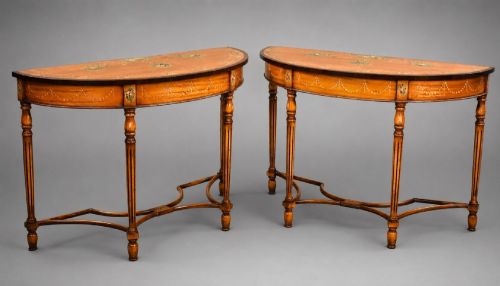
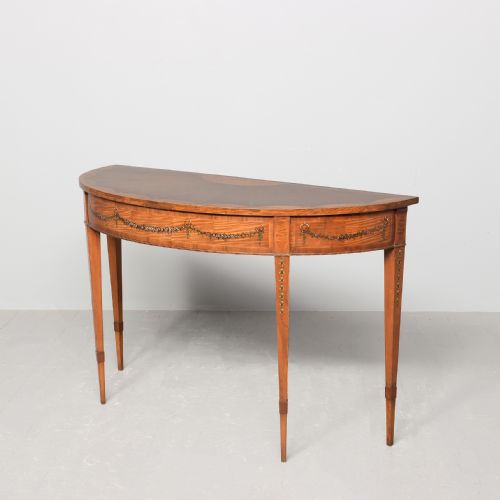
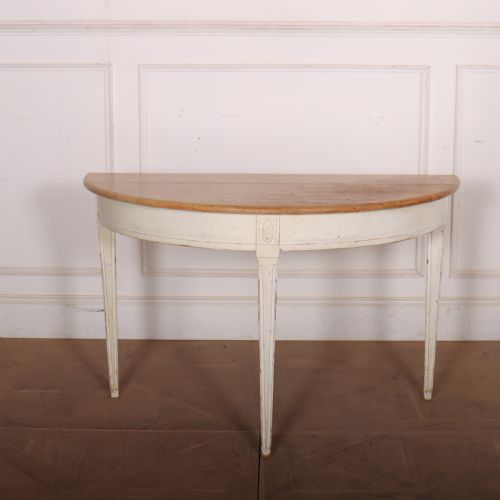
A painted half moon table emerges across the eighteenth and nineteenth centuries, taking the form of a semicircular console or games table. These pieces stand against walls in halls and reception rooms, often appearing in pairs.
The nineteenth century yields many examples in the Sheraton Revival and Swedish styles, alongside earlier Georgian and Regency pieces. Console and card tables dominate the selection, functioning as surfaces for display or unfolding for play.
How they were made
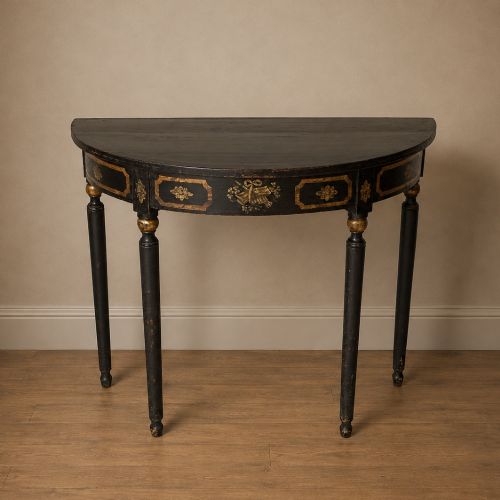
Carpenters build these frames from timber such as mahogany, pine, and satinwood, applying decorative painted finishes directly to the wood. Some examples incorporate gold leaf, parcel gilt, or red lacquer to accent the curved surfaces.
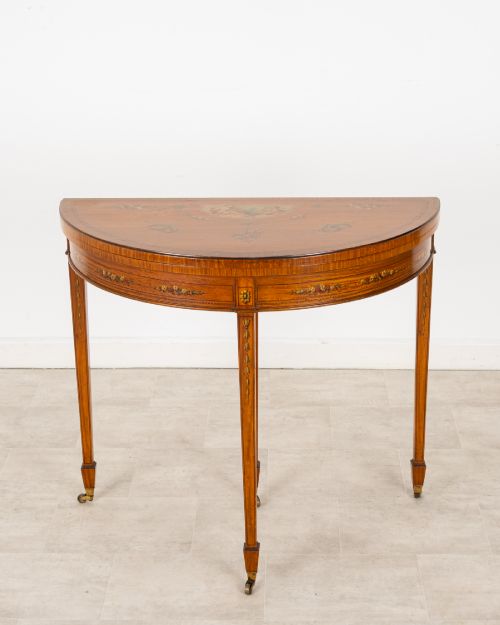
Surface decoration ranges from delicate floral motifs in the neoclassical taste to bold Chinoiserie scenes and inlaid details. Tops occasionally feature marble inserts alongside the painted wooden panels.
Materials recorded across the selection include painted wood, solid timber, satinwood, pine, mahogany, gold leaf, and marble.
What varies in quality
The refinement of the painted decoration dictates the distinction between standard provincial pieces and sophisticated urban commissions. Crisp brushwork and well-preserved gilt or lacquer indicate superior workshops.
Timber selection and the intricacy of the underlying cabinetwork separate basic hallway tables from elaborate games tables with folding tops and fitted interiors.
The Painted Half Moon Table Glossary
- Demi-lune
- A French term meaning half-moon, describing tables with a semicircular top and flat straight edge for placement against a wall.
- Console table
- A wall table supported by console brackets or legs, designed primarily for display rather than freestanding use.
- Satinwood
- A light-coloured timber native to Ceylon and India, prized for its smooth grain and frequently used as a canvas for painted decoration.
- Chinoiserie
- European decorative art imitating Chinese artistic styles, often featuring figures, landscapes, and pavilions rendered in lacquer or paint.
- Neoclassical
- A style drawing on classical antiquity, characterised by symmetry, restraint, and straight lines contrasting with the curved top.
Painted Half Moon Table: Frequently Asked Questions
Where should I place a half moon table?
These tables suit narrow hallways, landings, and reception rooms where a deep rectangular piece would obstruct movement. Their flat back rests flush against the wall while the curved front softens the room's geometry.
They also serve beneath mirrors or paintings, providing a compact surface for lamps, bowls, or decorative objects without dominating the floor space.
Are painted finishes original to the piece?
Many eighteenth and nineteenth-century pieces retain their original painted surfaces, from Swedish pale finishes to English satinwood floral decoration. Over time, surfaces may show natural craquelure and gentle wear appropriate to their age.
Some tables receive later decorative layers, so examining the integration of the paint with the underlying timber helps determine the piece's history.
How do I distinguish between periods?
Eighteenth-century examples often display Georgian proportions and finely detailed neoclassical or inlaid painted motifs. Nineteenth-century revivals borrow these vocabulary elements while employing distinct construction methods and timber preparation.
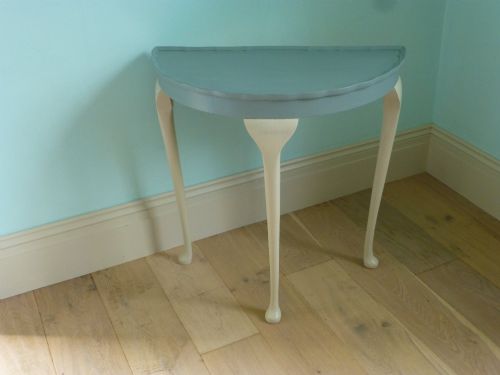
Swedish and continental pieces from the nineteenth century frequently exhibit lighter painted palettes, such as soft greys and creams, compared to darker British woods.