
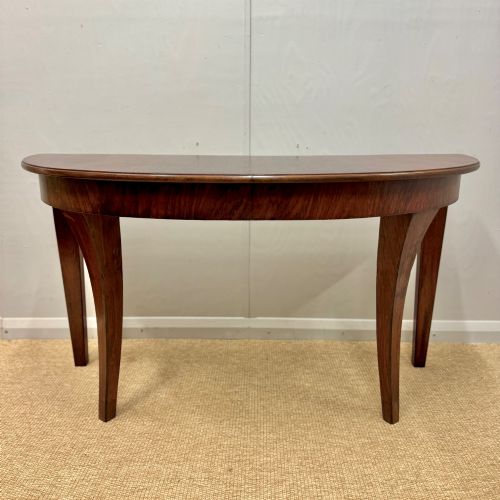


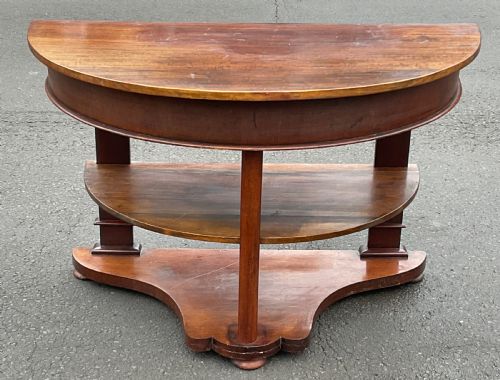

Semicircular Wall Table
A semicircular wall table offers shallow proportions and elegant wall placement, making it a practical choice for narrow hallways and reception rooms.
What They Are
A semicircular wall table provides a flat edge to sit flush against a wall while projecting minimally into the room, fulfilling the function of a console or hall table. Examples on this page span the eighteenth and nineteenth centuries, including Victorian and George III style pieces.
The dominant forms appearing here are demi-lune console tables and wall tables originating from English, French, and Swedish workshops. These pieces frequently utilise classical outline shapes associated with Neoclassical, Louis XVI, Regency, and Gustavian design vocabulary.
Makers designed these items to anchor entrance halls and principal living spaces, often serving as a surface for decorative objects or mirrors. Their shallow footprint distinguishes them from freestanding dining or centre tables.
How They Were Made
Cabinetmakers constructed these tables primarily in mahogany, rosewood, and bleached mahogany, occasionally employing pine as a secondary timber and adding painted wood surfaces. Finer surfaces incorporate crossbanding and inlaid details alongside gilded wood finishes.
Structural elements integrate brass fittings and marble tops, paired with specific structural components such as concave legs or distinct demi-lune frames. Joinery methods reflect traditional cabinetmaking standards of the eighteenth and nineteenth centuries.
Retail Price Guide 2026
Typical UK retail prices for semicircular wall table, calculated from the Sellingantiques database of over a million retail prices indexed since 2003. This retail price guide relies exclusively on Sellingantiques data; no external sources or auction records are used, so the figures do not describe the wider market.
Current listings feature mahogany, rosewood, giltwood, marble, and pine across nineteenth-century and eighteenth-century periods.
What Varies in Quality
Distinctions in quality arise from the selection of timber figures, such as figured mahogany or rich rosewood, and the precision of inlaid work and crossbanding. Finer examples display refined carving or crisp gilding on giltwood surfaces, whereas simpler pieces rely on plain painted wood.
The sophistication of the stylistic execution, whether adhering closely to Louis XVI Neoclassical principles or executed in a later George III style, governs the aesthetic standing of each table. Structural integrity in supporting marble tops and the balance of concave legs further separate standard production from superior craftsmanship.
The Semicircular Wall Table Glossary
- Demi-lune
- A half-moon shape used to describe tables with a flat rear edge and a semicircular front. This format allows the furniture to stand neatly against a wall.
- Console table
- A table supported by wall brackets or console legs, designed to stand against a vertical surface. They often feature decorative carving or marble tops.
- Crossbanding
- A strip of veneer running perpendicular to the grain of the main surface, often bordering the edge of a tabletop. This technique frames the primary timber.
- Giltwood
- Wood that has been coated with gold leaf or a gold-coloured finish. It appears frequently on decorative frames and neoclassical furniture.
- Gustavian
- The Swedish interpretation of French neoclassical style, characterised by lighter painted finishes and restrained ornamentation. Pieces from this tradition often appear in pale or muted tones.
Frequently Asked Questions
Where should I place a semicircular wall table?
These tables suit narrow spaces such as hallways, corridors, and entrance foyers because their shallow depth prevents them from obstructing walkways.
They also function effectively beneath wall mirrors or artwork in living rooms and dining areas.
Are these tables stable without being fixed to the wall?
Most freestanding console tables balance adequately on their own four or two legs, though historic designs intended for wall placement sometimes relied on structural wall fixings for total security.
Heavier tops, such as marble inserts, help anchor the piece, but checking the leg stability remains advisable.
How do I identify a George III style table?
George III style furniture typically draws upon classical proportions, straight or tapered legs, and refined surface ornament such as inlay and crossbanding.
Items in this style reflect the tastes prevalent during the late eighteenth century, though later Victorian interpretations also replicate these motifs.
What maintenance do mahogany and rosewood tables need?
Timber surfaces benefit from occasional dusting with a soft cloth and minimal exposure to direct sunlight or fluctuating humidity to prevent wood movement.
Applying appropriate wax polish helps maintain the lustre of the grain without building up heavy residue.