




Pair Semi Circular Tables
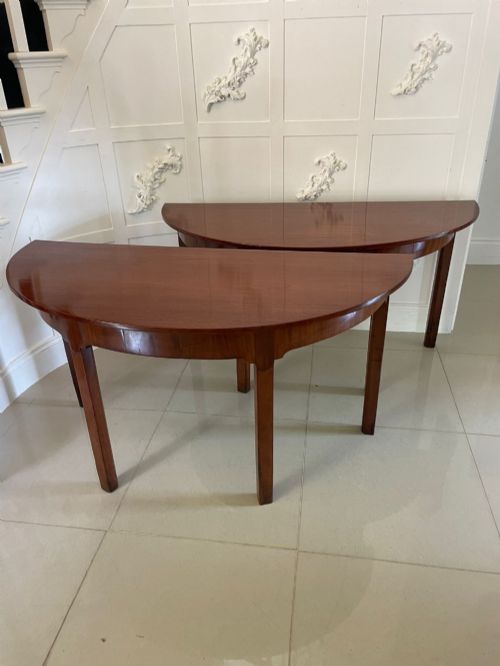
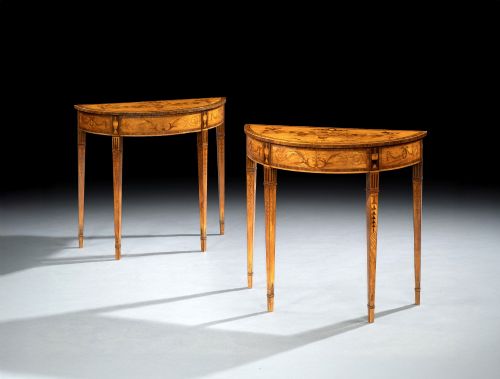
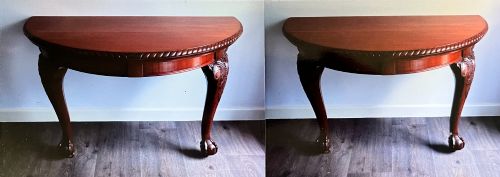
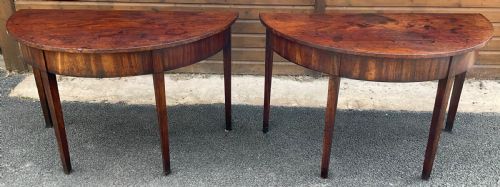
Pair semi circular tables offer versatile elegance against a wall, and this selection ranges from Georgian mahogany to twentieth-century painted timber.
Pair Semi Circular Tables
When you search for pair semi circular tables, you encounter demi-lune console tables, side tables, and D-end formats designed to stand flush against a wall. The pieces listed here span the eighteenth century, the Georgian period, and later revivals, offering symmetrical arrangements for hallway or living room placement.
The dominant forms are George III console tables and nineteenth-century variations in mahogany, satinwood, and painted wood. You also find walnut, maple, and wrought iron pieces from Italian, Swedish, and Chinese origins alongside traditional English examples.
How they were made
Cabinetmakers constructed these tables using solid timbers like mahogany, walnut, and maple, frequently applying veneers to create figured grain patterns across the semi-circular surfaces. Marquetry inlay adds intricate decorative detail to satinwood tops, particularly on eighteenth-century examples.
Structural support relies on timber framing, while certain later pieces incorporate wrought iron or brass framing. Painted wood finishes appear across various periods, from English painted styles to Gustavian-inspired pieces.
One resourceful pair traded its formal hall duties for modern bedroom service as brass-framed drinks tables.
What varies in quality
The distinction between standard and superior pieces rests on the choice of timber and the precision of the cabinetwork. Figured mahogany and delicate marquetry inlay indicate higher ambition in the workshop, whereas simpler painted surfaces offer a different decorative intent.
Proportion and period integrity separate exceptional examples from later interpretations. Original Georgian craftsmanship displays refined proportions and harmonious grain alignment across both halves of the pair.
The Pair Semi Circular Tables Glossary
- Demi-lune
- Half-moon shape. This term describes furniture with a flat back and a curved front designed to stand against a wall.
- Console table
- A table supported by wall brackets or legs. These pieces are intended to sit against a vertical surface rather than stand independently in the centre of a room.
- Marquetry inlay
- Decorative veneer patterns. Craftsmen piece together different coloured woods to create pictorial or geometric designs on the table top.
- D-end table
- A table with one curved end shaped like the letter D. Pairs of these tables can often be joined together to form a larger dining surface.
- Quarter-veneered
- Wood veneer arranged in four segments. The grain runs outwards from the centre to create a symmetrical pattern on the top.
Pair Semi Circular Tables: Frequently Asked Questions
Where should I place pair semi circular tables?
These tables are traditionally placed against a hallway or living room wall where their flat backs fit flush. They work effectively beneath mirrors or artwork.
Separating the pair allows you to use them as matching bedside tables or side tables in different corners of a room.
Can these tables be joined together?
Certain designs, particularly D-end tables from the Georgian period, were originally built to lock together with other sections. This created a larger freestanding dining table when needed.
Most console tables in this selection, however, remain fixed against the wall as decorative furniture rather than modular dining pieces.
How do I identify a Georgian pair?
Georgian pieces typically feature solid mahogany, satinwood, or figured veneers combined with period construction techniques. Look for hand-cut joints and timber ageing consistent with the eighteenth century.
Stylistic markers such as George III inlay work or specific leg forms also point toward this foundational era.
Are painted tables genuine antiques?
Painted wood finishes appear across multiple eras, including nineteenth-century English pieces and Swedish Gustavian styles. Some pieces carry original paint surfaces while others reflect later decorative painting.
Examine the underlying timber and wear patterns to understand the age and origin of the painted finish.