


Satinwood Wall Tables
Satinwood wall tables are elegant display and serving pieces defined by their luminous timber surfaces, offering refined utility for period interiors.
Satinwood Wall Tables
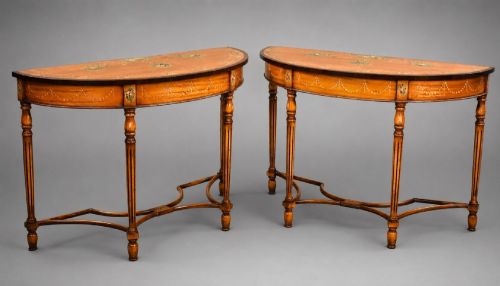
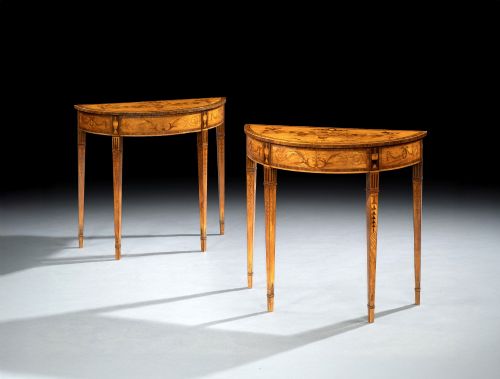
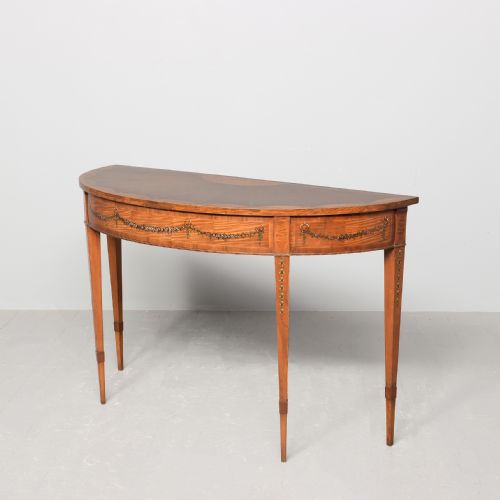
Satinwood wall tables comprise a varied group of antique console, side, pier, and hall tables designed to stand against a room partition. These items span the eighteenth and nineteenth centuries, taking forms from the Georgian and Edwardian eras.
The buyer meets demi-lune shapes most frequently among these listings, alongside rectangular console and pier formats. Makers constructed these pieces using primary timbers like satinwood and mahogany, often enhanced with painted decoration or marquetry.
Examples originate from distinct historical periods including George III, Victorian, and Edwardian times. Certain pieces incorporate specific decorative schemes such as Neoclassical motifs or Sheraton Revival styling.
How they were made
Craftsmen built these tables using figured satinwood and mahogany, frequently employing crossbanding to frame the principal timber grains. Marquetry inlay added complex geometric or floral patterns across the table tops and friezes.
Many surfaces received hand-painted enamel decoration depicting classical motifs, urns, or floral garlands. Giltwood and paint appeared on specific decorative frames, whilst marble tops provided durable surfaces on select pier tables.
Several tables feature hidden fold-over mechanisms, transforming modest console stands into full card tables with a gentle pivot.
What varies in quality
Quality separates through the precision of the marquetry inlay and the fineness of the hand-painted detailing on the satinwood surface. Superior examples exhibit balanced proportions and crisp execution in their Neoclassical or Sheraton Revival motifs.
The choice and figuring of the timber dictate the visual depth of the top, with select specimens showing exceptional grain luminosity. Structural integrity and the careful matching of veneers distinguish workshop production of higher standing.
Edward and Roberts
The Satinwood Wall Tables Glossary
- Demi-lune
- Half-moon shape, describing tables with a curved front and a straight back designed to fit flush against a wall. This profile became particularly popular during the eighteenth century for pier and console tables.
- Marquetry
- Decorative veneer work arranged in pictorial or geometric patterns using various coloured woods. Craftsmen applied these thin wood slices to the structural carcass of the table.
- Crossbanding
- A border technique where veneer strips are laid grain-perpendicular around the edge of a table top. This frames the primary timber panel and provides a neat visual perimeter.
- Pier table
- A table designed specifically to stand against the wall pier between two windows, frequently paired with a matching wall mirror above. These often featured decorative marble or timber tops.
- Console table
- A table supported by wall brackets or console legs rather than four independent vertical supports. They served decorative and display purposes in formal rooms.
Satinwood Wall Tables: Frequently Asked Questions
Where should I place a wall table?
These tables suit hallways, drawing rooms, or entrance spaces where floor depth is restricted. Their flat backs allow them to anchor securely against vertical partitions.
Positioning them beneath a mirror or artwork creates a balanced decorative focal point within a period interior scheme.
How do I care for satinwood surfaces?
Satinwood requires gentle dusting with a soft, dry cloth to prevent abrasion to the polished finish. Avoid placing timber pieces in direct sunlight or near heat sources to protect the delicate veneers and painted details.
Applying a traditional beeswax polish occasionally maintains the natural lustre of the wood without building up heavy chemical residues.
How can I distinguish George III from Edwardian pieces?
George III furniture typically dates from the eighteenth century, showing authentic period construction methods and organic timber ageing. The proportion, hand-cut joinery, and restrained Neoclassical detailing define this earlier era.
Edwardian items reflect later nineteenth and early twentieth century revivals, often displaying brighter painted decoration and specific Sheraton Revival design influences.