


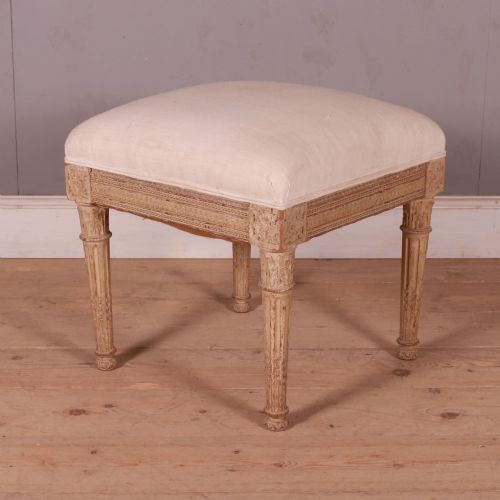


Swedish Painted Stools
These Swedish painted stools bring crisp architectural lines and pale tones to a room, offering practical seating with distinct Nordic character.
Swedish Painted Stools
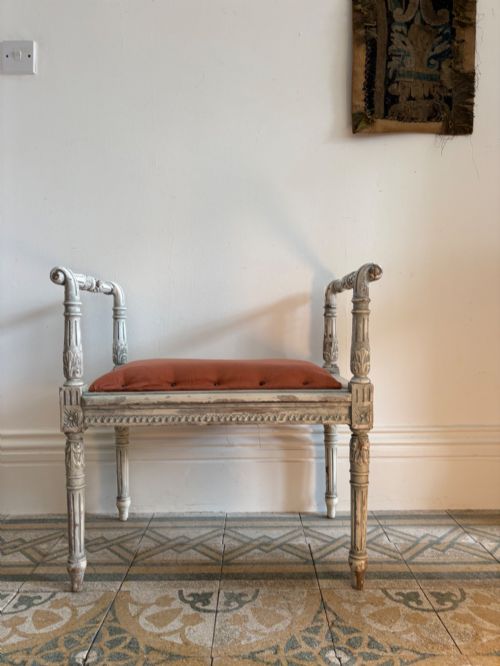
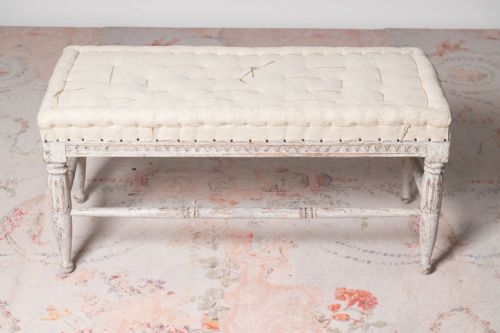
Swedish painted stools encompass low seating, benches, and footstools produced primarily across the eighteenth and nineteenth centuries. Examples range from simple original painted wood to formal Gustavian Neoclassical forms dressed in silk or linen.
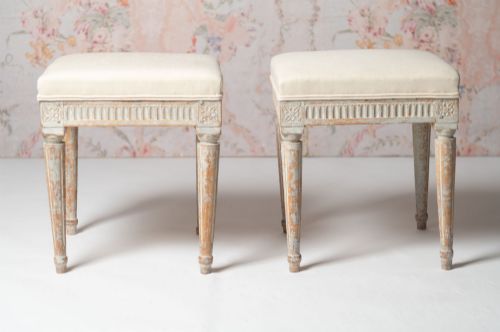
The most common pieces encountered on this page date from the nineteenth century, including pairs of original painted stools and carved variants following Gustavian traditions.
Makers such as John Tesch also contributed to larger suites of furniture featuring related seating forms during this period.
How they were made
Construction relies upon traditional woodworking techniques using timber shaped into carved frames and sturdy supports. Artisans applied multiple layers of paint, often in pale white or soft tones, to achieve a durable finished surface.
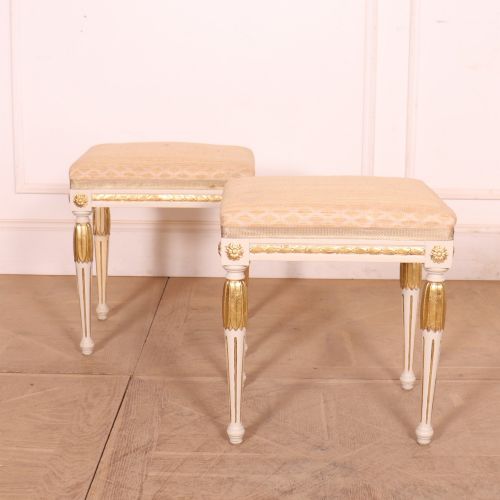
Upholstered elements incorporate traditional textiles including silk, cotton, linen, and general fabric seats. Occasional details such as gold leaf accent specific carved portions of the woodwork.
What varies in quality
Quality rests upon the crispness of the original carved detail within the wood and the integrity of the paint surface. Pieces retaining their original layered paint finish carry greater historical character than later surface updates.
The sophistication of the Gustavian Neoclassical design influences the distinction between standard utilitarian seating and finer parlour pieces. Upholstery choices, from simple linen to luxury silk, reflect the original intended tier of the furniture.
John Tesch
The Swedish Painted Stools Glossary
- Gustavian
- The Swedish interpretation of neoclassical style, characterised by restrained symmetry, fluted legs, and pale monochrome paint. It emerged during the reign of Gustav III and dominated Scandinavian furniture design.
- Neoclassical
- A revival style drawing inspiration from classical antiquity, featuring straight lines and balanced proportions. This aesthetic defines the architectural framing of many nineteenth-century stools.
- Original painted
- A descriptor indicating that the surface coating of the timber dates from the period of manufacture rather than a recent workshop application. Such surfaces often show natural ageing through gentle wear.
- Gold leaf
- Beaten gold applied to carved wooden details to provide metallic highlights against painted surfaces. It appears selectively on finer decorative elements.
Swedish Painted Stools: Frequently Asked Questions
What periods do these Swedish painted stools represent?
The selection spans pieces from the eighteenth century through the nineteenth century, including specific dates like 1880, 1890, 1900, and general nineteenth-century production.
Most items reflect Gustavian design principles and Swedish revival aesthetics developed across these eras.
How were these stools originally used in homes?
These pieces served as portable seating in parlours, bedrooms, and drawing rooms, as well as footstools paired with larger seating.
Some examples also formed part of larger coordinated furniture suites designed for unified interior schemes.
What materials appear in the construction?
Construction primarily utilises painted wood, occasionally enhanced with carved details and gold leaf highlights.
Seats feature diverse textiles including linen, silk, cotton, and standard woven fabrics.
How do I identify Gustavian styles?
Gustavian pieces display neoclassical symmetry, pale painted finishes, and refined carved motifs derived from classical architecture.
They stand apart from heavier rustic furniture through their slender proportions and restrained ornamentation.