

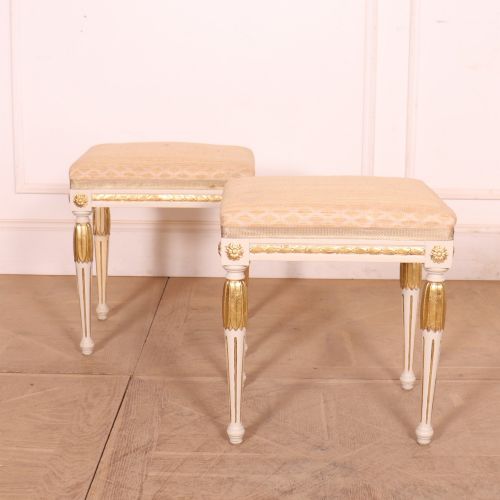
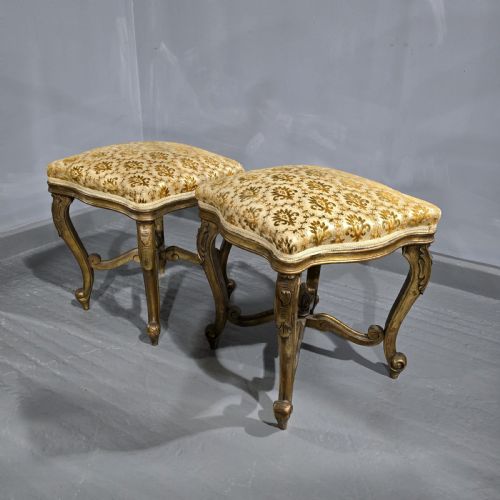


Pair Upholstered Ottomans
Pair upholstered ottomans bring matched symmetry and low-profile seating to a room, offering practical comfort rooted in period craftsmanship.
Pair Upholstered Ottomans
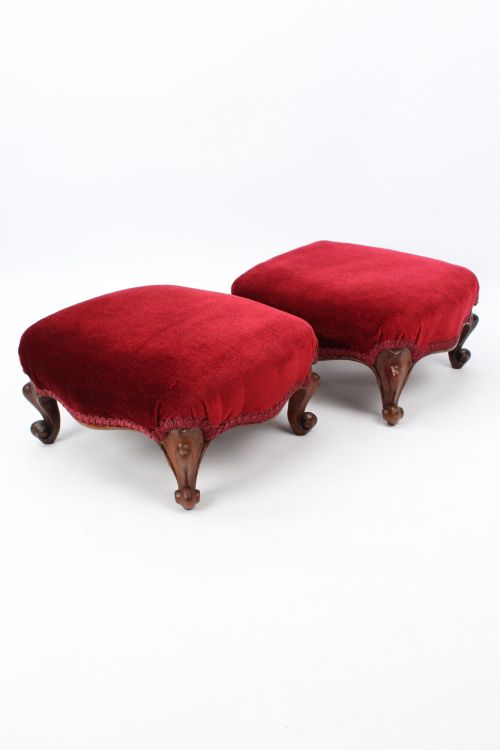
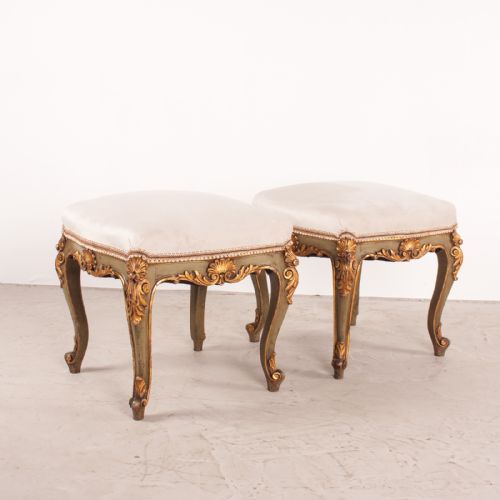
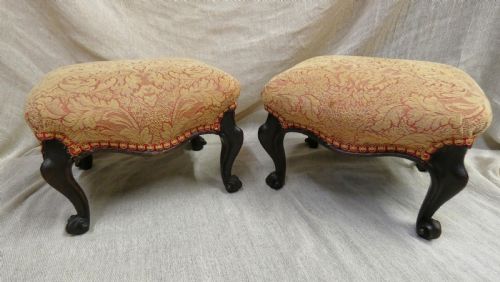
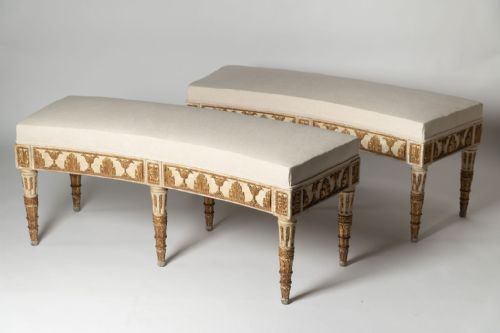
When you search for pair upholstered ottomans, you encounter matched low seating spanning footstools, long benches, and window seats originating from the Georgian period through to the early twentieth century. The selection leans heavily towards nineteenth-century Victorian and Regency examples, alongside Continental painted and gilded pieces.
These items typically present as pairs of footstools, window stools, or larger ottoman forms. Frames range from mahogany and walnut to satin birch and rosewood, dressed in velvet, leather, silk, or fabric upholstery.
How they were made
Makers constructed the timber frames using traditional joinery, working with dense hardwoods like mahogany, walnut, and rosewood, or softer birch shaped for painted finishes. Carved details, giltwood, and gold leaf applied to the wood added decorative distinction.
Upholstery involved securing fabric, velvet, leather, or silk over padding, often accented with brass studs or buttoned backs to complete the traditional finish.
Frame materials recorded include mahogany, walnut, brass, satin birch, and rosewood.
What varies in quality
The precision of the timber carving and the integrity of the frame construction dictate the baseline worth of each piece. Crisp detailing on mahogany or giltwood surfaces distinguishes superior workshop production from simpler output.
The choice of covering material and the execution of traditional upholstery techniques, such as neat buttoning or secure brass studding, separate standard decorative items from finer examples.
James Shoolbred
The Pair Upholstered Ottomans Glossary
- Ottoman
- A low, upholstered seat or stool without arms or a back. It frequently serves as a footrest or auxiliary seating within a room.
- Giltwood
- Timber treated with gold leaf or gold paint for a decorative surface finish. This technique appears widely on Continental and revival pieces.
- Mahogany
- A durable, reddish-brown hardwood favoured for furniture framing during the eighteenth and nineteenth centuries. It provides a stable base for carved legs and details.
- Buttoned
- An upholstery technique where recessed buttons create a diamond pattern across the padded surface. This method secures the internal stuffing while adding texture.
Pair Upholstered Ottomans: Frequently Asked Questions
What is a pair upholstered ottoman?
These are matched low seats designed for resting feet or sitting, usually found in periods ranging from the Georgian era to the early twentieth century.
They appear in forms such as long benches, window seats, and compact footstools.
How were pair upholstered ottomans used?
Historically, they provided flexible seating in libraries, drawing rooms, and bedrooms, functioning as footstools or window seats.
Their matched nature allowed them to sit symmetrically at the foot of a bed or beneath a window.
How do I date these ottomans?
Dating relies on timber choices, such as mahogany or rosewood, alongside stylistic indicators like Regency curves or Victorian buttoning.
Construction methods and framing details help anchor pieces to specific decades like the 1880s or 1890s.
What materials should I expect?
Frames consist primarily of hardwoods like mahogany, walnut, and rosewood, or painted birch on Continental pieces.
Upholstery materials include leather, velvet, silk, and standard fabric, frequently finished with brass studs.