
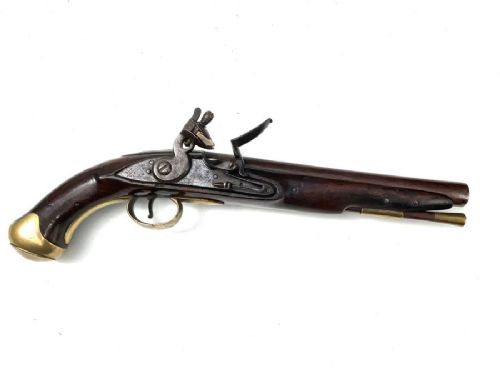


Steel Flintlock Pistol
A steel flintlock pistol offers tangible military and civilian history, prized by collectors for its mechanics and craftsmanship.

Steel Flintlock Pistol
A steel flintlock pistol represents a firearm mechanism developed for self-defence and military use across the eighteenth and nineteenth centuries. Buyers searching for a steel flintlock pistol encounter diverse forms ranging from pocket pocket pistols to larger holster and military arms.
The inventory on this page spans the eighteenth century, the year 1800, and the nineteenth century. Pieces reflect Georgian and Ottoman Empire styles alongside Scottish Highland traditions.
Forms include Queen Anne pistols, turn-off box-lock pocket pistols, overcoat pistols, and heavy holster pistols. Origins extend across British workshops and the Ottoman Empire, showing varied regional design priorities.

How they were made
Construction relies heavily on steel and iron for barrels and lock mechanisms, paired with stocks shaped from walnut and other woods. Metal components are forged and hand-finished to ensure the spark-producing lock operates correctly against the frizzen.
Many examples incorporate decorative enrichment alongside utilitarian construction. Silver inlay work and brass mounts appear on specific regional types, while proof marks stamped onto metal indicate official testing of the barrel strength.
Steel Flintlock Pistol Retail Price Guide 2026
Typical asking prices for steel flintlock pistol among the pieces listed under this phrase on Sellingantiques today, from the lower quarter to the upper quarter. They describe what is for sale here now, not the wider market.
Some travel pistols belonged to inspectors who guarded mail coaches against highwaymen on dark roads.
What varies in quality
Quality differences lie in the crispness of the lock mechanism, the precision of metal engraving, and the preservation of the original wood stock. Finer pieces demonstrate superior integration between the steel parts and the carved wooden grip.
The presence of maker signatures and regional attribution elevates a piece, as seen in signed works from documented gunmakers or distinct Scottish scroll-butt geometries. Untouched original surfaces carry more historical authority than heavily restored components.
John Campbell of Doune·J. Robinson
The Steel Flintlock Pistol Glossary
- Flintlock
- A firearm ignition mechanism that uses a piece of flint held in a cock to strike a steel frizzen, creating sparks to ignite the priming powder. This system dominated personal firearms technology for centuries.
- Box-lock
- A firearm design where the lock mechanism is forged integrally with the breech or frame rather than mounted on a separate sideplate. It provides a compact and robust construction often seen on pocket pistols.
- Turn-off
- A barrel design that unscrews from the frame to allow loading from the breech end rather than the muzzle. This feature was popular on eighteenth-century pocket arms.
- Proof marks
- Official stamps struck onto the metal barrel and action to show the firearm has passed testing for structural safety under pressure. These marks help identify the city of origin and the testing house.
Steel Flintlock Pistol: Frequently Asked Questions
What is a flintlock pistol?
A flintlock pistol is a muzzle-loading firearm that uses a flint and steel mechanism to generate the spark required to fire the gunpowder charge.
These weapons were standard personal defence and military arms throughout the eighteenth and nineteenth centuries before percussion cap systems replaced them.
Were these pistols used in combat?
Many steel flintlock pistol examples served military officers, travellers, and mail coach inspectors for protection against highwaymen and hostile forces.
Others were made for civilian self-defence, pocket carriage, or as diplomatic gifts within the Ottoman Empire.
How should I clean my pistol?
Historic firearms require careful environmental control and minimal intervention to preserve original metal patinas and wood finishes.
Apply specialist museum-grade wax or oils sparingly to inhibit corrosion without altering the historical surface.