
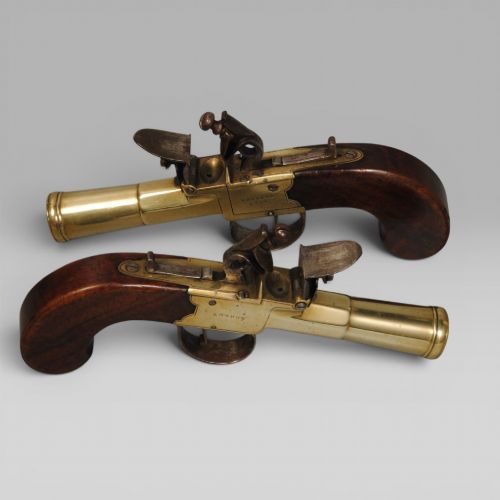


Flintlock Pocket Pistol
A flintlock pocket pistol is a compact personal defence arm designed for discretion, carrying the history of Georgian personal security in steel and walnut.
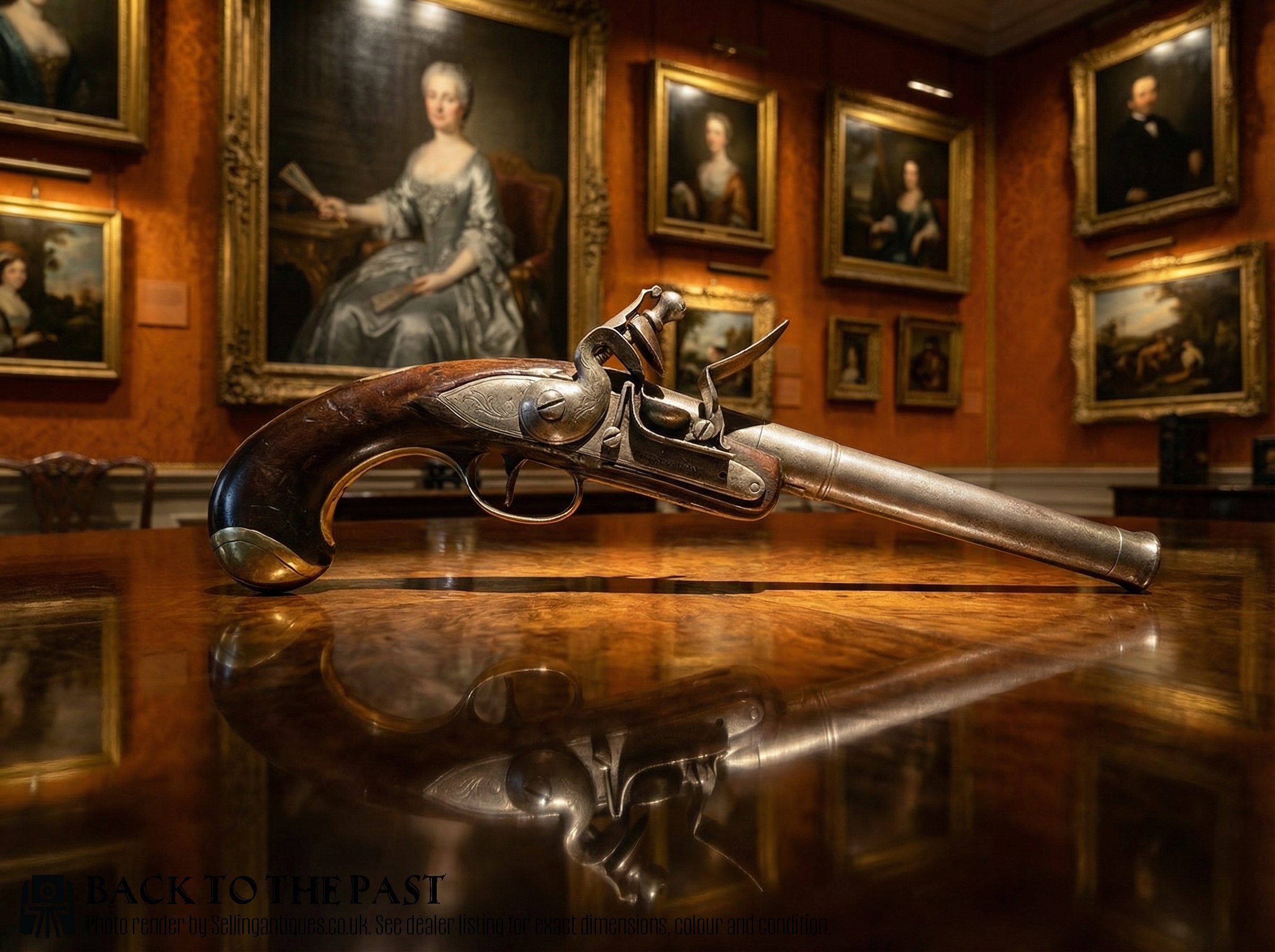
Flintlock Pocket Pistol
When you examine a flintlock pocket pistol, you are looking at small-scale firearms built for concealment by travellers and gentlemen during the eighteenth and nineteenth centuries. These pieces appear primarily in Georgian and Regency styles, reflecting the period's demand for personal protection during highway travel.
The inventory on this page demonstrates that the form spans the eighteenth and nineteenth centuries, taking shape as turn-off cannon barrel designs and box-lock pocket pistols. You will encounter London makers frequently, alongside provincial makers from Liverpool and Birmingham, working in forms ranging from muff pistols to larger overcoat variations.
Makers adapted these arms with folding triggers and concealed mechanisms to prevent snagging in pockets or muffs. The survival of pairs and individual pieces indicates that these weapons were valued possessions, often embellished with silver wire inlay or silver band mounts.
How they were made
Gunsmiths constructed these arms using steel for the barrels, locks and internal mechanisms, paired with stocks shaped from walnut, hardwood or general wood. The metal components required precise forging and filing to ensure reliable ignition of the flint against the frizzen.
Brass was utilised extensively for cannon barrels and frames, particularly in Queen Anne type pistols where the barrel unscrewed for loading. This material provided corrosion resistance and distinct visual contrast against the dark wood of the grip.
Decoration involved intricate silver wire inlay set into the wooden stocks and engraved details on the steel box-lock actions. Makers signed their work on the metal surfaces, incorporating Birmingham proof marks to certify the barrel strength.
Flintlock Pocket Pistol Retail Price Guide 2026
Typical asking prices for flintlock pocket pistol among the pieces listed under this phrase on Sellingantiques today, from the lower quarter to the upper quarter. They describe what is for sale here now, not the wider market.
Makers represented include London and provincial gunsmiths, alongside specialised pieces made for mail coach inspectors.
What varies in quality
Quality in these arms rests upon the crispness of the engraving and the integration of the metalwork with the wooden stock. Superior examples display deeply chiselled foliage on the action and precise, flush fitting where the brass or steel meets the wood.
The reputation of the maker dictates the standing of a piece within the field, with signed works by known London gunmakers commanding greater regard. The complexity of the mechanism, such as turn-off barrels or revolving designs, also elevates the sophistication of the manufacture.
Twigg London·La Motte·James Barber·Thomas Henshaw·I Parr·John Rimes·Meyer And Mortimer·J Robinson·Spencer London·Sutherland Of London·Joseph Egg
The Flintlock Pocket Pistol Glossary
- Box-lock
- A firearm design where the lock mechanism is integral with the breech of the barrel in a single forged frame. This layout improves compactness for pocket carriage.
- Turn-off barrel
- A barrel that unscrews from the frame for muzzle loading directly into the chamber. It eliminates the need for a ramrod.
- Cannon barrel
- A barrel featuring a flared muzzle resembling a ship's cannon, typical of early eighteenth century designs. It adds structural strength around the muzzle.
- Bore
- The interior diameter of the barrel, often measured in gauge or-bore size. This indicates the calibre of the projectile.
- Frizzen
- The vertical steel plate struck by the flint to create sparks. Its proper hardening is essential for reliable ignition.
Flintlock Pocket Pistol: Frequently Asked Questions
What is a flintlock pocket pistol?
A flintlock pocket pistol is a small, concealable firearm utilising a flint ignition system, designed for self-defence during the eighteenth and nineteenth centuries.
These pieces were carried in pockets, holsters, or muffs by travellers and citizens navigating unsafe roads and city streets.
How were pocket pistols used?
Owners carried these arms for personal protection against highwaymen and footpads when travelling or walking at night.
Because they were smoothbore and designed for close range, accuracy at a distance was secondary to immediate stopping power in an emergency.
How do I identify a Queen Anne pistol?
A Queen Anne pistol is distinguished by its turn-off barrel and an integral breech and lock cast as a single piece of brass or steel.
This specific architectural style remained popular through the eighteenth century for its reliability and compact form.
What makes a pocket pistol rare?
Rarity in these arms is found in signed works by premier London makers, specialised formats like revolving barrels, and surviving matched pairs.
Original decorative elements such as silver wire inlay also elevate the historical significance of an individual piece.