




Standing Brass Magazine Rack
A standing brass magazine rack keeps periodicals tidy while bringing bright metallic polish and rich timber into a room.
Standing Brass Magazine Rack
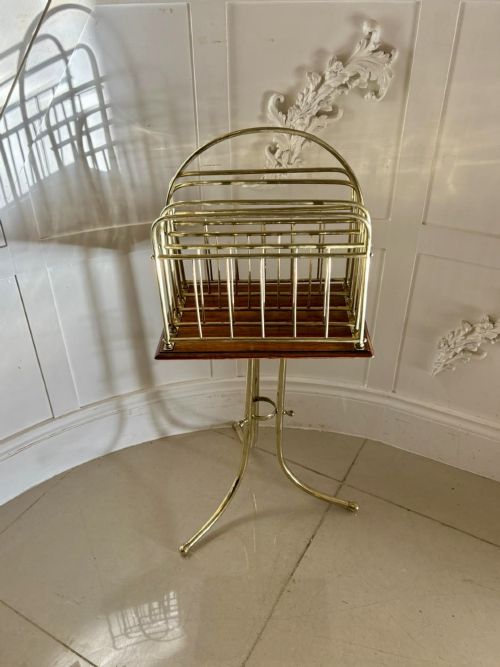
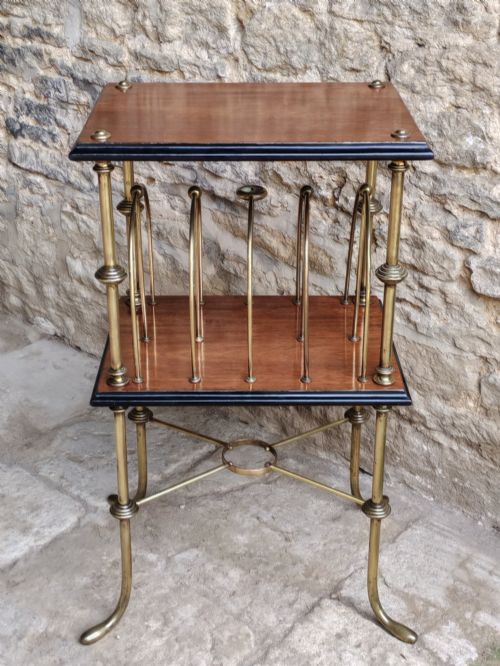
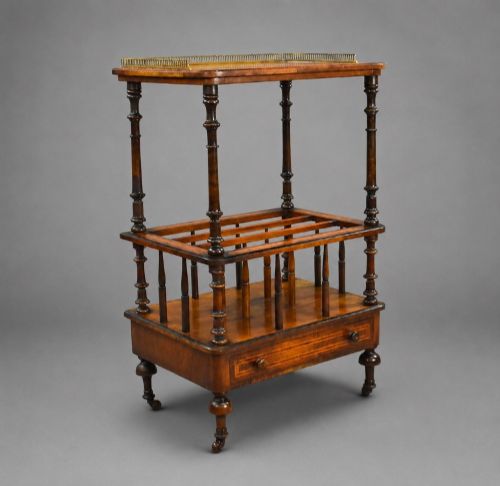
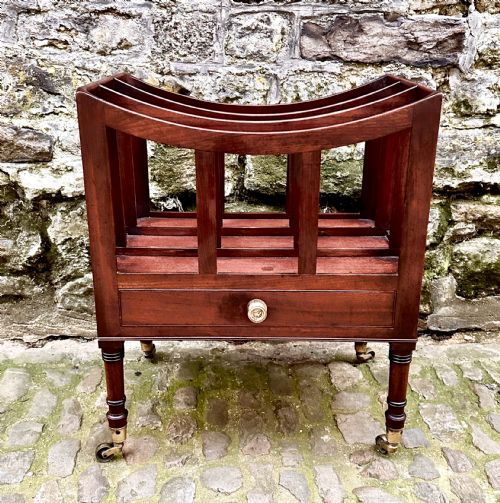
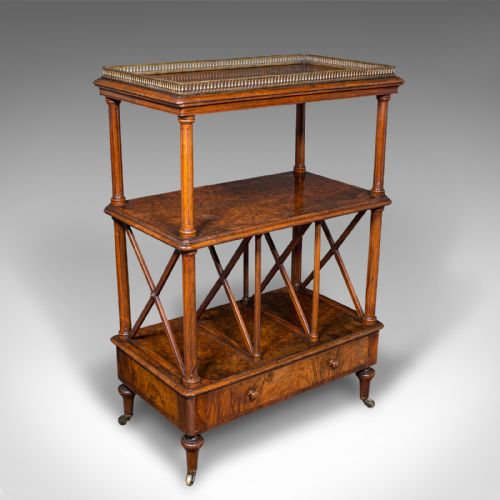
A standing brass magazine rack combines metal framing or mounts with timber bodies to hold newspapers and periodicals off the floor. The selection spans distinct forms, including boat-shaped canterburys, revolving stands, and multi-division tables originating from the Georgian, Regency, Victorian, and Edwardian eras.
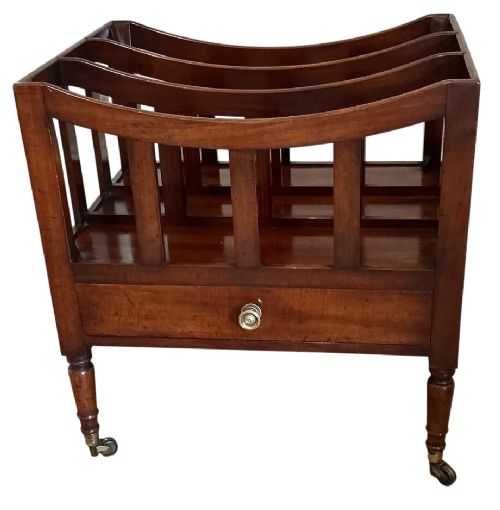
Canterburys form a major part of the selection, often featuring slatted wooden partitions above low drawers or castors. Alongside these traditional designs appear later tubular brass frames, bamboo-style metalwork, and revolving book stands suited to corner placement.
Makers and designers referenced in the pieces range from Gillows of Lancaster to J.C. Loudon and Maison Jansen. These workshops produced both formal dining room pieces and lighter occasional stands intended for sitting rooms.
Materials and construction
Makers combined polished brass with dense cabinet timbers such as mahogany, burr walnut, oak, rosewood, and copper. Brass appeared as cast carry handles, corner mounts, tubular uprights, spindle divisions, and decorative casters.
Cabinetmakers utilised dovetailed joints for underdrawers and turned or reeded supports for the upright frames. Metal components were joined by soldering, riveting, or screw-fixing to timber bases and dividers.
Several stands spin like miniature libraries, proving that Victorians loved a good swivel long before office chairs caught on.
Factors of quality
Quality rests on the crispness of the brass casting, the thickness of the gauge used for tubes and handles, and the selection of timber veneers. Superior examples display figured mahogany or burr walnut with clean inlay work, while simpler items rely on plain oak or standard brass plating.
Structural rigidity separates finer stands from heavier utilitarian pieces. Well-made canterburys incorporate stable base plinths, smooth-revolving mechanisms where applicable, and securely fixed vertical partitions that bear the weight of heavy volumes without wobble.
Gillows of Lancaster·J.C. Loudon·Maison Jansen
The Standing Brass Magazine Rack Glossary
- Canterbury
- A low stand fitted with divisions for holding sheet music, folios, or periodicals, usually mounted on castors. This form originated in the late eighteenth century and often includes a single drawer beneath the slatted compartments.
- Etagere
- A set of open shelves for displaying small objects or holding books, sometimes combined with magazine storage. These pieces utilise slender vertical supports.
- Folio stand
- A piece of furniture designed to hold large books or unbound prints upright or in sloping racks. They share common ground with large canterburys.
- Whatnot
- A multi-tiered shelving unit used for ornaments and books. Victorian variations frequently incorporated magazine storage within the lower tiers.
- Tubular brass
- Hollow metal tubing used to construct lighter frames during the later Victorian and Edwardian periods. This material allowed for complex curved and revolving designs.
Standing Brass Magazine Rack: Frequently Asked Questions
What is a canterbury?
A canterbury is a low, compartmentalised stand originally built for sheet music and folios, which evolved to hold newspapers and magazines.
Most feature three or four vertical divisions above a low drawer, often mounted on small castors for easy movement across a room.
How do I date a brass magazine rack?
Dating relies on the combination of materials, joinery methods, and overall style. Georgian and Regency pieces favour solid mahogany with hand-turned spindles.
Victorian and Edwardian versions frequently introduce burr walnut veneers, ebonised details, or tubular brass frames with machine-threaded fittings.
Where should I place a revolving stand?
Revolving magazine stands work best beside an armchair or sofa where all sides remain accessible. Their rotating action makes them practical for tight corners.
Ensure they sit on level flooring so the central pivot turns smoothly without catching.
How do I care for brass and mahogany?
Dust timber regularly with a dry cloth and feed the wood with wax polish occasionally to maintain the grain. Clean brass elements gently with a non-abrasive metal polish.
Avoid placing these stands in direct sunlight or near heat sources to prevent the wood veneers from drying out.