
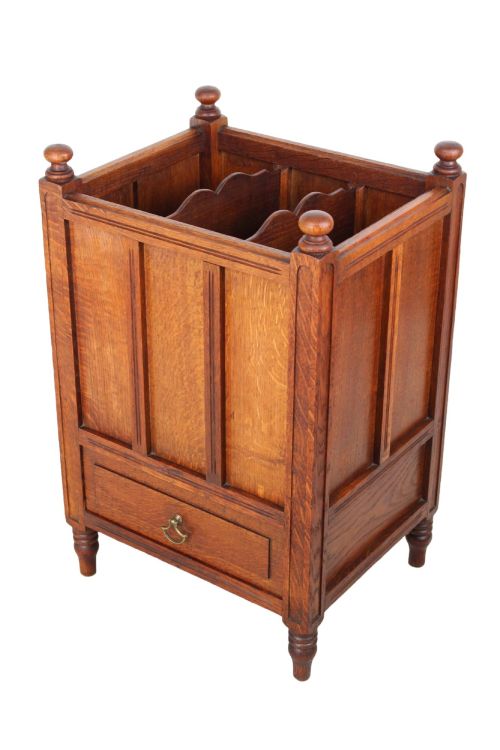
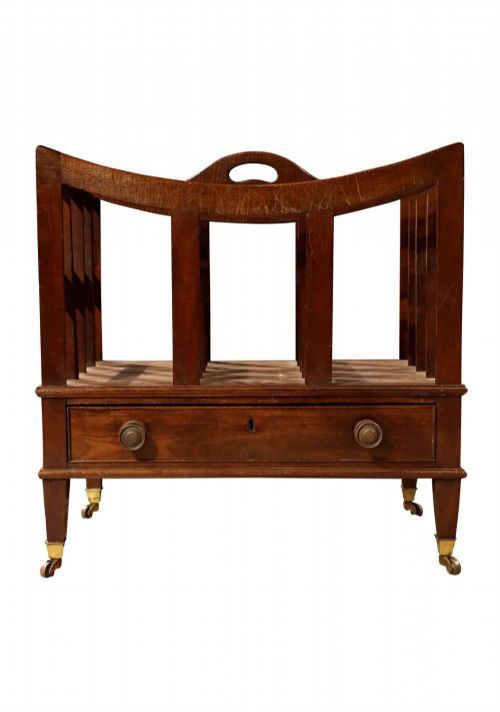


Edwardian Period Magazine Rack
An edwardian period magazine rack brings tidy elegance to a room, holding newsprint and journals with polished timber grace.
Edwardian Period Magazine Rack
An edwardian period magazine rack offers a practical vessel for periodicals, combining everyday utility with the refined cabinet-making of the early twentieth century. These pieces stand beside armchairs and writing desks, keeping the daily papers and journals orderly.
The versions met most frequently on this page span the Edwardian era itself, alongside earlier Victorian and Regency examples and later 1920s interpretations. They appear as dedicated magazine racks and traditional canterburys, often featuring division slats to keep publications upright.
Makers of the period worked within established furniture forms, adapting the traditional lower-tier drawer or slatted compartment specifically for the rising volume of weekly and monthly reading material. The results range from simple oak frames to richly inlaid mahogany stands.
How they were made
Timber selection dictated the character of each piece, with mahogany and oak providing sturdy structural integrity while rosewood and walnut offered richer, darker grains. Workshops frequently applied satinwood inlay to add delicate contrast against the primary wood.
Metal components such as brass appeared in handles, castors, and structural rods, combining durability with a bright metallic accent against the polished timber surfaces. Joinery relied on traditional cabinet-making methods to support the weight of heavy volumes and stacked papers.
Some models managed to hold both the morning broadsheet and the evening musical scores in one tidy spot.
What varies in quality
The distinction between standard examples and superior pieces rests on the crispness of the timber carving and the precision of any satinwood inlay work. Finer items exhibit thoughtful proportion, balanced grain patterns, and careful attention to less visible joints.
Materials elevate the stature of a piece, moving from straightforward utility timbers like oak up to decorative hardwoods such as rosewood. The inclusion of functional additions like smooth drawers or brass castors further separates ordinary racks from distinguished ones.
The Edwardian Period Magazine Rack Glossary
- Canterbury
- A low, open-partitioned stand traditionally used for holding sheet music, books, or magazines. These pieces often feature carrying handles and small drawer compartments beneath the main storage slots.
- Satinwood Inlay
- A decorative technique where contrasting light-coloured timber veneer is inserted into the primary wood surface. This creates fine geometric or floral patterns typical of Edwardian cabinet work.
- Regency Revival
- A nineteenth or twentieth-century furniture style copying the neoclassical lines, saber legs, and dark wood finishes of the early nineteenth century. It borrows heavily from classical antiquity.
- Tier
- A single level or shelf in a multi-level shelving unit or rack. Multiple tiers allow for the sorting of different periodicals by size or topic.
Edwardian Period Magazine Rack: Frequently Asked Questions
What is a canterbury?
A canterbury is a traditional compartmentalised stand originally built for sheet music and books before adapting to hold magazines and journals.
These pieces typically feature upright dividers and often sit on low legs or castors for easy movement beside seating.
How do I clean timber?
Cleaning antique timber requires simple dusting with a soft, dry cloth to prevent the accumulation of grit in the grain. Avoid modern chemical sprays and instead use a traditional beeswax polish sparingly to maintain the natural sheen.
Where should I place it?
These racks sit comfortably beside armchairs, sofas, or writing desks where periodicals are read most frequently.
Keep the wood away from direct sunlight and strong heat sources such as radiators to prevent the timber and veneer from drying out.
Are Edwardian racks sturdy?
Edwardian and Victorian racks were built by skilled cabinet-makers using solid hardwoods and traditional joinery designed to bear the weight of heavy paper volumes.
While robust, the upright slats and divisions benefit from sensible handling rather than heavy overloading.