
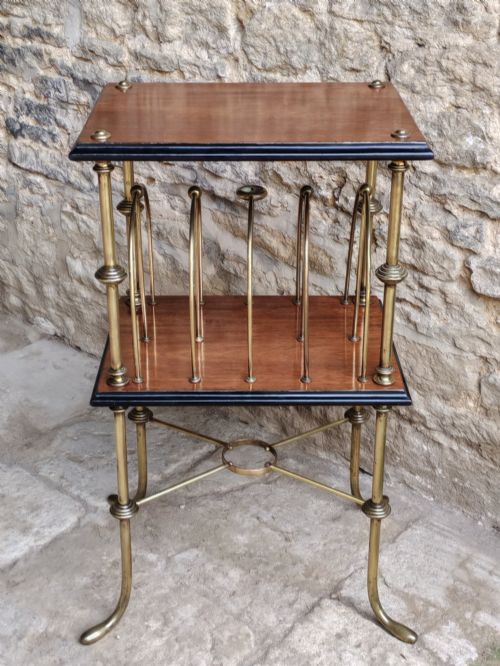
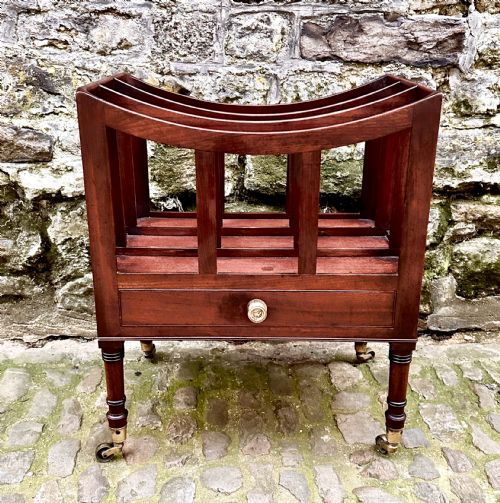


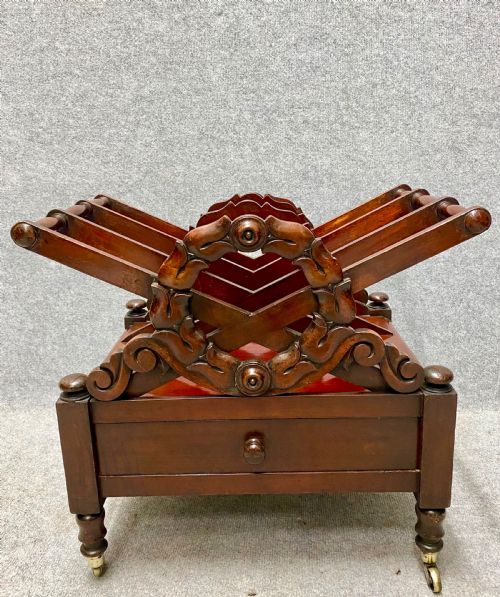


Brass and Wood Magazine Rack
These brass and wood magazine rack pieces combine solid timbers with polished metal mounts to bring orderly charm to daily reading.
Brass and Wood Magazine Rack
A brass and wood magazine rack gathers newspapers, periodicals and folios within partitioned wooden frames lifted by metal handles or spindle work. The selection spans distinct historical periods including George III, Regency, Victorian and Edwardian eras.
Most examples take the form of traditional canuterburys and magazine tables, built to house reading material beside seating or desks. You will encounter boat shaped designs alongside multi division stands and occasional tables adapted for storage.
Origins stretch from early nineteenth century workshops up to Edwardian parlours, demonstrating how domestic paper storage evolved over generations.
How they were made
Cabinet makers utilised choice timbers such as mahogany, rosewood and ebonised mahogany to construct the structural dividers and lower plinths. These hardwoods provided the stability necessary to bear heavy folios and bound volumes.
Polished brass formed the carrying handles, spindle supports and corner mounts, screwed directly into the timber frame. Turners shaped the wooden legs while joiners integrated slatted or solid partitions for individual compartments.
A nineteenth century designer named J.C.Loudon lends his name to a mahogany canterbury on this page, proving even storage had its stars.
What varies in quality
Superior quality rests upon the selection of timber grain and the precision of the joinery within each partition. Finer pieces demonstrate careful timber matching and substantial brass fittings rather than thin plated alternatives.
Proportion and scale dictate the distinction between standard room furniture and grand country house examples. Weighty rosewood frames and well defined turned supports elevate the presence of the piece.
J.C.Loudon
The Brass and Wood Magazine Rack Glossary
- Folio stand
- A larger piece designed to hold oversized prints, maps or bound volumes flat or upright. These often display substantial framing and sturdy hinged supports.
- Ebonised
- Timber treated with a finish to imitate expensive ebony wood. This dark surface creates a sharp contrast against polished brass mounts.
- Division
- An individual compartment or section within the rack designed to keep papers upright and separated. Division counts vary from single spacious troughs to four or more distinct slots.
Brass and Wood Magazine Rack: Frequently Asked Questions
What is a canterbury?
A canterbury is a low compartmentalised stand designed to hold sheet music, newspapers and books near a chair or table. They usually feature carrying handles and are easy to move about a room.
Historically used in formal sitting rooms, they served to keep daily reading materials tidy and close at hand.
How do I date a rack?
Dating relies on observing the timber species, structural hardware and overall style characteristics such as Regency curve lines or Edwardian turnings. Comparing the construction methods to known period pieces clarifies the age.
Earlier pieces often use solid mahogany or rosewood while later examples adopt different decorative treatments.
Can they hold modern magazines?
Most standard divisions accommodate contemporary periodicals, though oversized modern publications may require wider compartments. Measuring the partition spacing ensures a proper fit for larger journals.
They function well beside armchairs for everyday storage of current reading matter.
Where should I place it?
These pieces sit comfortably beside sofas, writing desks or reading chairs where papers accumulate. Their low profile prevents them from dominating the floor space of a room.
Keep them away from direct heat sources to protect the polished timber and brass finishes.