


Snaffles Hunting Print
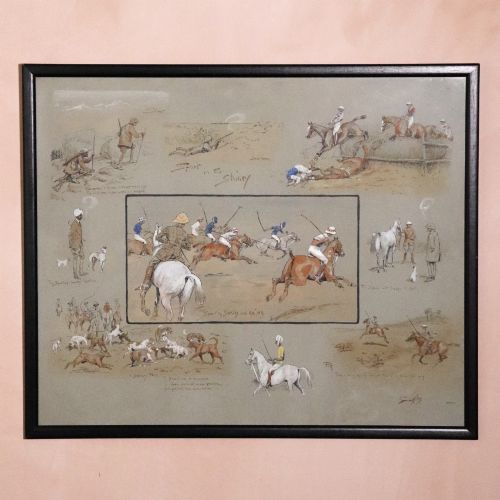
A snaffles hunting print captures the character and motion of early twentieth century equestrian sport through the distinctive hand of a master illustrator.
Snaffles Hunting Print
A snaffles hunting print brings the tradition of early twentieth century sporting art directly into a room, depicting fox hunting scenes and rural subjects from the nineteen hundreds through the nineteen forties. These works capture spirited horses, riders, and hounds across various British sporting contexts, reflecting a distinct era of field sports.
Buyers encounter framed prints alongside original watercolours and gouache paintings, often housed within traditional oak frames under glass. The visual record includes iconic titles such as Sport in the Shiney, The One To Carry Your Half Crown, and High Leicestershire, spanning decades of artistic output.
The selection ranges from individual framed artworks to complete hunting sequence paintings and printed Christmas cards. Each piece relies on the characteristic humour, observation, and lettering applied by the artist to ground the scene in authentic sporting life.
Materials and construction
These works are executed on paper using printmaking techniques, watercolour, and gouache, often enhanced with hand-colouring or distinctive pencil inscriptions. The combination of printed line work and pigment creates depth within the hunting scenes.
Framing materials consist primarily of wood and oak, fitted with protective glass to preserve the paper underneath. The construction reflects the standard picture framing methods of the Edwardian period and subsequent decades.
Some hunting scenes include printed Christmas cards inscribed with festive greetings for field sports enthusiasts.
Distinctions in quality
Quality rests in the vibrancy of the remaining pigment on the paper and the crispness of the printed line work. Pieces retaining strong colour contrast and clean paper surfaces demonstrate better preservation over the decades.
The presence of original framing materials and the clarity of the artist inscriptions also influence the standing of an individual work. Early editions show sharper detail in the intricate hunting scenes compared to later impressions.
Charles Johnson Payne Snaffles
The Snaffles Hunting Print Glossary
- Watercolour
- A paint consisting of pigment suspended in a water-based solution, utilised here for original artworks and hand-tinted details. It provides transparent washes of colour that define the landscape and figures.
- Gouache
- An opaque water-based paint that adds solid areas of colour and highlights to works on paper. It allows the artist to build dense, vibrant passages within a hunting scene.
- Limited Edition
- A restricted number of impressions produced from a single printing plate. These numbered runs indicate the scarcity and production scale of the specific image.
- Edwardian Sporting Art
- Artistic output depicting equestrian and field sports produced during the reign of Edward VII and the surrounding decades. This genre focuses on accurate observation of horses, hounds, and riders.
Snaffles Hunting Print: Frequently Asked Questions
What periods do these pieces date from?
The works originate from the early twentieth century, spanning from nineteen hundred through the nineteen forties. This timeframe covers the Edwardian era and the interwar years.
Changes in printing techniques and subject matter developed across these decades, reflecting the shifting tastes in British sporting art.
How should these framed works be displayed?
Display the pieces away from direct sunlight to protect the paper and watercolour pigments from fading over time. Maintaining stable indoor humidity prevents warping in the wooden frames.
Traditional oak frames suit country house interiors and studies, complementing the equestrian subject matter.
What is the difference between prints and watercolours?
Prints are mass-produced impressions from a plate, often featuring hand-coloured details and signature typography by the artist. Watercolours are unique, hand-painted works created directly with pigment on paper.
Original paintings offer singular brushwork, whereas prints provide the widely recognised published compositions.
How do I identify a genuine period piece?
Examine the paper quality, framing materials, and the characteristic typography found on the composition. Period pieces exhibit age-appropriate materials consistent with early twentieth century framing.
The specific titles and signatures associated with the artist provide clear markers for authentic examples.