




Small Convex Mirror
A small convex mirror bends the room into a single circular room, catching light and distortion in one gilded frame.
Small Convex Mirror
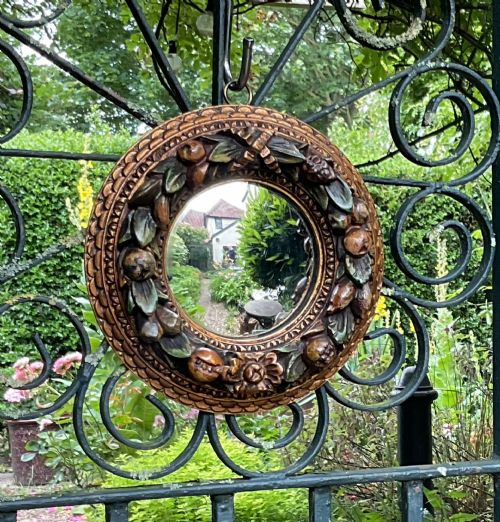
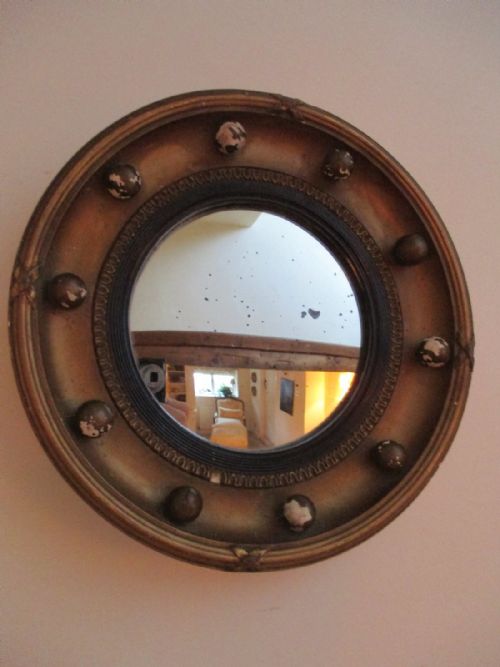
A small convex mirror is primarily a wall mirror designed to reflect a wide angle of an interior within a compact circular frame. These pieces appear most frequently in Regency and Victorian incarnations, often featuring round wooden or gesso bodies hung in principal rooms.
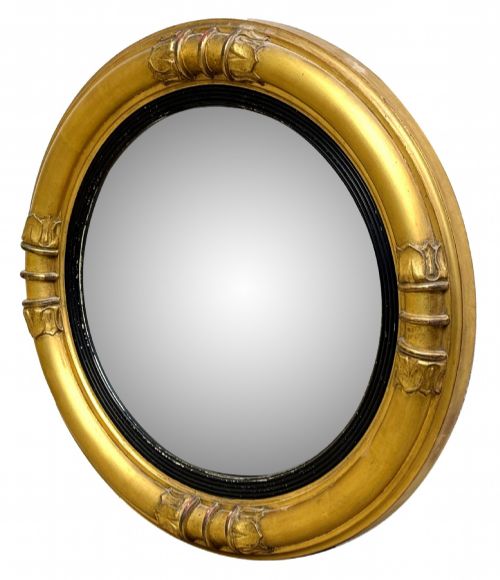
The evidence shows forms ranging from plain circular wall mirrors to elaborate Regency designs topped with carved eagle mounts or framed in moulded ebony and mahogany. Many examples rely on water gilt finishes over carved wood, bringing brightness to dark corners of a house.
Materials and Construction
Frames are built from carved wood, oak, or mahogany, sometimes ebonised or finished with japanning for dark, high-contrast surfaces. Giltwood and gesso form the foundation for gold leaf applications, which are burnished to catch ambient daylight.
The glass itself curves outward to create the signature spherical reflection, housed securely within circular mouldings. Artisans applied layers of gold leaf or water gilding over preparatory grounds, creating a durable metallic sheen seen across the nineteenth-century examples.
Some nineteenth-century examples feature perched wooden eagles staring downward, keeping permanent watch over everyone who enters the room.
Evaluating Quality
Quality rests upon the crispness of the carved details within the frame, especially on pieces featuring eagle surmounts or elaborate foliate decoration. Superior examples display fine hand-carving in the wood beneath the gold leaf rather than heavy, indistinct moulded gesso.
The clarity and depth of the curved glass pane also set finer pieces apart from later commercial adaptations. A well-preserved gilt surface retains its original tonal warmth without excessive modern re-gilding that obscures the underlying structure.
The Small Convex Mirror Glossary
- Convex mirror
- A circular looking glass with an outward-curving surface that produces a wide-angle, distortion-heavy reflection of the surrounding space. These are frequently known historically as butler's mirrors or convex wall mirrors.
- Giltwood
- Timber that has been coated with a thin layer of gold leaf over a prepared gesso base. This technique creates a bright, reflective metallic surface popular in Regency and Victorian framing.
- Gesso
- A plaster-like mixture applied to wooden frame bases to provide a smooth surface for gilding or painting. It allows carvers to achieve sharp decorative details before applying gold leaf.
- Ebonised wood
- Timber treated with chemical stains or dark finishes to imitate the appearance of expensive ebony. This dark framing material provides a sharp contrast against bright gilded inner rings.
Small Convex Mirror: Frequently Asked Questions
Where should I hang a small convex mirror?
These mirrors work best on narrow wall spaces, between windows, or above mantelpieces where their wide reflective angle can capture the entire room. Their compact size allows them to sit comfortably in hallways or studies without dominating the wall.
Because they bend light across a wide field, placing them opposite a light source maximises their brightness. They serve as focal points in period interiors and contemporary spaces alike.
How do I date a convex mirror?
Dating relies on examining the framing materials, the construction of the backboards, and the style of any carved ornaments like eagles or candle sconces. Regency examples often feature delicate reeding and water gilding, while Victorian pieces can display heavier gesso moulding.
Secondary indicators include the composition of the glass and the nails or fixings used to secure the back. Comparing the timber species, such as oak, mahogany, or softwoods, also helps narrow down the period of manufacture.
Why are some called sorcerer's mirrors?
The term sorcerer's mirror or convex witch mirror derives from their historic association with divination and the unusual optical distortion they produce. The curved glass gathers an entire room into a single spherical image, which superstitious past owners believed had protective properties.
In practical interior terms, this distortion made them useful for observing staff or guests across a large dining room without turning around. Today the name is used interchangeably with standard convex wall mirrors from the nineteenth century.
How do I clean the glass safely?
Cleaning requires a soft, dry microfibre cloth to gently remove dust from the curved surface without applying excessive pressure. Avoid spraying liquid cleaner directly onto the glass, as moisture can seep behind the edges and damage the silvering or the frame.
If a liquid cleaner is necessary, apply a minimal amount to the cloth rather than the mirror itself. Take care around antique giltwood frames, as water or harsh chemicals will strip the gold leaf.