

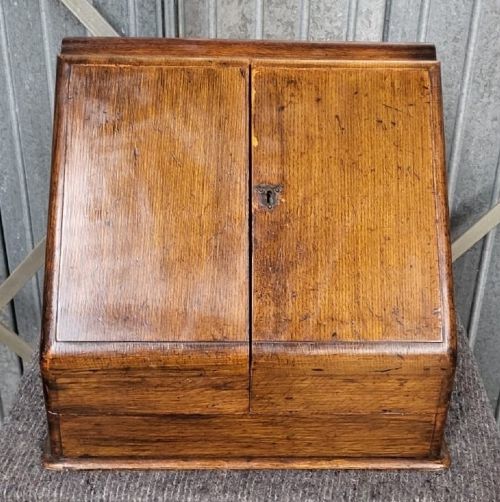
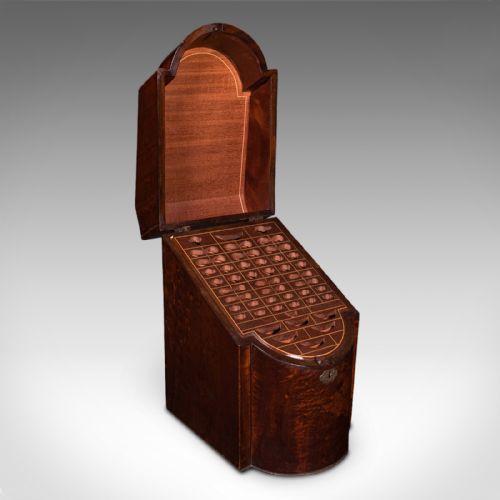
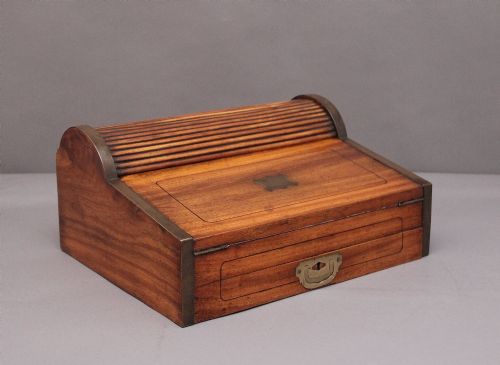


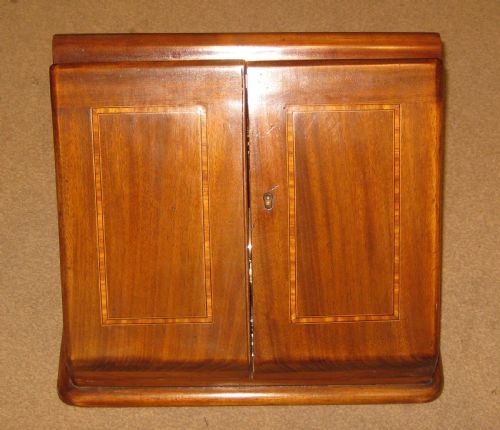


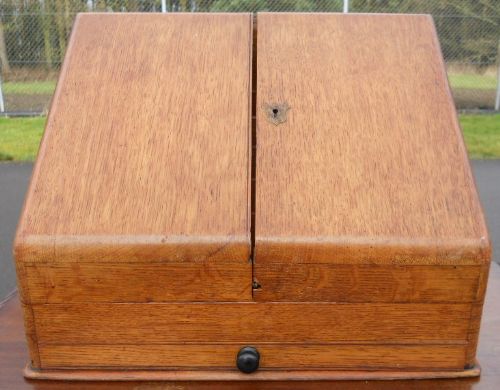

Slope Front Stationery Box
A slope front stationery box sits on a desk to hold letters and paper in neat order.
Slope Front Stationery Box
A slope front stationery box is a desk accessory designed to hold correspondence, paper, and envelopes within reach. The pieces found here span the eighteenth century, the Georgian period, the Victorian era, and the Edwardian years.
Most examples take the form of a cabinet or box with a fall front, drop front, or sloping lid. They often double as letter holders or desk tidies, serving the working desk in a study or library.
Mahogany, oak, and walnut form the core of the selection, accompanied by camphor wood, satinwood, and coromandel. Some pieces show the influence of the Victorian Gothic Revival style or carry brass fittings.
How They Were Made
Cabinet makers built these boxes using solid timbers such as mahogany, oak, and walnut, often selecting figured veneers and burr walnut for decorative effect. Wood inlay added linear detail and contrast to the surfaces.
Brass fittings, including hinges, carrying handles, and escutcheons, reinforced the construction and added weight to the design. Some pieces integrated hand-painted porcelain plaques or gilt decoration into the exterior timber.
Slope Front Stationery Box Retail Price Guide 2026
Typical asking prices for slope front stationery box among the pieces listed under this phrase on Sellingantiques today, from the lower quarter to the upper quarter. They describe what is for sale here now, not the wider market.
Listings feature mahogany, oak, walnut, camphor wood, and coromandel across Georgian and Victorian periods.
What Varies in Quality
The choice of timber dictates the character of the piece, ranging from plain oak to highly figured mahogany, burr walnut, and exotic coromandel. Superior examples display careful grain matching across the fall front and lid.
Internal fittings show the standard of manufacture, with fitted pigeonholes, letter dividers, and writing surfaces revealing the maker's hand. The precision of the joinery and the integration of brass hardware set the finer boxes apart.
The Slope Front Stationery Box Glossary
- Slope front
- A sloping lid that lifts or drops to reveal the interior compartment of a box or desk tidy. This form protects the contents and presents paper at an angle for easy selection.
- Fall front
- A hinged front panel that drops forward when opened to give access to stationery compartments and pigeonholes. It forms a vertical display when closed.
- Burr walnut
- Timber taken from the warted excrescence of a walnut tree, yielding a swirling and highly decorative grain pattern. It appears on finer Victorian boxes.
- Serpentine
- A curved shape that undulates outward at the centre and inward at the sides, seen on Georgian mahogany boxes. This contour requires skilled carpentry to execute cleanly.
- Pigeonhole
- A small open compartment inside a desk tidy or stationery cabinet used for sorting letters. Multiple pigeonholes keep correspondence organised by category.
Slope Front Stationery Box: Frequently Asked Questions
What is a slope front stationery box?
A slope front stationery box is a desk accessory designed to organise writing paper, envelopes, and letters. It sits upon a desk or table for everyday correspondence.
These pieces appeared in various timber forms across the Georgian and Victorian periods, reflecting the writing habits of their time.
How do I date a stationery box?
Dating relies on timber choice, construction methods, and decorative styles visible in the piece. Georgian examples often feature solid mahogany and serpentine fronts, while Victorian models introduce burr walnut and gilt decoration.
Hardware such as brass hinges and escutcheons also provides clues to the period of manufacture.
Where should I place a stationery box?
A stationery box fits naturally on a writing desk, bureau, or library table. It keeps paper and letters contained while adding period timber tone to the room.
Keep such wooden pieces away from direct sunlight and strong heat sources to protect the polish and veneer.
What is the difference between a writing slope and a stationery box?
A writing slope opens to provide an inclined writing surface with internal storage for ink and pens. A stationery box is built solely to store paper, envelopes, and letters in an upright or stacked position.
Some desk accessories combine aspects of both forms, depending on their period and intended use.