

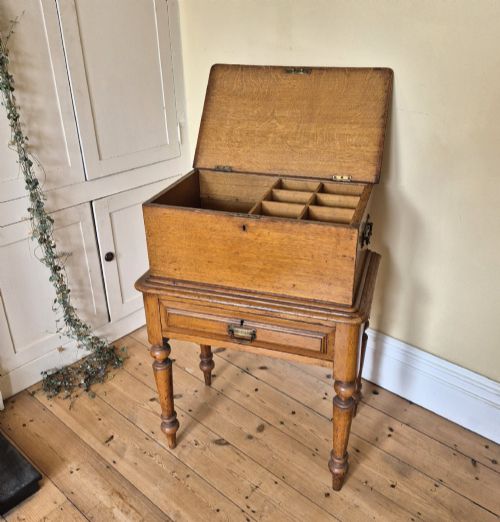


Victorian Oak Document Box
These victorian oak document box pieces are sturdy desktop containers built to hold letters and papers, offering a practical touch of nineteenth-century order.
Victorian Oak Document Box
A victorian oak document box brings together heavy timbers and brass hardware designed to withstand daily use on a nineteenth-century desk or table. Buyers seeking a victorian oak document box will encounter desk tidies, stationery cabinets, and wall organisers tailored for sorting correspondence.
The items found here span the nineteenth century, taking the form of presentation boxes, letter boxes, and desk top boxes. Certain examples serve specific functions, such as requisitions boxes or railway ticket dispensers, reflecting the bureaucratic demands of the period.
Materials and construction
These pieces rely primarily on oak, paired with brass and steel for hinges, mounts, and carrying handles. Timber surfaces often receive carving, while internal compartments organise paper, letters, and small office supplies.
Cabinetmakers constructed these boxes to endure constant handling, frequently incorporating brass binding to reinforce the corners and edges. Secret drawers and locking mechanisms appear in several variations, adding secure storage hidden within the wooden framework.
Victorian Oak Document Box Retail Price Guide 2026
Typical asking prices for victorian oak document box among the pieces listed under this phrase on Sellingantiques today, from the lower quarter to the upper quarter. They describe what is for sale here now, not the wider market.
Listings feature items from the nineteenth century, incorporating oak, brass, and steel across various forms like stationery boxes and desk tidies.
Judging the standard
Quality rests upon the crispness of the timber carving, the thickness of the oak boards, and the finish of the brass hardware. Superior examples display tighter joinery and more ambitious internal layouts, such as dedicated compartments for stationery and correspondence.
The presence of original fitted interiors and functional locking mechanisms elevates a piece above simpler utilitarian boxes. Finer items integrate specialised hardware like brass bindings or campaign mounts, showing a higher level of attention from the maker.
The Victorian Oak Document Box Glossary
- Desk tidy
- A desktop container featuring partitioned sections for organising letters, pens, and small office accessories. These items kept writing materials orderly in nineteenth-century studies.
- Presentation box
- A commemorative container often presented to mark a specific military or civic event. They frequently feature inscriptions or specialised plaques detailing the occasion.
- Campaign mount
- Brass corner brackets and flush-fitting handles designed to protect furniture during military travel. This hardware originates from the practical demands of officers on the move.
- Stationery cabinet
- An upright wooden box with doors or drop fronts revealing internal pigeonholes for paper and envelopes. They represent a more elaborate evolution of the basic desk box.
Victorian Oak Document Box: Frequently Asked Questions
What is a victorian oak document box?
A victorian oak document box is a sturdy nineteenth-century wooden container built to hold letters, papers, and writing materials.
These pieces range from simple desktop boxes to elaborate stationery cabinets and wall organisers fitted with internal compartments.
How were these boxes used?
They served to keep correspondence, receipts, and important papers organised in offices, homes, and military quarters.
Many included specialised fittings such as letter slots, secret drawers, or partitions for sorting incoming and outgoing post.
Where do these pieces originate?
The items originate primarily from nineteenth-century British workshops, offices, and military contexts.
Some bear specific institutional connections, such as railway companies or military regiments, reflecting their official administrative use.
How do I care for antique oak?
Keep the wood away from direct heat sources and sudden humidity changes to prevent the oak from splitting.
Apply a traditional wax polish occasionally to nourish the timber and maintain the natural lustre of the surface.