
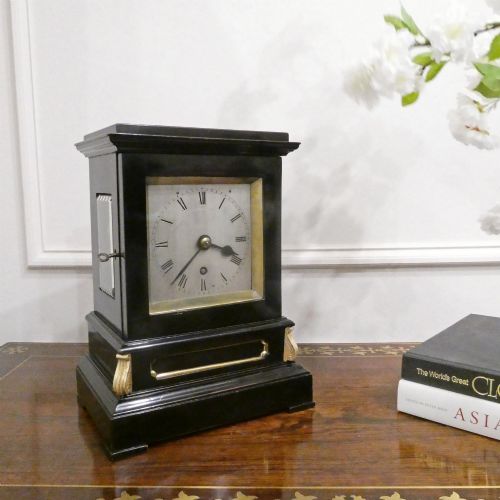


Single Fusee Table Clock
A single fusee table clock brings mechanical precision and striking cabinetwork into a room, offering both reliable timekeeping and period design.
Single Fusee Table Clock
A single fusee table clock is a timepiece driven by a spring and a cone-shaped pulley that ensures even power delivery to the movement as the spring unwinds. The examples on this page primarily take the form of mantel clocks and library clocks housed in compact wooden or metal cases.
You will encounter pieces spanning the Georgian, Regency, Victorian, and Edwardian periods. Common case designs range from simple pad tops and lancet arches to elaborate architectural porticos and four-glass brass frames.
How they were made
Clockmakers housed these movements in cases fashioned from mahogany, ebonised wood, oak, coromandel, and satinwood, frequently embellished with brass inlay, gilt bronze, or ormolu mounts. Dials are often silvered or enamelled, protected behind bevelled glass panes.
The mechanics rely on a brass movement connected via a chain or cord to the fusee cone, regulating the pull of the mainspring to maintain consistent accuracy across the running duration.
Several makers concealed their winding holes with such neatness that visitors might mistake the ticking piece for a static bronze sculpture.
What varies in quality
Quality rests in the harmony between the precision of the brass movement and the refinement of the cabinetwork. Finer examples display crisp casting on ormolu mounts, intricate wood inlays, and signed dials from notable makers.
Simpler workshop pieces focus strictly on utilitarian function within modest wooden cases, whereas top-tier pieces integrate specialised complications such as year-going movements or exotic materials like green marble and alabaster.
W. Burton·Phillips Brothers·Wilkinson Leicester·Barrett London·J Kingerley Manchester·Thomas Cole and James Cole·Hunt And Roskell·William Hardy London·Hay London·Barraud and Lund·Henry Berkeley Square London·John Massey·Baetens London·Fatton Eleve De Breguet London·Bently & Beck London·Payne & Co London
The Single Fusee Table Clock Glossary
- Fusee
- A conical pulley used in clock movements to equalize the decreasing power of the mainspring as it runs down. This mechanism ensures consistent torque and therefore better timekeeping accuracy.
- Ormolu
- Gilded bronze, widely utilised for decorative mounts and figures on Regency and Victorian clock cases. The technique involves applying a mercury and gold amalgam to a bronze base.
- Silvered dial
- A brass clock face treated with a silver solution to create a matte white finish with engraved numerals. This treatment provides high contrast for reading the time.
- Portico clock
- A mantel clock designed with architectural columns supporting the movement housing, often executed in alabaster or marble. The style reflects classical revival influences.
- Library clock
- A portable timepiece designed for desk or table use in a study, frequently featuring a glass case or a robust wooden housing for easy relocation.
Single Fusee Table Clock: Frequently Asked Questions
What is a single fusee movement?
A single fusee movement uses a conical pulley and a chain or cord to regulate the power delivered from the mainspring to the gear train. This design compensates for the weakening tension of the spring as it unwinds.
The result is a more consistent force applied to the escapement, which helps the clock maintain steady accuracy throughout its running cycle.
How do I wind a fusee clock?
Winding requires a dedicated key inserted into the dial or movement plate to tension the mainspring via the fusee cone. Care must be taken not to overwind the mechanism.
Most single fusee clocks require winding at regular intervals, typically weekly, depending on the specific duration engineered into the movement by the maker.
How do I identify the period?
Period identification relies on a combination of case style, wood selection, and dial characteristics. Georgian and Regency pieces often feature clean architectural lines or classical bronze mounts, while Victorian and Edwardian examples embrace diverse revivals.
Signatures or inscriptions on the dial or movement backplate also provide definitive clues to the date of manufacture and the maker.