
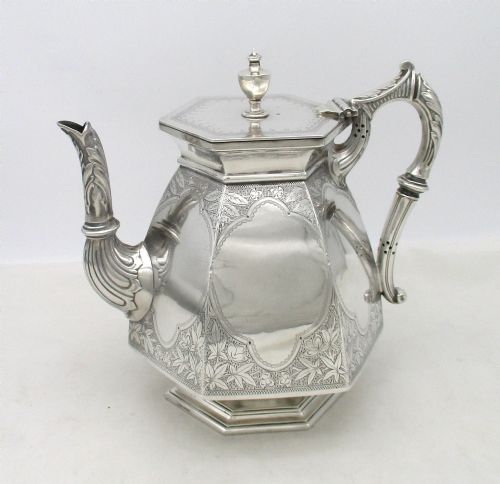

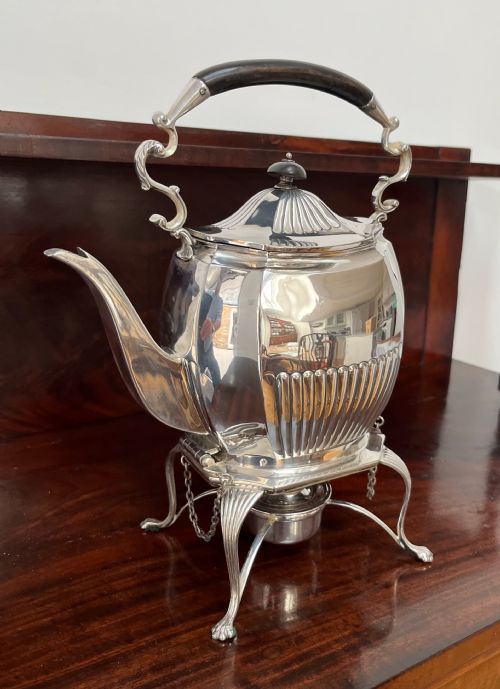


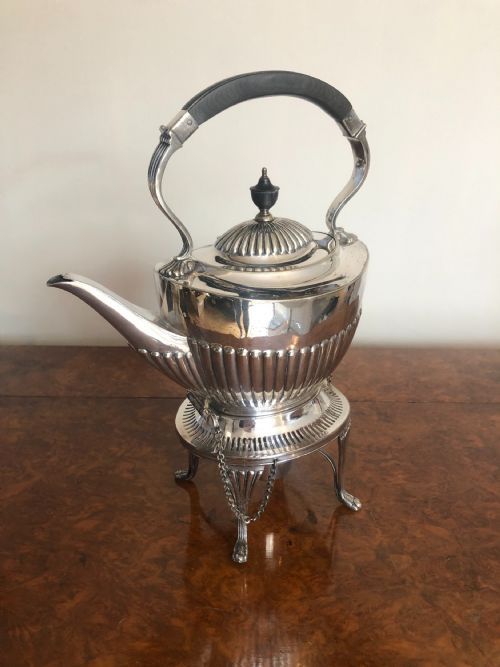

Silver Plate Kettle
A silver plate kettle brings warmth and theatre to the tea table, holding water above a flickering spirit burner.
Silver Plate Kettle
When searching for a silver plate kettle, a buyer encounters vessels designed for pouring hot water, often accompanied by matching stands and spirit burners. These pieces span periods from the Georgian and Regency eras through the Victorian, Edwardian, and Art Deco years.
The most common examples on this page are Edwardian and late Victorian spirit kettles mounted on metal stands, frequently joined by tea urns, samovars, and standard tea pots. Makers adopted varied historical revivals, producing Georgian-style items alongside Aesthetic Movement and Art Nouveau designs.
Forms range from compact domestic vessels to large exhibition pieces, occasionally including novelty shapes or fish kettles. Each configuration reflects the social rituals of tea preparation across the nineteenth and early twentieth centuries.
Materials and methods of manufacture
Silversmiths utilised base metals such as nickel silver and copper as foundations, applying layers of silver through electroplating or the earlier Old Sheffield plate technique where silver was fused to a copper core. These methods created durable surfaces that imitated solid silver while offering structural rigidity.
Handles and finials incorporated secondary materials including ebony, ebonised wood, plain wood, and bone to insulate against heat during use. Stands and burners integrated matching metalwork, often supported by hinged frames and tiny spirit lamps designed to maintain water temperature.
Makers occasionally fashioned novelty silver plate kettles shaped like curling stones, bringing winter sports indoors.
Factors that distinguish quality
Excellence in a silver plate kettle rests upon the crispness of chased or engraved ornament, the structural integrity of the stand and burner mechanism, and the thickness of the original plating over the base metal. Heavier vessels with well-balanced handles and intact heat-insulating insulators demonstrate superior workshop execution.
Makers known for exceptional metalwork, such as Elkington, Walker & Hall, or Mappin & Webb, often applied meticulous attention to hinges, thumbpieces, and internal seals, elevating utilitarian tea equipment into pieces of fine domestic metalwork.
Walker & Hall·Fenton Brothers·Frederik Ellis Tim & Co·Elkington & Company·Martin Hall & Co·Mappin & Webb·Deakin & Sons·William Padley·WMF
The Silver Plate Kettle Glossary
- Spirit kettle
- A water vessel suspended above a small spirit burner on a metal stand. This setup allowed water to remain hot throughout a drawing room tea service.
- Old Sheffield plate
- An early method of fusing a thin sheet of silver to a thicker copper ingot before rolling and shaping. This technique preceded modern electroplating.
- Electroplated Nickel Silver
- A durable alloy of copper, nickel, and zinc coated with an electrolytic layer of silver. It became the standard manufacturing base from the mid-nineteenth century onward.
- Samovar
- A large heated urn traditionally used to boil water for tea. These containers feature a central internal heating tube or a tap at the base for dispensing.
- Aesthetic Movement
- A late nineteenth-century design style emphasising visual beauty over narrative function. Pieces from this movement often display stylised natural motifs.
Silver Plate Kettle: Frequently Asked Questions
What is a spirit kettle used for?
A spirit kettle provides a continuous supply of hot water during formal tea service by utilising a small under-mounted burner filled with methylated spirit.
The flame keeps the water at a steady temperature without requiring a return trip to the kitchen.
How do I clean a silver plate kettle?
Maintenance requires mild soapy water and a soft cloth to remove dust and oils from the plated surface.
Harsh abrasive pastes strip the thin silver layer, so specialist silver dips should be used sparingly and only when necessary.
What is Old Sheffield plate?
Old Sheffield plate is an early nineteenth-century material made by fusing silver sheets onto a copper core under heat and pressure.
Examining the edges often reveals a thin line of copper where the metals meet during fabrication.
Can I boil water directly in these kettles?
Most antique spirit kettles are intended to hold pre-heated water rather than withstand direct hob heat.
The small spirit burners beneath the stands are designed to maintain warmth rather than bring cold water to a boil.