
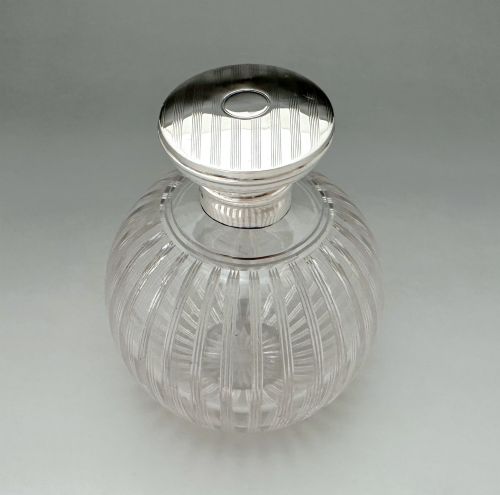
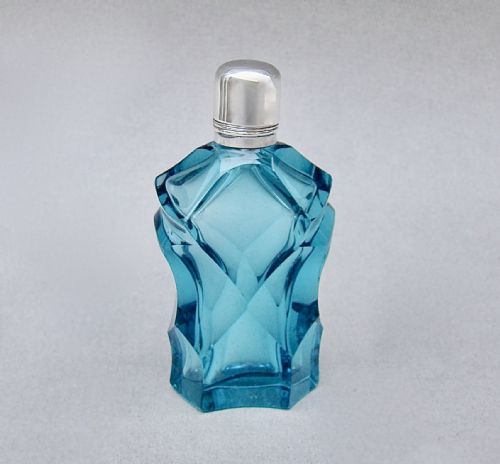
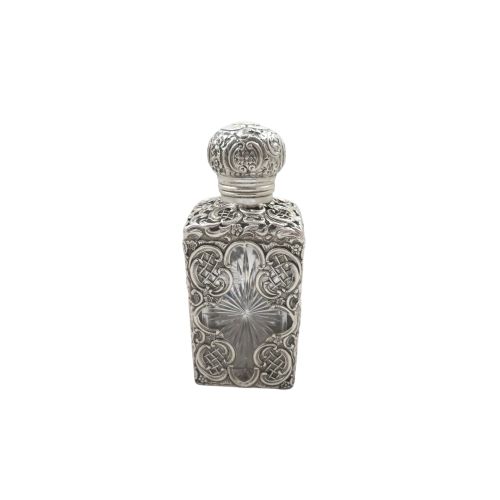


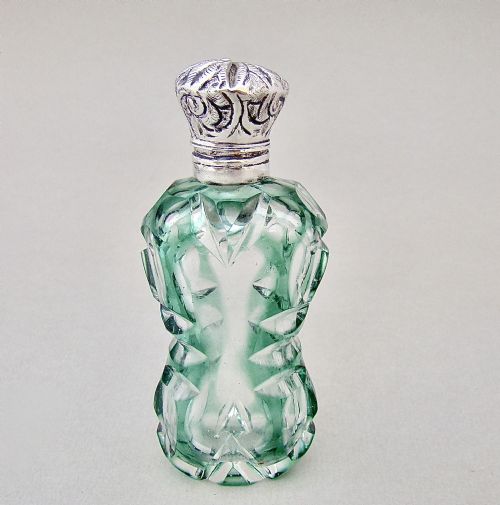


Silver Cap Perfume Bottle
These silver cap perfume bottle examples combine heavy cut or coloured glass reservoirs with solid sterling mounts, offering a tactile pocket of Victorian and Edwardian dressing table elegance.
What These Pieces Are
A silver cap perfume bottle pairs a glass vessel with a matching metal lid designed to secure volatile scents on the dressing table. When you search for a silver cap perfume bottle, you encounter domestic accessories spanning the Victorian era and the reign of George V.
The surviving examples range from compact miniature scent bottles to larger square and triangular desk pieces. Most pieces you meet on this page utilise deep green or ruby glass cut with crisp facets beneath unmarked or hallmarked silver mountings.
Makers from the nineteenth and early twentieth centuries produced both single-ended reservoirs and double-end variants intended for two distinct fragrances. The predominant forms reflect utilitarian luxury from eighteen-fifty to nineteen-ten.
How They Were Made
Craftsmen formed the glass bodies through mould-blowing or free-blowing before cutting deep geometric facets across the surface. Overlay techniques involved casing clear or coloured glass in a contrasting outer layer that artisans then cut through to reveal the shade beneath.
The sterling silver caps and collars were shaped to fit snugly over glass necks, often secured with internal cork stoppers to prevent evaporation. Engraving and repoussé decoration adorned many outer metal covers, executed by hand before final assembly.
Double-end bottles solved the eternal Victorian dilemma of whether to smell like roses or lavender on a Tuesday afternoon.
What Varies in Quality
Quality rests upon the crispness of the glass faceting and the depth of the colour within the body. Fine examples display sharp, clean lines where wheel-cut edges catch the light, whereas lesser pieces show softer, rounded contours.
The thickness and gauge of the sterling silver cap determine the durability and weight of the mount. Thicker metal resists denting and maintains a tight closure, whilst thin foil-like caps bend easily under normal handling.
The Silver Cap Perfume Bottle Glossary
- Overlay glass
- A glass vessel formed of two or more distinct layers of different colours, where the outer layer is partially cut away to expose the base metal. This technique creates high-contrast visual patterns across the body.
- Sterling silver
- An alloy consisting of ninety-two point five percent silver by mass, with the remainder composed of copper or other metals. It provides the standard durable material for bottle caps and collars.
- Double end
- A scent bottle design featuring compartments at both extremities, allowing the owner to carry two separate fragrances simultaneously. Each end possesses its own independent cap.
- Faceting
- The process of grinding and polishing flat geometric planes into the exterior of a glass vessel. It enhances light refraction through coloured glass.
Frequently Asked Questions
How do I clean the inside?
Residue inside vintage scent reservoirs requires gentle treatment to protect the antique glass and internal fittings.
Warm water mixed with mild dish soap and a bottle brush usually removes old perfume oils without damaging the material.
Were these made for travel?
Many smaller nineteenth-century specimens slipped easily into reticules or tailored travel cases for daily use.
Larger square shapes remained stationary on dressing tables rather than accompanying owners on journeys.
How do I date the silver?
Hallmarks stamped onto the metal mountings provide official assay office symbols and date letters for British items.
Unmarked collars rely upon stylistic clues from the glass cutting and overall silhouette to establish the period.
Why use coloured glass?
Coloured glass shielded delicate aromatic oils from direct sunlight that could degrade volatile organic compounds.
Ruby and green hues additionally provided a decorative contrast against polished silver caps.