
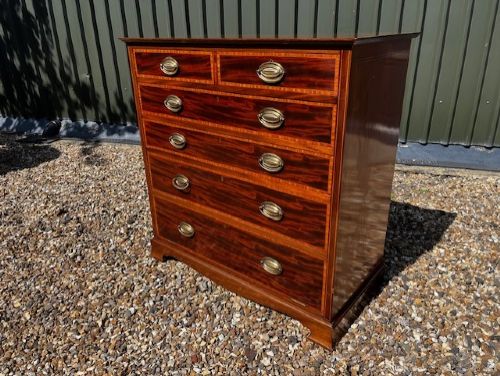


Sheraton Revival Chest
A sheraton revival chest brings refined neoclassical lines and delicate marquetry into the home, offering both practical storage and exceptional decorative polish.
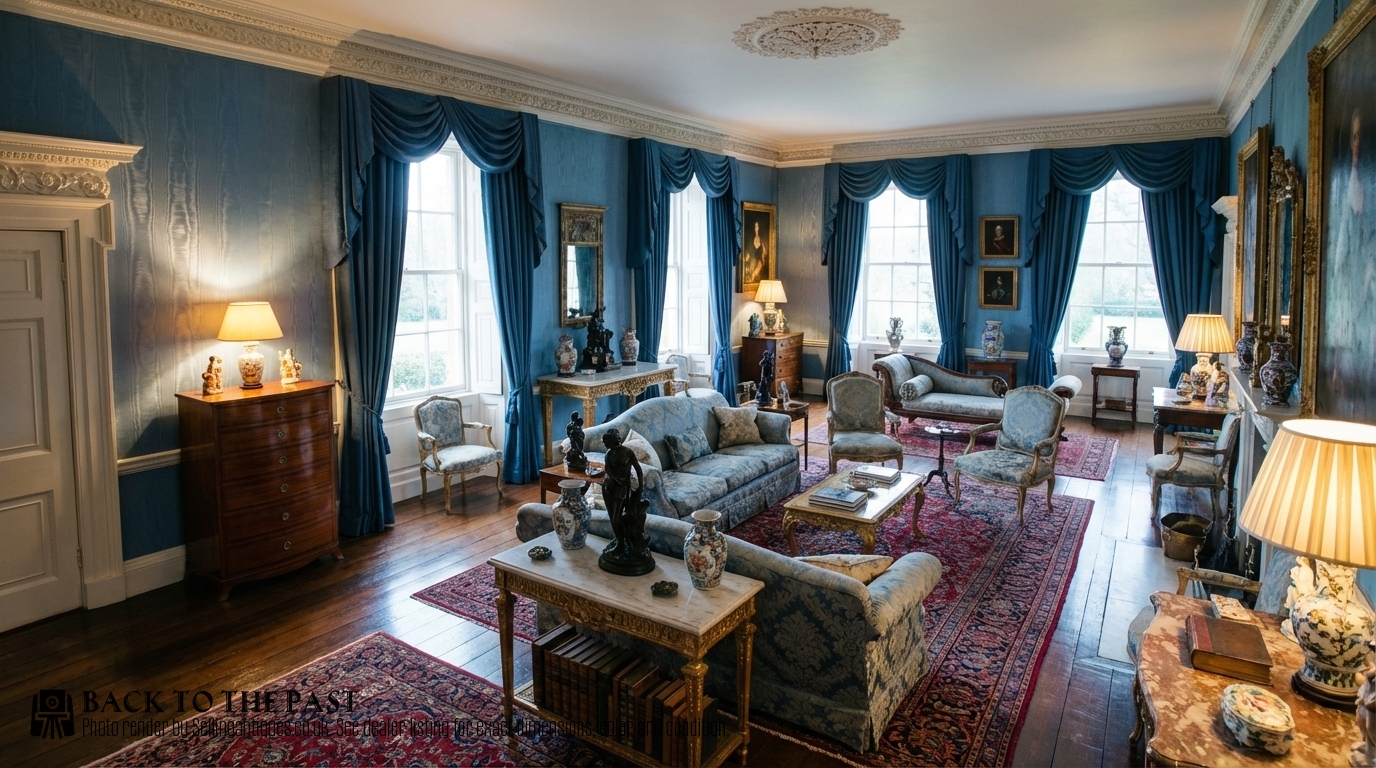
Sheraton Revival Chest
When you search for a sheraton revival chest, you are looking at sophisticated case furniture that echoes the light, elegant proportions of late eighteenth-century cabinet making. These pieces date predominantly from the Edwardian era and the late nineteenth century, though similar examples appear across several decades either side of nineteen hundred.
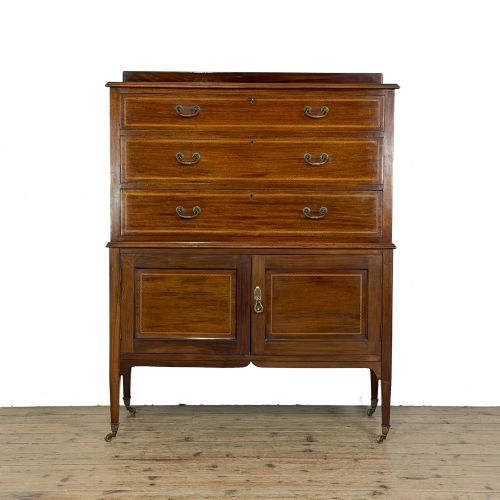
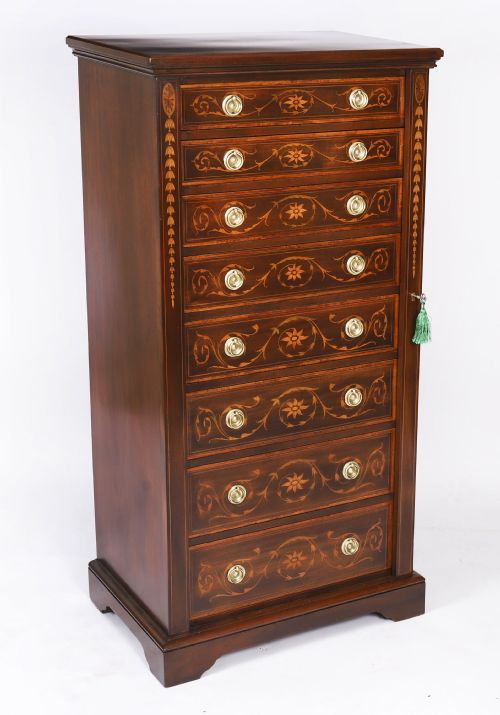
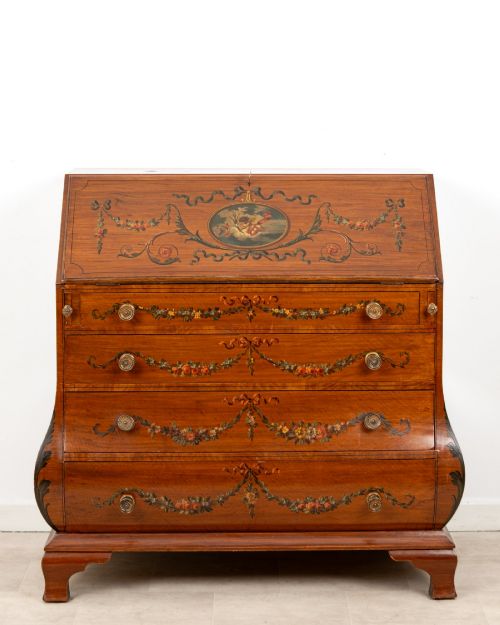
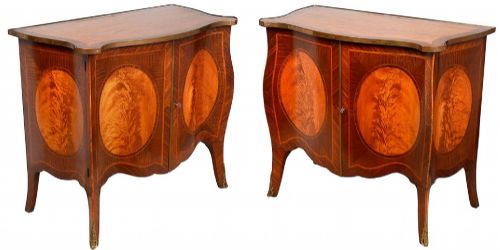
The versions you are most likely to meet on this page take the form of mahogany or satinwood chests of drawers, dressing tables, and bureaux. Many feature serpentine or bow fronts, often enhanced by delicate boxwood inlay, marquetry, and hand-painted details.
Makers of the period adapted classic Georgian designs to suit modern domestic needs, resulting in tall chests, bedside tables, and Wellington chests that combine period grace with practical proportions.
How they were made
Cabinet makers constructed these pieces using solid timbers such as mahogany and rosewood, frequently employing rich satinwood veneers for primary surfaces. The timber was selected for grain and colour before being shaped into straight, bow, or serpentine forms.
Decoration relied heavily on contrasting stringing, boxwood inlay, and intricate marquetry motifs, alongside hand-painted floral panels. Brass drop handles, key escutcheons, and occasional mirror glass completed the construction.
Music cabinets make an unexpected appearance among the chests, proving that Victorians wanted their sheet music stored with neoclassical elegance.
What varies in quality
Quality in a sheraton revival chest rests largely on the ambition of the timber work and the precision of the inlay. Pieces featuring finely figured satinwood veneers and crisp, tightly fitted boxwood stringing stand well apart from plainer examples.
The artistic execution of any hand-painted details and the crispness of the marquetry define the upper tier of the range. Furthermore, substantial pieces by documented makers command greater interest due to superior cabinet making and heavier brass hardware.
J Shoolbred·Edwards and Roberts·Gillows
The Sheraton Revival Chest Glossary
- Sheraton Revival
- A design movement spanning the late nineteenth and early twentieth centuries that reinterpreted the refined neoclassical furniture of Thomas Sheraton. It relies on light proportions, straight tapered legs, and delicate contrasting veneers.
- Satinwood
- A lustrous, hard timber native to Ceylon and India, prized for its golden yellow colour and reflective sheen. It was frequently used as a primary veneer on high-status Edwardian and late Victorian pieces.
- Marquetry
- The art of applying small pieces of veneer to a structure to form decorative patterns and pictorial designs. Cabinet makers used various tinted woods to achieve shaded floral or classical motifs.
- Serpentine
- A furniture front curved in a wave-like shape, with a convex centre flanked by concave ends. This contour requires immense skill from the woodworker to shape accurately.
- Stringing
- Thin strips of contrasting wood inlaid into grooves on drawer fronts or table edges. It outlines panels and emphasises the geometric lines of the piece.
Sheraton Revival Chest: Frequently Asked Questions
What periods do these chests come from?
The pieces listed here date predominantly from the Edwardian era and the late nineteenth century, with some examples reaching into the early twentieth century.
Craftsmen during this period drew heavy inspiration from eighteenth-century neoclassical designs, reinterpreting them with the manufacturing techniques of their own day.
How do I distinguish satinwood from mahogany?
Satinwood presents a distinct golden yellow colour with a natural sheen that catches the light differently depending on the viewing angle. Mahogany offers a deeper reddish-brown tone with a pronounced grain pattern.
Many pieces combine both timbers, using mahogany for structural framing and satinwood for decorative drawer fronts and top surfaces.
Were these chests used just for bedrooms?
While many served as bedroom furniture or dressing tables, smaller chests and cabinets found places in reception rooms and hallways as decorative storage. Bureau chests additionally provided a compact surface for writing and correspondence.
Their refined appearance allowed them to sit comfortably in principal living spaces rather than remaining hidden away upstairs.
What is a serpentine front?
A serpentine front curves outward in the middle and inward toward the edges, creating a gentle undulating shape across the drawer fronts. This profile demands exceptional joinery to ensure the drawers open smoothly despite the complex angles.
It marks out pieces intended to show greater elegance and ambition in their design.