

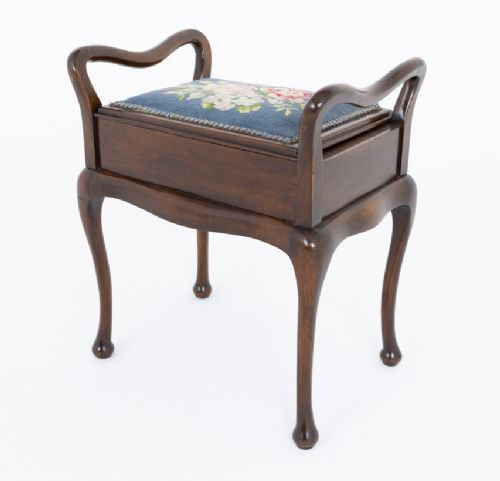


Sheet Music Stool
These sheet music stool designs give you period seating purpose-built for the piano, combining practical storage with classic cabinet timber.
Sheet Music Stool
A sheet music stool is a specialised seat designed to accommodate a keyboard player while housing scores and folios beneath the cushion. These pieces range from compact single seats to wider duet formats meant for two players sharing a bench.
You will most commonly meet Edwardian mahogany examples on this page, often featuring inlaid boxwood details and lift-up lids. Victorian walnut pieces also appear frequently, including fall-front variants and Canterbury formats fitted with vertical partitions for organising paper.
Earlier interpretations extend back to the Georgian era in the manner of Chippendale, alongside later oak versions from the early twentieth century. Most are catalogued simply as piano stools or music stools within the broader category of seating.
How they were made
Cabinet makers constructed these stools primarily from solid timber and veneers, using mahogany, walnut and oak as the principal structural woods. Boxwood inlay frequently provides linear decoration on Edwardian Sheraton Revival frames.
Functional hardware such as brass hinges and latches supports the mechanical action of lift-up seats and fall-front compartments. Upholstered tops utilise traditional fabric and velvet coverings over the padded seat frames.
Sheet Music Stool Retail Price Guide 2026
Typical asking prices for sheet music stool among the pieces listed under this phrase on Sellingantiques today, from the lower quarter to the upper quarter. They describe what is for sale here now, not the wider market.
What varies in quality
The refinement of the timber and the crispness of any inlay set the finer examples apart from simpler utility pieces. Selecting denser mahogany or figured walnut with precise boxwood stringing indicates a higher standard of cabinet work.
Complexity of form also dictates distinction, moving from basic box seats to sophisticated fall-front mechanisms and partitioned Canterbury designs. The integration of functional storage with decorative Revival styling marks the more ambitious workshops.
The Sheet Music Stool Glossary
- Canterbury stool
- A low music seat incorporating vertical wooden partitions beneath or beside the cushion for holding folios and scores.
- Duet stool
- An extended bench designed to seat two musicians side by side during piano practice or performance.
- Fall-front stool
- A cabinet-style seat featuring a hinged drop-down front panel that conceals interior shelving or storage compartments for music.
- Sheraton Revival
- A late nineteenth and early twentieth century design style drawing on neoclassical motifs, light woods and symmetrical inlay.
- Boxwood inlay
- Contrasting pale wood inserted flush into the darker mahogany surface to create decorative geometric borders.
Sheet Music Stool: Frequently Asked Questions
What is a piano stool?
A piano stool is a designated seat built to support a keyboard player at the correct height.
Many examples include internal compartments designed specifically to hold sheet music and folios.
How do duet stools differ?
Duet stools provide a wider bench surface intended to accommodate two players at the same time.
They share the same internal storage purpose as single variants but span a broader footprint.
What is a Canterbury stool?
A Canterbury stool incorporates integrated vertical divisions into its design for organising paper.
This format allows sheet music to stand upright rather than stacking flat inside the cabinet.
How were fall front stools used?
Fall-front stools allow access to interior storage via a hinged panel that drops forward.
This mechanism conceals the music compartments while maintaining a clean exterior cabinet profile.