

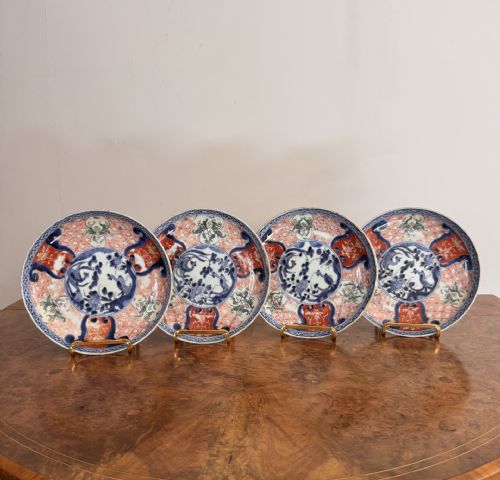
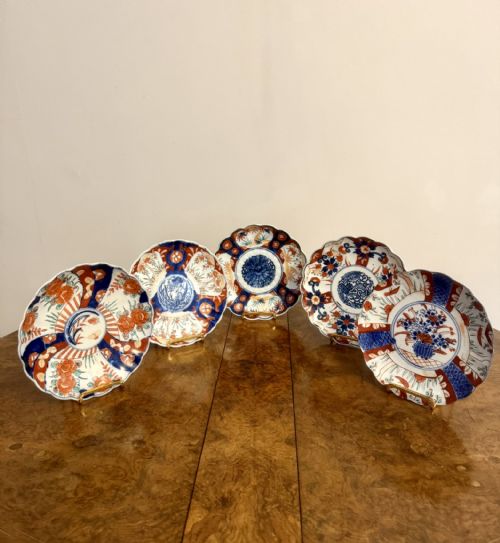


Set of Imari Dishes
These set of imari dishes bring a striking palette of iron red, cobalt blue and gold leaf to any table, spanning Japanese, Chinese and British workshops.

Set of Imari Dishes
When you search for a set of imari dishes, you are looking at groupings of decorative plates, serving dishes and dessert shapes created across several centuries. The Japanese examples dominate the selection, particularly those from the Meiji period and around 1900, alongside Chinese export wares from the Qianlong dynasty and British interpretations in ironstone from the Georgian era.
The configurations vary from small groups of four or five items to larger collections of six, eight or fourteen matching pieces. You will find shaped dishes alongside round plates and dessert services, reflecting both traditional Far Eastern aesthetics and nineteenth-century European dining habits.
How they were made
The manufacture relies primarily on porcelain and ironstone, shaped into plates, dishes and basin sets before receiving their initial firing. Earthenware also appears among the British dessert services from the early nineteenth century.
Artisans applied underglaze cobalt blue and overglaze iron-red enamel, frequently finishing the decoration with generous applications of gold leaf and gilt highlights to create the characteristic rich surface pattern.
Set of Imari Dishes Retail Price Guide 2026
Typical asking prices for set of imari dishes among the pieces listed under this phrase on Sellingantiques today, from the lower quarter to the upper quarter. They describe what is for sale here now, not the wider market.
Some plates feature historical trading vessels painted directly onto the porcelain, immortalising ancient merchant ships in vibrant enamel.
What varies in quality
Quality rests upon the crispness of the hand-painted brushwork and the precision of the enamel application within the design. Pieces that retain vibrant cobalt blue and untarnished gold leaf stand apart from those with softened or rubbed decoration.
The uniformity of matching sets and the inclusion of specific thematic details, such as black ship decoration, influence the character of the collection. Finer examples display meticulous attention to detail in the border patterns and central motifs.
Mason's
The Set of Imari Dishes Glossary
- Imari
- A style of ceramic decoration originating in Japan, defined by a distinct palette of cobalt blue, iron red and gilt. It heavily influenced both Chinese export porcelain and British ironstone manufacturers.
- Ironstone
- A durable type of earthenware patented in the nineteenth century by English makers such as Mason's. It provided a robust alternative to porcelain for heavy-use items like dessert services and wash sets.
- Qianlong Dynasty
- A period of Chinese imperial rule during the eighteenth century noted for the production of export wares made for Western markets. These pieces often adopted the Japanese imari colour scheme.
- Meiji Period
- An era in Japanese history spanning the late nineteenth and early twentieth centuries associated with the export of decorative plates and dishes to Europe. Works from this time frequently feature intricate enamel and gold leaf work.
Set of Imari Dishes: Frequently Asked Questions
What is an imari dish?
An imari dish is a ceramic piece decorated in the traditional Japanese style using underglaze blue, iron red and gold leaf. The style was widely adopted by Chinese export kilns and later imitated by British potteries.
The resulting wares are easily recognised by their dense, colourful geometric and floral patterns, designed primarily for display or formal dining.
How do I date imari dishes?
Dating relies on examining the base material, the weight of the ceramic and the style of the enamel painting. Japanese examples often date from the Meiji period or around 1900, while Chinese export pieces trace back to the eighteenth-century Qianlong dynasty.
British ironstone versions usually point to the Georgian or Victorian eras, frequently accompanied by maker marks stamped into the paste.
Were these dishes used for food?
Many items in a set of imari dishes served practical purposes during nineteenth-century dining, including dessert services and serving dishes. Others were purely decorative plates meant for display on walls or in cabinets.
When living with these pieces today, gentle hand washing preserves the delicate overglaze enamels and gold leaf highlights.
What are black ship imari plates?
Black ship imari plates feature pictorial references to the Western trading vessels that arrived in Japanese ports during the nineteenth century. This specific imagery marks a distinct departure from traditional floral and landscape motifs.
Collectors prize these historical depictions for the specific maritime trade history they record on porcelain.