
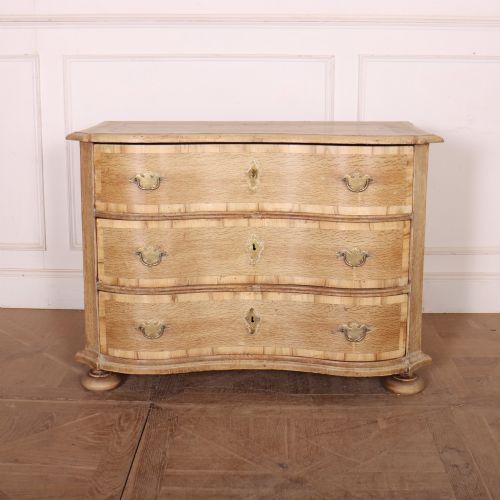
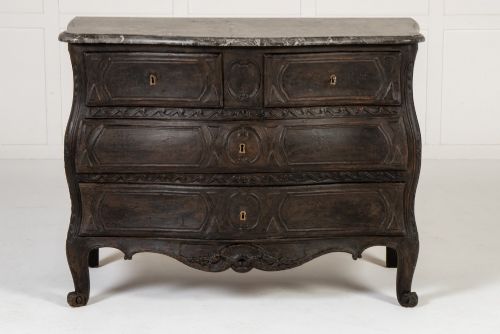
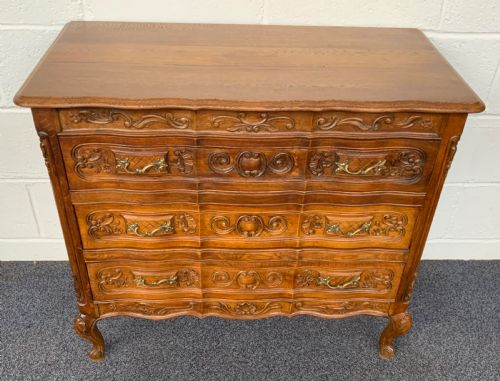


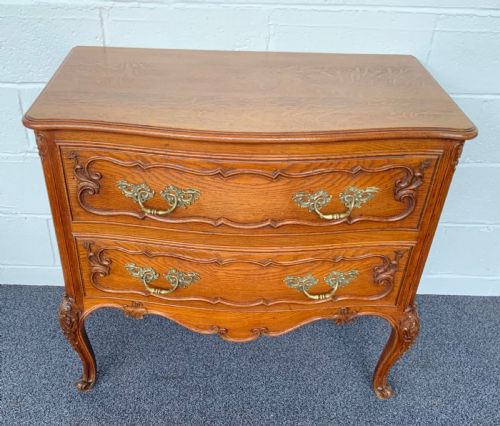


Serpentine Oak Commode
These serpentine oak commode pieces combine flowing curved fronts with sturdy timbers, offering robust storage paired with sophisticated continental styling.
Serpentine Oak Commode
A serpentine oak commode presents a distinct undulating front profile that softens the rigid lines typically found in standard chests of drawers. These pieces appear in forms ranging from eighteenth-century continental designs to later provincial interpretations.
Most examples encountered here are French or Dutch in origin, frequently featuring the characteristic curved drawer configuration. Makers utilised both solid timbers and veneers to achieve the sweeping lines demanded by rococo and baroque tastes.
The category spans centuries of cabinetmaking, showing variations from crisp eighteenth-century carvings down to twentieth-century reproductions. Buyers select them to anchor a room with functional surface space and significant historical presence.
How they were made
Cabinetmakers constructed these chests around robust timber carcases, employing oak as the primary structural and visible medium. Walnut, fruitwood, and marquetry inlay frequently complement the main oak body to create contrasting panels and decorative surfaces.
Craftsmen shaped the characteristic curved fronts by sawing solid timber or laminating and bending veneers over shaped frames. Brass hardware, including handles and escutcheons, was fitted to secure the drawers and accent the sweeping wooden contours.
Listings include pieces spanning from the mid eighteenth century through the nineteenth century, alongside twentieth-century interpretations.
What varies in quality
Quality rests in the fluidity of the carved serpentine line and the integrity of the timber joints. Superior pieces exhibit seamless transitions along the curved drawer fronts and precise alignment within the carcase.
The treatment of the wood also dictates the grade of the piece, distinguishing between straightforward structural timber and intricate marquetry work. Finer examples maintain crisp carving details and retain appropriate period brasses that harmonize with the scale of the chest.
The Serpentine Oak Commode Glossary
- Serpentine
- A front profile characterised by a sweeping convex centre flanked by concave curves, or vice versa. This shaping creates a sense of movement across the piece.
- Commode
- A low chest of drawers, generally of French origin, standing on legs or a shaped plinth base. The term covers various styles from formal court furniture to provincial rustic chests.
- Bombe
- A swollen, bulging chest profile where the sides and front curve outward. It requires advanced cabinetmaking skill to achieve the dramatic swelling form.
- Marquetry
- The art of applying decorative pieces of veneer to a structure to form intricate patterns or pictures. Craftsmen use various coloured woods to achieve tonal contrast.
- Bleached oak
- Timber treated with chemical solutions to lighten its natural dark tone. This finish creates a paler, scrubbed appearance favoured in decorative interiors.
Serpentine Oak Commode: Frequently Asked Questions
What is a serpentine commode?
A serpentine commode is a low chest of drawers featuring an undulating front edge that curves outward and inward. These pieces provide generous storage while presenting a decorative profile derived from eighteenth-century continental cabinetmaking.
They function well as statement pieces in living areas or bedrooms, offering a broad top surface for display alongside deep storage drawers.
How do I date a commode?
Dating relies on examining construction methods, timber choice, and the profile of the mouldings and feet. Eighteenth-century pieces often show hand-cut joints and distinct tool marks inside the drawer linings.
Later nineteenth-century and twentieth-century versions adopt similar stylistic cues but utilise different assembly techniques and standardised hardware fittings.
Where were these chests made?
The pieces originate primarily from continental workshops in France, the Netherlands, and Austria. Provincial makers in these regions adapted court styles into sturdy regional interpretations.
French and Dutch examples dominate the available designs, showing local preferences for oak, walnut, and elaborate bombe shaping.
How do I care for oak furniture?
Oak furniture benefits from consistent indoor humidity levels and protection from direct sunlight to prevent timber movement. Regular dusting with a dry cloth keeps the surface clean without stripping the finish.
Applying occasional natural wax helps nourish untreated or bleached oak surfaces and maintains the soft sheen of the timber.