
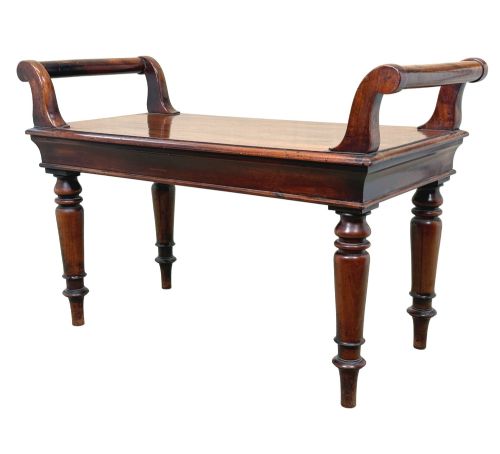


Scroll Arm Window Seat
Scroll arm window seat pieces are classic timber benches designed for placement beneath glazing, combining supportive curved ends with upholstered seating.

Scroll Arm Window Seat
A scroll arm window seat provides a low, narrow bench form engineered specifically to sit below a casement or bay without blocking the light. The pieces span from the mid-nineteenth century through the Edwardian period, encompassing walnut and mahogany frames.
Most examples combine timber structures with upholstered pads, sometimes incorporating duet proportions or X-frame geometry. You will encounter styles ranging from Regency and Victorian to French Neoclassical.
Forms often double as centre stools or dressing furniture while retaining the signature scrolled wooden supports at each end. The selection relies heavily on nineteenth-century craftsmanship and later revival interpretations.
Materials and construction
Carpenters built these frames using dense hardwoods like mahogany, walnut, and occasional satinwood, shaping the timber to form the characteristic scroll arms. Oak appears in specific structural variants alongside gilded or painted finishes.
Upholstery relies on traditional textiles including damask, velvet, and patterned fabrics fixed over padded seat bases. Brass components and carved wooden details finish the structural assembly.
Some Edwardian makers built these seats wide enough for two people to quarrel over the morning post.
Judging quality in construction and material
Quality rests in the crispness of the timber carving on the scroll arms and the integrity of the underlying hardwood frame. Finely figured mahogany or walnut distinguishes the superior examples from plain utility pieces.
The precision of joinery at the joints and the harmony of the proportions dictate the overall standard. Original upholstery materials or sympathetic re-upholstery maintain the integrity of the design.
The Scroll Arm Window Seat Glossary
- Scroll arm
- A structural wooden terminal shaped into a spiral or curved scroll at the end of a seat. This feature provides a handhold and frames the upholstered cushion.
- Damask
- A reversible figured fabric traditionally woven on a jacquard loom. It frequently appears on period upholstery.
- X-frame
- A structural base formed by intersecting diagonal timbers creating an X shape. This configuration supports stools and benches.
- Regency
- An English design style dating from the early nineteenth century defined by classical restraint and neoclassical motifs. Pieces from this period often display clean mahogany lines.
Scroll Arm Window Seat: Frequently Asked Questions
Where should a scroll arm window seat go?
These benches fit naturally beneath low windows, in hallways, or at the foot of a bed. Their narrow profile ensures they occupy minimal floor space while offering a resting place.
They also function effectively as centre stools or dressing furniture in larger rooms. The low back allows them to sit against glass without obscuring outside views.
How do I identify a Victorian window seat?
Victorian examples typically employ solid mahogany or walnut with heavier proportions than earlier Regency pieces. Carved details tend to be robust and deep.
Look for construction methods and timber ageing consistent with the mid to late nineteenth century. Archive records show these often feature scrolled arms and upholstered pads.
Are these seats comfortable for daily use?
Most pieces feature padded upholstery over a sprung or webbed base designed for short periods of sitting. The low height matches dressing tables or hallway requirements.
Adding cushions can alter the firmness depending on personal preference. The primary function historically combined seating with decorative utility.
What is the difference between a window seat and a stool?
A window seat specifically incorporates armrests, such as scroll arms, framing the ends of the bench. Standard stools lack these structural end supports entirely.
Window seats also tend to be elongated to fit the span of a typical window frame. Both forms share similar heights and upholstery treatments.