
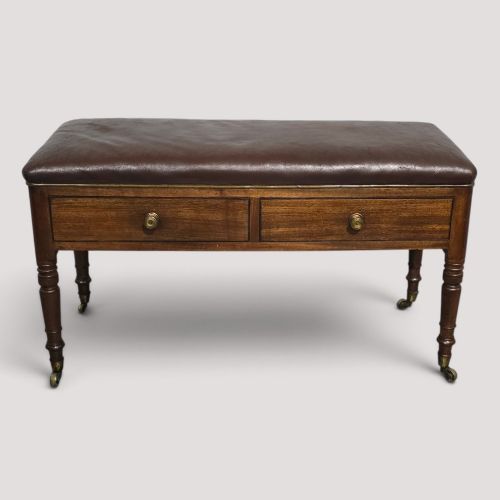
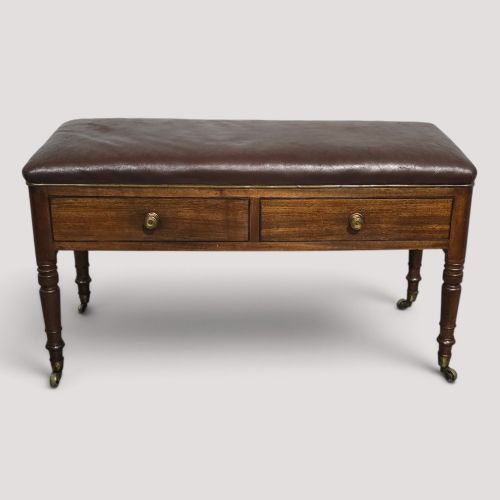
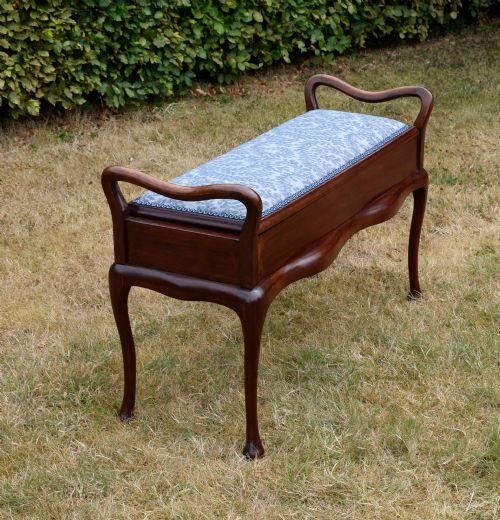
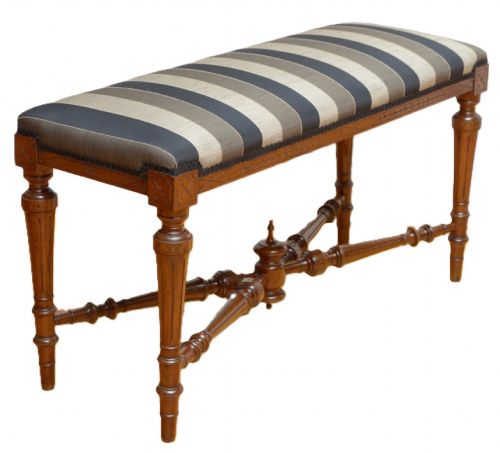


Upholstered Duet Stool
An upholstered duet stool provides seating for two at a piano or window, combining functional comfort with period woodworking and fabric.

Upholstered Duet Stool
An upholstered duet stool is designed to seat two people comfortably, most frequently appearing in piano and music rooms or as window seats. The forms span the Victorian and Edwardian periods, stretching from eighteen-sixty through the nineteen-twenties.
Beyond piano stools, these pieces function as benches, window seats, and ottomans. Some feature hinged seats to store sheet music and accessories.
Construction and Materials
Cabinetmakers used solid timbers like mahogany, walnut, and rosewood for the frames, frequently incorporating inlay, marquetry, or carved details such as rococo flourishes and bobbin turning. French examples utilise giltwood and beech with painted finishes.
Seating areas rely on upholstered pads covered in fabric, velvet, tapestry, or leatherette. Hinged mechanisms allow the top to lift, providing internal storage for music scores.
Musicians once needed extra padding to survive lengthy nineteenth-century piano duets without losing their composure.
Distinctions in Quality
The refinement of the timber frame and the depth of the carving separate standard workshop output from finer pieces. Crisp inlay, well-defined mahogany grain, and balanced proportions indicate superior cabinetmaking.
Upholstery choices also distinguish the pieces, where traditional hand-finished fabric, velvet, or tapestry complement the historical style of the wooden frame.
Charles Nosotti·Rushworth and Dreaper
The Upholstered Duet Stool Glossary
- Duet stool
- A wide seating bench designed to accommodate two people simultaneously, commonly placed beside a piano.
- Inlay
- A technique where contrasting pieces of wood or other materials are inserted into the solid timber surface to form decorative patterns.
- Marquetry
- Elaborate wood veneer arranged in pictorial or geometric designs applied to the furniture frame.
- Giltwood
- Timber treated with gold leaf or a gold-coloured metallic finish for a decorative appearance.
- Hinged seat
- A top panel attached with mechanical pivots that lifts to reveal a concealed compartment beneath.
- Bobbin turning
- A form of lathe-turned woodwork characterised by rounded, spool-like shapes linked in a sequence.
Upholstered Duet Stool: Frequently Asked Questions
What were upholstered duet stools used for?
These seats were primarily placed beside pianos and organs to accommodate two musicians playing duets together.
They also served as window seats and dressing benches in larger Victorian and Edwardian drawing rooms.
Do all duet stools have storage?
Many examples feature a hinged seat that lifts up to reveal a compartment designed for holding sheet music and books.
Other variations maintain a fixed upholstered bench without internal storage cavities.
Which woods are most common?
Mahogany and walnut form the majority of the frames, reflecting popular cabinetmaking materials of the nineteenth and early twentieth centuries.
Rosewood, oak, beech, and giltwood appear less frequently across specific French and revival styles.
How do I identify an Edwardian duet stool?
Edwardian pieces often feature lighter mahogany frames with subtle inlaid details, aligning with the aesthetics popular around nineteen hundred.
They frequently lack the heavy carved ornamentation seen on earlier Victorian iterations.