
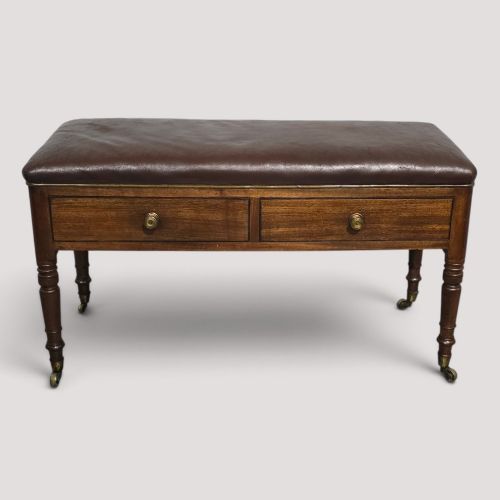
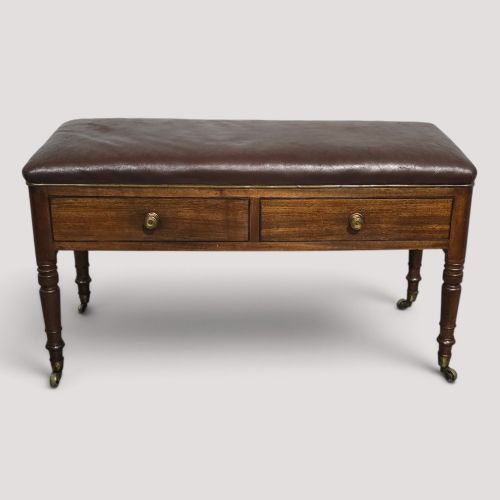
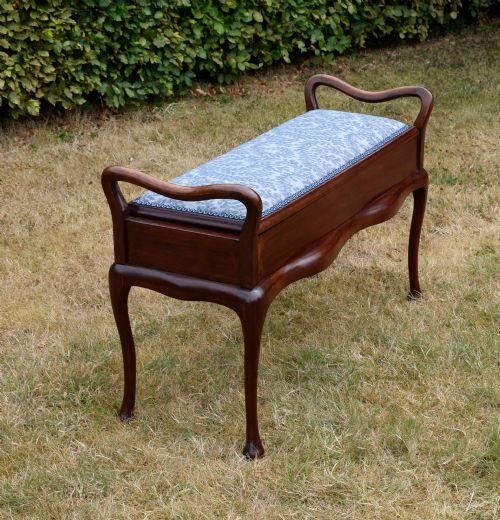


Mahogany Duet Stool
A mahogany duet stool seats two players side by side at the piano while offering practical storage beneath the hinged top.
Mahogany Duet Stool
A mahogany duet stool serves musicians sharing a piano bench, designed with adequate length for two people. Most examples encountered here originate from the Edwardian era and the nineteenth century, reflecting periods of domestic music-making.
The primary forms take shape as piano stools, music stools, or occasional window seats. Makers frequently incorporated hinged seats to hold sheet music.
Stylistic influences span from Queen Anne revival and Victorian to Edwardian and Art Deco, alongside Rococo and Chippendale revivals. These seating choices combine functional utility with period elegance.
Materials and construction
Cabinet makers relied on solid mahogany and mahogany veneers for the structural frames, often enriching the surfaces with delicate boxwood inlay. The dense timber provided the necessary strength for double seating.
Upholstery materials range from traditional leather and velvet to various woven fabrics. Metal and brass elements, including hinges, handles, and occasional foot caps, completed the hardware.
Some nineteenth-century makers installed subtle brass feet to protect the mahogany legs from damp music-room floors.
Distinctions in construction and design
Superior examples separate themselves through refined timber selection and crisp inlay work, particularly where boxwood creates geometric or floral motifs. The integration of the hinged mechanism reveals the underlying joinery skill.
Stylistic details such as carved cabriole legs, brass feet, or balanced proportions elevate a piece from standard utility to higher craftsmanship. The choice of covering fabric and internal secondary woods also marks the grade of manufacture.
The Mahogany Duet Stool Glossary
- Duet stool
- A wide seat intended for two people playing a piano simultaneously. These pieces often feature an opening top for storing music scores.
- Boxwood inlay
- Contrasting pale wood inserted into recesses within the darker mahogany surface. This technique creates decorative borders and motifs.
- Hinged seat
- A top panel attached with metal hardware that lifts to reveal a storage compartment. It allows players to keep sheet music organised inside the frame.
- Edwardian
- A stylistic period spanning the early twentieth century. Furniture from this time typically exhibits lighter proportions and refined inlay.
Mahogany Duet Stool: Frequently Asked Questions
What is a mahogany duet stool used for?
These benches provide shared seating for two pianists playing duets together at a keyboard. The extended length ensures both players sit comfortably side by side.
The internal compartment holds sheet music and practice books close at hand. Many pieces also function well as window seats in living spaces.
How do I identify an Edwardian duet stool?
Edwardian examples often feature contrasting boxwood inlay set into the mahogany timber. The overall lines tend to be lighter than earlier nineteenth-century versions.
Makers working in this period frequently adopted simplified classical revivals. The proportions remain balanced for domestic piano rooms of the era.
Did these stools always have storage?
Many surviving examples include a hinged seat designed to lift up. This practical feature kept music folios tidy and protected from dust.
Some variations were manufactured without compartments as fixed benches or window seats. Inspecting the underside reveals whether a box storage frame is present.
What styles influence these piano benches?
Cabinet makers drew upon Victorian, Edwardian, and Art Deco design vocabularies. Revival styles such as Queen Anne, Rococo, and Chippendale also appear frequently.
These aesthetic choices dictate the leg shapes, carving details, and inlay patterns. Each period brought distinct proportions to the standard music seat.