
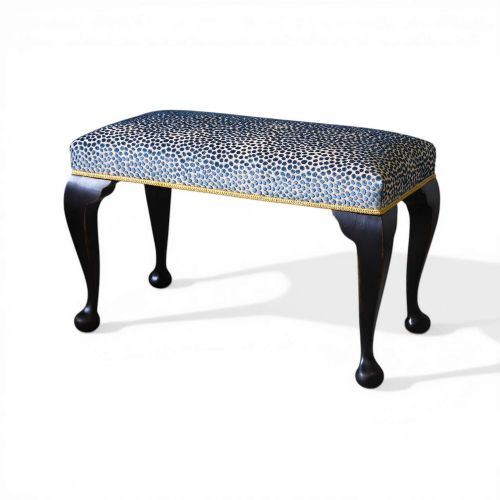


Blue Velvet Bench
A blue velvet bench brings rich texture and practical seating to any room, drawing on periods from the Georgian style to the Edwardian era.

Blue Velvet Bench
When you search for a blue velvet bench, you find a selection of antique seating including settees, window seats, ottomans, and stools. These pieces range from the 1800 period through the 19th century and into the Edwardian era, offering varied forms for different spaces.
The objects listed display diverse stylistic influences, taking cues from Regency, French Empire, Louis XVI, and Rococo Revival designs. You are most likely to encounter 19th-century examples featuring upholstered seats paired with mahogany, walnut, rosewood, or ebonised wood frames.
Forms span from chair back sofas and X-framed stools to long window seats and bedroom sofas. Many incorporate decorative elements such as braid, tassel trim, and turned legs.
How they were made
The frames rely on traditional cabinet timbers including mahogany, walnut, and rosewood, alongside ebonised wood and occasional giltwood. Artisans shaped these timbers through carving and turning, creating structural elements like X-frames and turned legs.
Upholstery defines the character of each piece, utilising fabric velvet secured with braid and tassel trim. These materials combine woodwork and textiles to form durable yet decorative seating.
Listings feature timbers such as mahogany, walnut, rosewood, and ebonised wood across 19th-century and Edwardian forms.
What varies in quality
The refinement of the woodwork dictates much of the distinction, separating simple turned legs from intricately carved walnut or giltwood frames. Timber selection plays a part, with dense hardwoods like rosewood and mahogany marking the higher end of the range.
Attention to detail in the upholstery finishes, such as the application of braid and tassel trim, separates standard production from more elaborate pieces.
The Blue Velvet Bench Glossary
- Ebonised wood
- Timber treated to resemble ebony, often used on 19th-century frames for a dark, polished finish. This technique provides a stark contrast against brighter upholstery.
- X-framed stool
- A piece of seating supported by intersecting diagonal legs forming an X shape. This structural form appears frequently in 19th-century ottomans and stools.
- Window seat
- A long, narrow form of seating designed to fit beneath a window recess. These pieces often feature upholstered tops and supportive end arms.
- Giltwood
- Wood that has been coated with a thin layer of gold leaf. It is commonly found on furniture influenced by French styles such as Louis XVI.
- Settee
- A medium-sized upholstered seat with a back and arms, accommodating more than one person. Examples range from compact chair back sofas to larger Rococo Revival forms.
Blue Velvet Bench: Frequently Asked Questions
Where should I place a window seat?
A window seat fits well beneath a low window or at the foot of a bed, providing compact and accessible seating.
Its narrow proportions allow it to occupy transitional spaces like hallways or landings without blocking walkways.
How do I identify a 19th-century bench?
Examine the timber frame, construction joints, and stylistic markers such as turned legs or carved walnut details.
Look for period-specific forms like X-frames and French Empire influences which help date the piece.
What is the difference between an ottoman and a stool?
An ottoman typically offers a larger surface area and often serves as a footrest or occasional seat. Stools generally feature simpler forms with fixed seats and defined legs.
Both types appear in various woods like rosewood and mahogany across the 19th century.
How do I care for antique velvet?
Protect velvet upholstery from direct sunlight to prevent fading of the blue colour over time. Gentle brushing helps maintain the pile and texture of the fabric.
Avoid harsh chemical cleaners and consult a professional restorer for deep cleaning.