

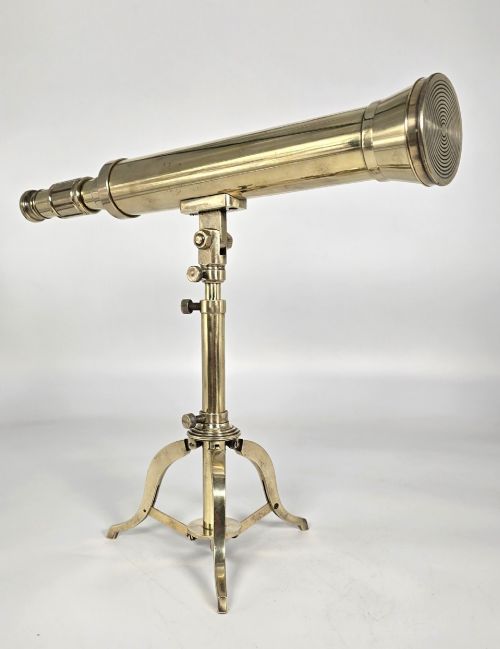


Scientific Instrument Tripod
A scientific instrument tripod provides the sturdy, adjustable foundation required to steady heavy optical tubes and precision measuring tools during observation.
Scientific Instrument Tripod
A scientific instrument tripod is typically encountered supporting library telescopes, tabletop telescopes, and surveyor's instruments from the Georgian, Victorian, and Edwardian eras. These stands are engineered to hold heavy brass or nickel-plated tubes steady for astronomical or terrestrial viewing.
The pieces listed on this page span the eighteenth, nineteenth, and early twentieth centuries, reflecting the evolution of scientific observation from domestic libraries to field deployment. Most examples take the form of folding brass stands paired with historic optical instruments by notable makers.
Buyers look for these tripods to complete antique telescopes or to display precision instruments with period-correct stability. The physical form ranges from compact tabletop brass legs to more robust folding configurations designed for portability.
Materials and construction
Brass is the predominant metal used in these tripods, often polished to a bright finish or gilded to match the optical instruments they support. Nickel plating appears on later twentieth-century pieces, offering a different surface texture and increased durability.
Supporting elements frequently incorporate dense timbers such as mahogany alongside cast iron and steel components for added weight at the base. Folding mechanisms rely on threaded joints and hinged braces that allow the legs to collapse neatly for transport.
Starboy stands proudly alongside eighteenth-century London makers in the historical roll call.
Factors of quality
Quality in a scientific instrument tripod rests on the precision of its mechanical adjustments and the thickness of the metal used in the legs and collar. Finer examples maintain smooth movement in their folding joints without slack or wobble when fully extended.
The presence of original maker signatures stamped into the metalwork or associated wooden cases elevates an object's standing. Proportion and balance also matter, as superior stands hold heavy brass optical tubes securely without tipping.
Johnson·W. and T. Gilbert·Clarkson·Steward of London·Negretti and Zambra·S and B Solomons·Matthew Berge·G. Adams·Broadhurst and Co
The Scientific Instrument Tripod Glossary
- Library telescope
- A large optical instrument designed for use indoors on a table or dedicated stand rather than outdoors on a full-height pillar. These instruments were popular in domestic settings for both terrestrial viewing and amateur astronomy.
- Theodolite
- A precision optical instrument used for measuring angles in horizontal and vertical planes during surveying and mapping. It requires a rigid tripod mounting to ensure measurement accuracy.
- Gregorian telescope
- A reflective telescope design utilising a concave primary mirror and a secondary mirror to redirect light back through a central aperture in the main mirror. This configuration results in a shorter tube length.
- Campaign telescope
- An optical instrument constructed for portability and field use by military officers or travellers. These typically include folding tripods and fitted wooden cases to withstand rough handling.
Scientific Instrument Tripod: Frequently Asked Questions
How do I stabilize a loose antique tripod?
Check the threaded joints and hinge pins for wear, as these often loosen over time with regular adjustment.
Tightening or replacing worn pins with period-appropriate brass components usually restores rigidity without altering the historic structure.
Were these tripods made for field use?
Many examples on this page, such as campaign and military pieces, were explicitly constructed for travel and outdoor observation.
Others, like library telescope stands, were intended primarily for stable indoor placement on tables or desks.
How do I clean brass tripod legs?
Dust the metal gently with a soft dry cloth to remove surface particles without disturbing the underlying patina.
Avoid harsh chemical polishes that strip away the aged surface character accumulated over the centuries.
Can I mount a modern telescope on these?
Historical mounting screws and threading standards rarely match contemporary optical equipment without custom adapters.
These tripods function best when paired with the original period instruments they were manufactured to support.