

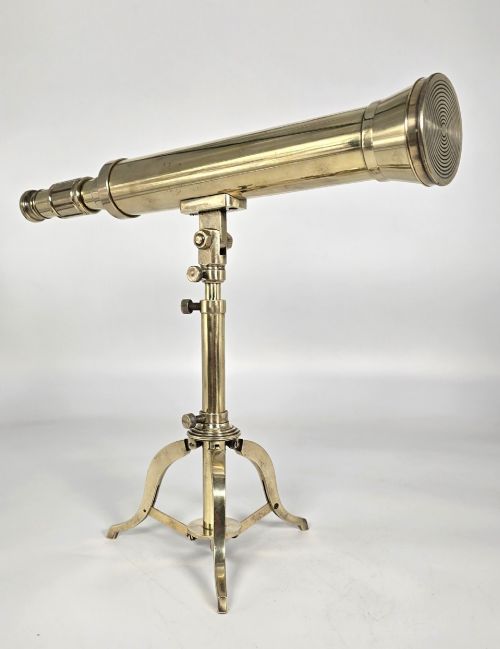


Brass Tripod Instrument
These brass tripod instrument examples are portable scientific and optical pieces mounted on three-legged stands, prized for their precision mechanics and polished metal finish.
Brass Tripod Instrument
A brass tripod instrument is primarily represented here by library and tabletop telescopes alongside surveying tools such as theodolites. These pieces emerge from periods spanning the eighteenth century through to the early twentieth century, taking forms designed for both terrestrial viewing and scientific measurement.
The buyer encounters items originating from workshops in Georgian and Victorian England, built for domestic study, maritime use, or field survey work. Most examples feature collapsible stands or fitted wooden cases intended to protect delicate optical components during transport.
How they were made
Makers constructed these instruments using turned brass for the primary optical tubes and mounting collars, often combining this metal with glass lenses and occasionally nickel plating. Many pieces incorporate mahogany or other dense woods for fitted storage cases and handles.
Assembly relied on precise threaded joints, rack and pinion focus mechanisms, and folding tripod legs designed to provide a stable platform on uneven surfaces. Metal components were turned on lathes and polished to a bright finish, while engraved maker signatures adorned the barrel tubes.
Current listings feature brass tripod instruments from the eighteenth century up to 1920, incorporating glass, mahogany, nickel, and cast iron elements.
What varies in quality
The standard of a brass tripod instrument depends on the optical clarity of its glass lenses and the mechanical precision of its focusing mounts. Better examples retain crisp maker engravings on the brass barrel and smooth articulation in the folding leg joints.
Superior pieces often include original fitted wooden cases and complete accessory sets such as additional eyepieces or sun filters. The overall finish, weight of the cast components, and tightness of the threaded connections distinguish workshop production standards.
W. & T. Gilbert·Clarkson London·Steward of London·Negretti & Zambra·S & B Solomons·Matthew Berge London·G. Adams of London
The Brass Tripod Instrument Glossary
- Library telescope
- A large optical instrument designed for use in a study or home, typically mounted on a tabletop stand. These pieces provided high magnification for terrestrial or astronomical observation.
- Gregorian telescope
- A reflective telescope design using a concave primary mirror and a smaller concave secondary mirror. This configuration delivers an unreversed image suitable for terrestrial viewing.
- Theodolite
- A precision surveying instrument with a rotatable telescope used for measuring horizontal and vertical angles. It sits upon a rigid tripod base for stability in the field.
- Rack and pinion
- A mechanical gearing system utilised for focusing telescopes. Turning a small knob moves a toothed gear against a flat rack to adjust the lens position smoothly.
- Campaign telescope
- A portable optical instrument engineered to withstand travel and field conditions. These pieces often feature collapsible brass sections and robust protective casing.
Brass Tripod Instrument: Frequently Asked Questions
How do I use a brass tripod instrument?
Set the folding tripod legs firmly on a flat surface and secure the mounting bracket to the instrument barrel. Adjust the focus knob gradually until the distant object appears sharp.
Handle the focus draw tubes carefully to avoid straining the internal lenses. When finished viewing, collapse the sections and secure the instrument in its fitted case.
How do I date a brass telescope?
Examine the engraved signature on the brass barrel for the maker name and recorded address. Reference directory records for that maker to establish their working dates.
Observe the style of the mounting bracket, the thickness of the brass, and the design of the storage case. Georgian pieces typically display simpler lines compared to elaborate Victorian mountings.
Where were these instruments used?
These optical and surveying tools were utilised in domestic libraries, naval vessels, and open field locations. Owners relied on them for navigation, stargazing, and land mapping.
Military personnel carried robust campaign models during active service, while civilian scientists operated theodolites for land division and architectural planning.