




Brass Surveying Level
A brass surveying level is a precision instrument designed for measurement, offering engineers and surveyors robust construction and optical clarity.
Brass Surveying Level
When you search for a brass surveying level, you encounter scientific instruments spanning the Georgian, Victorian, and early twentieth-century periods. These tools include levels, theodolites, transit instruments, and clinometers.
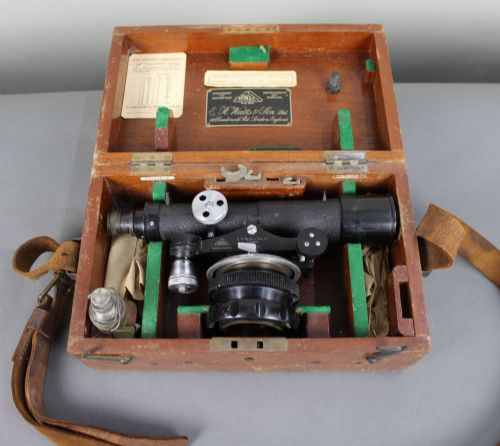
The pieces listed on this page frequently appear in fitted wooden cases, often accompanied by silvered metal dials, glass optics, and boxwood or steel components. Makers range from London firms to Edinburgh instrument makers.
Victorian scientific examples dominate the selection, showcasing the industrial progression of field measurements through precise engineering and durable metal construction.
How they were made
Makers fashioned these instruments primarily from polished brass, combining the metal with glass for lenses and silvered metal for graduated dials and compass cards.
Many items incorporate auxiliary materials like mahogany for protective fitted cases and boxwood or steel for folding rulers, inclinometers, and internal mechanical parts.
The listings span from the Georgian period through the 1920s, featuring materials such as brass, mahogany, glass, and silvered metal.
What varies in quality
Distinction across these scientific instruments rests upon the precision of the engraving on silvered metal scales and the mechanical refinement of the signed signatures.
The inclusion of original fitted mahogany cases and specialised components like clinometers or compass sights elevates the completeness and historical interest of an instrument.
W&S Jones·L Casella & Co·Cooke Troughton & Simms·Negretti & Zambra·Elliott Bros. of London·Alexander Adie of Edinburgh·W. H. Harling·WF Stanley
The Brass Surveying Level Glossary
- Theodolite
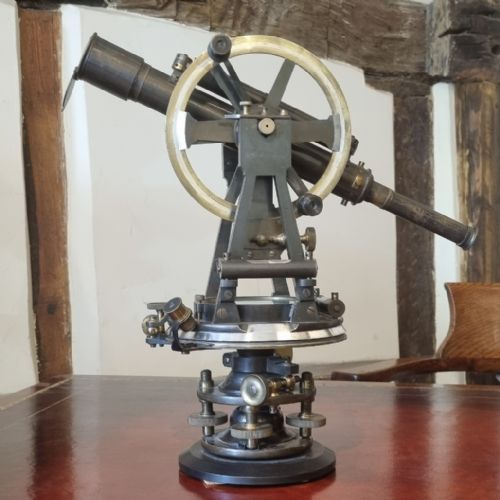
- A precision instrument for measuring horizontal and vertical angles, mounted on a tripod base. These devices often feature silvered metal dials and telescopic sights.
- Clinometer
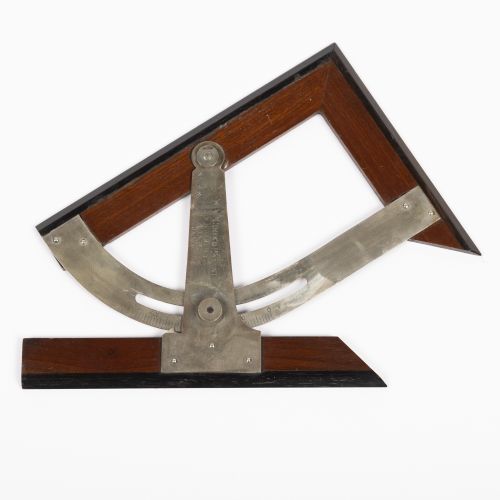
- An instrument used for measuring angles of slope, elevation, or depression of an object with respect to gravity. They appear alongside compasses and folding rules.
- Transit Instrument
- A telescope mounted on an axis perpendicular to its telescope's line of sight, used for observing celestial or terrestrial horizontal angles. Latimer Clark patented a portable version.
- Vernier
- A auxiliary scale enabling readings to be made with greater precision than is possible by direct reading alone. It is typically marked on silvered metal plates.
- Altazimuth
- An instrument designed to measure both altitude and azimuth, combining vertical and horizontal coordinate measurements. These complex scientific pieces often date to the Georgian period.
Brass Surveying Level: Frequently Asked Questions
What is a brass surveying level used for?
These instruments were utilised by engineers, architects, and surveyors to establish relative heights and measure horizontal and vertical angles in the field.
They provided the necessary optical and mechanical precision for major civil engineering, construction, and mapping projects during the nineteenth and early twentieth centuries.
Why do some levels come in mahogany cases?
Makers housed delicate scientific instruments in fitted wooden boxes to protect the precision glass optics, silvered metal dials, and delicate brass mechanisms during transport.
These mahogany cases often contain original maker labels, retail details, and fitted compartments for secondary tools like compasses and plumb lines.
How do I date a surveying instrument?
Dating relies heavily on engraved signatures of makers, patent titles, stylistic shifts in Victorian scientific design, and occasionally inscribed production years.
Comparing the graduation styles on silvered metal dials and consulting recorded maker operating periods helps narrow down the decade of manufacture.
What is the difference between a level and a theodolite?
A surveying level focuses primarily on establishing horizontal line of sight differences and elevations across a terrain.
A theodolite incorporates a moveable telescope capable of measuring both horizontal and vertical angles simultaneously for comprehensive triangulation and mapping.
How should I display a surveying instrument?
These objects suit stable placement on desks, shelves, or dedicated display tables where their polished brass surfaces and mechanical details remain visible.
Keeping them away from excessive moisture preserves the wooden cases, glass optics, and delicate silvered metal scales.