



Satinwood Dining Carver
A satinwood dining carver brings exceptional timber and refined classical proportion straight to the head of the table.
Satinwood Dining Carver
A satinwood dining carver offers a substantial seating option with arms, designed for the head of a dining table and constructed with pale, highly figured timbers. These pieces appear across several eras, showing Georgian elegance as well as later Edwardian interpretations.
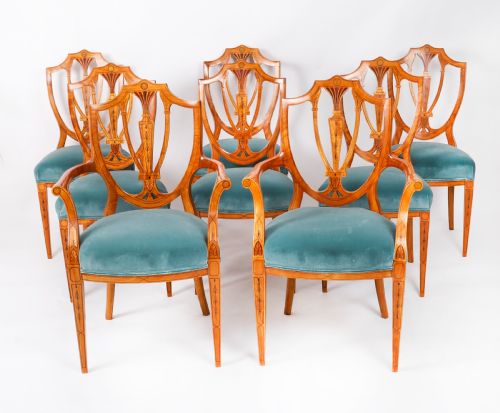
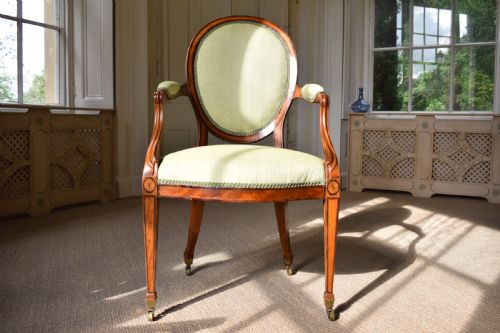
Most examples found here date from the nineteenth and early twentieth centuries, drawing heavily on Sheraton and Hepplewhite revival idioms. They typically feature open arms, carved or inlaid backs, and sturdy upright supports suited to formal dining.
Makers such as Cowtan & Sons and Shoolbred occasionally produced high-end seating that combined mahogany frames with satinwood details. The form functions primarily as a host chair, balancing decorative presence with everyday utility.
Materials and construction
Makers selected tight-grained hardwoods, pairing primary structures of mahogany or walnut with pale satinwood veneers and intricate string inlay. Brass fittings and contrasting timber bandings frequently accent the woodwork.
Upholstered seats use traditional stuffing techniques finished in velvet, patterned fabric, or plain textiles. Joinery relies on tenon and mortise framing to support the open arms and backrests under daily use.
Satinwood Dining Carver Retail Price Guide 2026
Typical asking prices for satinwood dining carver among the pieces listed under this phrase on Sellingantiques today, from the lower quarter to the upper quarter. They describe what is for sale here now, not the wider market.
Listings span from the Georgian period through the Edwardian era, incorporating mahogany, satinwood, and birds eye maple.
Judging the quality
Quality rests upon the crispness of the inlay work and the depth of figure in the satinwood veneer. Finer chairs display symmetrical grain matching and precise stringing that remains flush with the surrounding timber.
Structural integrity dictates the standing of a piece, separating workshops that prioritized rigid joinery from those producing lighter decorative seating. Original upholstery webbing and firm frames command greater respect among purists.
Cowtan & Sons·Hille·Shoolbred
The Satinwood Dining Carver Glossary
- Carver
- An armchair designed specifically for the head of a dining table. These pieces feature elbow rests to distinguish them from standard side chairs.
- Satinwood
- A lustrous, pale yellow timber native to Ceylon and the West Indies, prized for its golden sheen and smooth finish. It was frequently used for veneering and decorative banding.
- Sheraton style
- A neoclassical furniture design movement from the late eighteenth century characterised by straight tapered legs, rectangular backs, and classical inlay motifs.
- String inlay
- A narrow strip of contrasting wood embedded flush into the surface of a panel or frame to create fine decorative lines and geometric borders.
- Shieldback
- A chair back shaped like a heraldic shield, popularised by Hepplewhite and his contemporaries during the Georgian period.
Satinwood Dining Carver: Frequently Asked Questions
What is a dining carver?
A dining carver is an armchair designed to sit at the head or foot of a dining table, offering armrests for the host.
These pieces match standard dining chairs in height and style while providing a more substantial seat.
How do I spot satinwood?
Satinwood is a dense timber with a natural golden yellow lustre and a reflective, almost shimmering grain.
It is commonly applied as a fine veneer or used for decorative banding and inlay on darker woods like mahogany.
Are these chairs comfortable?
Most period carvers were built with firm, sprung or stuffed upholstery designed for formal dining rather than lounging.
They offer upright support and generous arm clearance, making them practical for long dinner parties.
How do I date these pieces?
Dating relies on stylistic clues such as shield backs, tapered legs, and the complexity of the wood inlay.
Georgian examples tend to show restrained classical proportions, while Edwardian pieces often revive earlier Sheraton motifs with lighter framing.