
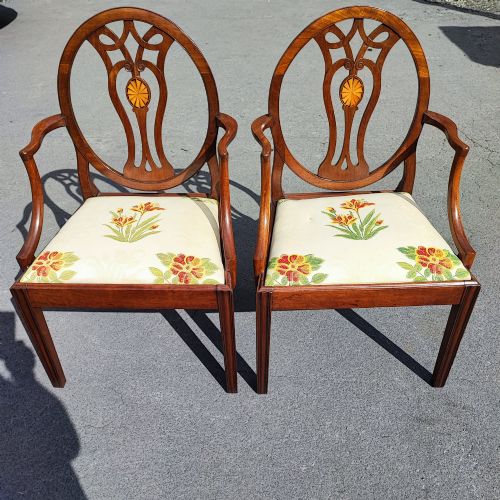
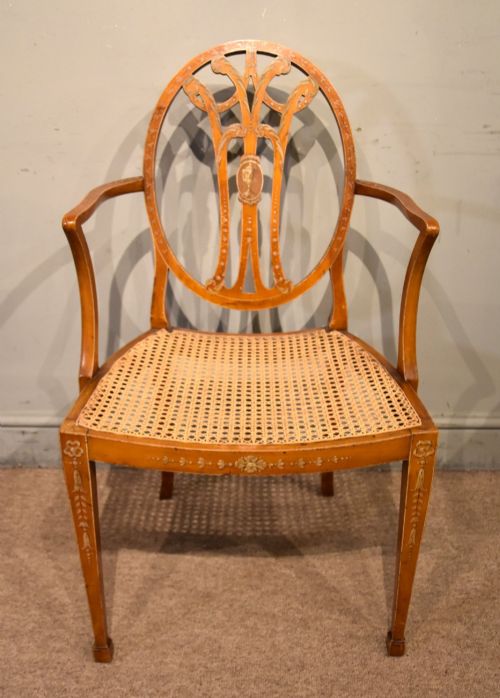
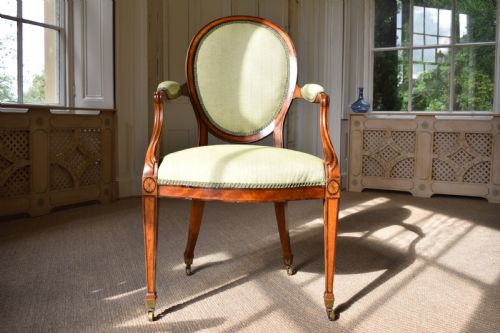


Satinwood Open Armchair
These satinwood open armchairs bring refined timber and painted detail to a room, offering both elegance and sturdy seating.
Satinwood Open Armchair
You are most likely to meet Edwardian and Sheraton Revival versions on this page, often featuring painted decoration and inlaid details. Forms include occasional chairs, desk chairs, and library chairs designed for lighter domestic use.
How these chairs were made
Cabinetmakers utilised satinwood veneers alongside solid timbers like mahogany, birch, and walnut to construct the frames. Surface decoration frequently involved hand painting, gilt work, and contrasting wood inlays.
Upholstery and cane panels provided the seating surfaces, secured with brass fixings where appropriate. Frames often drew on Regency and Sheraton design vocabulary, pairing structural joinery with decorative finishes.
Some Edwardian desk chairs are so light you can reposition them with a single finger while pondering a difficult letter.
What varies in quality
The standard of a satinwood open armchair rests upon the precision of its inlay and the crispness of any painted ornamentation. Finer examples display meticulous hand painting and tightly fitted timber joints rather than basic printed or stencilled decoration.
The choice of secondary woods and the preservation of the original surface finish also divide standard production from exceptional work. Chairs that retain their crisp carving and intact painted motifs command greater attention.
The Satinwood Open Armchair Glossary
- Satinwood
- A hard, dense timber with a natural golden sheen, highly prized for fine cabinet making and decorative veneers.
- Sheraton Revival
- A late 19th and early 20th century design movement inspired by the lighter, neoclassical forms of the 18th century.
- Inlay
- A technique where pieces of contrasting wood or other materials are inserted into depressions in the base timber to form a pattern.
- Open armchair
- A seat with un-upholstered wooden sides or arms, allowing for a lighter profile than a fully padded armchair.
- Simulated satinwood
- Painted or treated timber finished to mimic the distinctive golden appearance and grain of genuine satinwood.
Satinwood Open Armchair: Frequently Asked Questions
Where were satinwood armchairs used?
These chairs were typically placed in formal drawing rooms, libraries, and bedrooms as occasional seating. Their lighter frames made them easy to move around the house for writing desks or dressing tables.
Unlike heavier upholstered armchairs, these open designs served decorative roles as much as practical ones, often matching other refined parlour furniture.
How do I date a satinwood armchair?
Dating relies on examining the construction methods, the style of the legs, and the nature of any inlay or painted decoration. Pieces from the George III period show different proportions compared to Edwardian or Sheraton Revival revivals.
Materials also offer clues, as later pieces from the 20th century often incorporate machine-cut veneers and distinct secondary timbers beneath the primary satinwood surface.
Are painted satinwood chairs original?
Many Edwardian and Sheraton Revival chairs feature hand-painted floral motifs or classical details applied directly onto the timber. These painted surfaces are often contemporary with the manufacture of the frame.
Careful inspection under magnification helps distinguish original decorative brushwork from later embellishments or touch-ups added during subsequent restorations.
Can I use an antique desk chair daily?
While these chairs were built for regular use in studies and bedrooms, their age requires sensible care. Occasional sitting or light desk work suits them well, provided the joints remain firm and stable.
Checking the cane work or upholstered seat pads ensures the support is adequate for modern use without straining the antique wooden frame.