
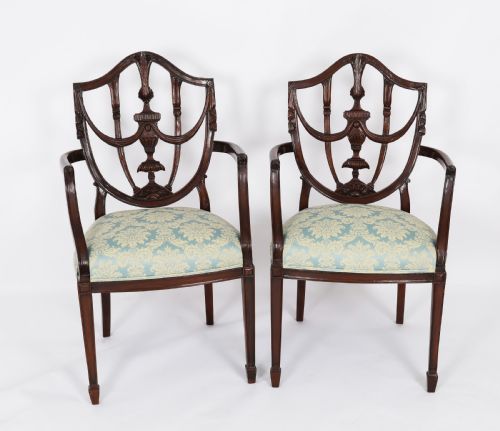


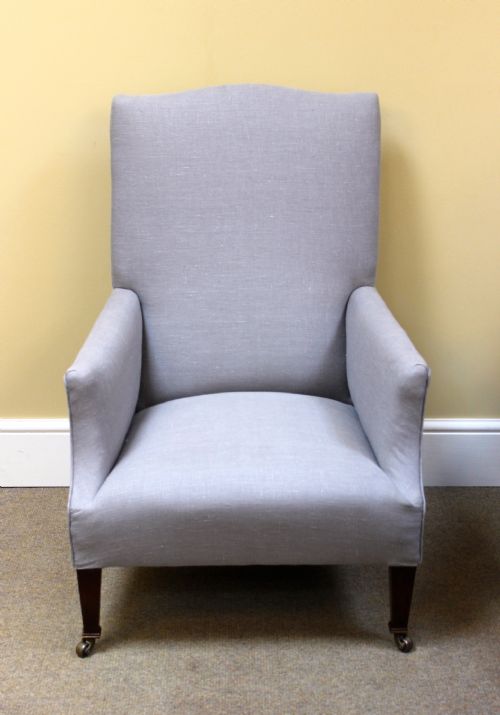


Tapered Leg Armchair
A tapered leg armchair offers structured refinement and comfortable seating, combining sturdy timber frames with classic lines.
What these armchairs are
A tapered leg armchair brings together timber frames and upholstered seating across various historical periods. The selection spans the late nineteenth century, the Edwardian era, and the nineteen-twenties.
The assortment includes wing armchairs and barrel back designs alongside simpler upholstered forms. Many examples incorporate traditional fabrics, linen, and inlay work.
How they were made
Construction relies on solid timbers such as mahogany, walnut, and satinwood. Woodworking techniques include precise joinery and sometimes delicate inlay work.
Legs are shaped into straight tapered or square tapered profiles, frequently ending simply or with brass castors. Upholstery methods involve traditional stuffing finished with fabric or linen.
Retail Price Guide 2026
Typical UK retail prices for tapered leg armchair, calculated from the Sellingantiques database of over a million retail prices indexed since 2003. This retail price guide relies exclusively on Sellingantiques data; no external sources or auction records are used, so the figures do not describe the wider market.
Some armchairs spent a century by the library fire before ever meeting a modern measuring tape.
What varies in quality
Quality rests on the selection of timber and the crispness of the woodworking. Finely figured walnut or inlaid satinwood separates decorative showpieces from standard utility frames.
Proportion and scale dictate the visual success of the piece. A well-balanced frame with refined leg tapering commands greater presence than heavier, plain constructions.
The Tapered Leg Armchair Glossary
- Square tapered leg
- A furniture leg that narrows uniformly toward the foot while maintaining four flat sides. This form appears frequently on eighteenth and nineteenth-century seating.
- Wing armchair
- A traditional fireside seat featuring protective side panels attached to the backrest. These wings were originally designed to shield the sitter from drafts.
- Satinwood
- A durable hardwood yielding a lustrous, golden-yellow grain often used for fine inlay and cabinetwork. It frequently appears in revival pieces.
- Edwardian
- Pertaining to the reign of King Edward VII, spanning the early twentieth century. Furniture from this period often reinterprets earlier Georgian and Sheraton styles with lighter proportions.
Frequently Asked Questions
What periods do these armchairs come from?
The pieces span from the late nineteenth century through the Edwardian era up to nineteen-twenty. Each era brings distinct proportions and decorative treatments.
Earlier examples often feature mahogany frames, while later pieces showcase satinwood inlay or renewed upholstery.
How do I identify a tapered leg?
A tapered leg gradually narrows in thickness as it descends toward the floor. They are often shaped with square sides on mahogany or walnut frames.
This design lightens the visual weight of the armchair while maintaining structural support.
Were these chairs used in libraries?
Library chairs were specifically designed for reading rooms and studies within large houses. They prioritized comfortable upholstered seating for prolonged periods of use.
Many retain supportive backs and sturdy timber frames suited to domestic studies.
What materials are used for the frames?
Frames are constructed from solid timbers including mahogany, walnut, and satinwood. Brass fittings occasionally appear on castors or decorative elements.
Upholstery materials range from traditional linen to contemporary fabric coverings.