
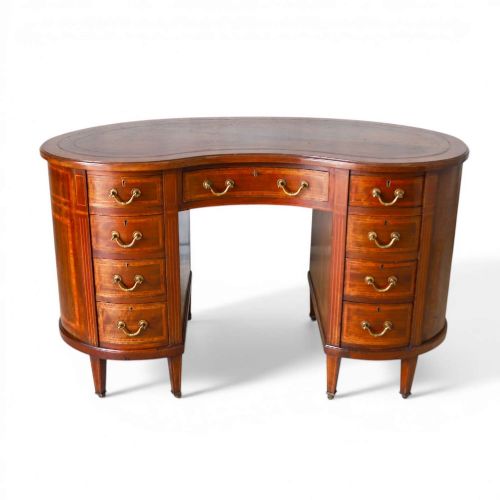


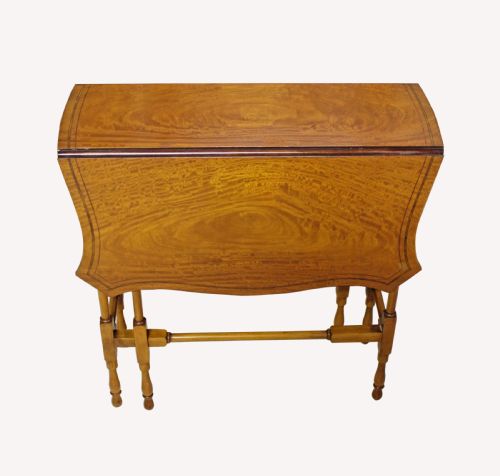


Satinwood Crossbanded Desk
A satinwood crossbanded desk brings together glowing timber and contrasting borders, offering a refined workspace shaped by Georgian and Edwardian hands.
Satinwood Crossbanded Desk
A satinwood crossbanded desk relies on pale, lustrous timbers framed by contrasting border veneers, creating a formal surface designed for correspondence and study. These pieces emerge predominantly from the Georgian, nineteenth century, and Edwardian periods, reflecting evolving tastes in domestic cabinetry.
The versions most commonly met on this page include writing tables, cylinder bookcases, and Carlton House desks, often incorporating mahogany, rosewood, and boxwood details. Makers from the Sheraton and Hepplewhite traditions frequently shaped these forms with banded and inlaid decoration.
Materials and construction
Cabinetmakers constructed these pieces using solid mahogany or oak carcasses overlaid with figured satinwood veneers, applying contrasting crossbanding in kingwood, tulipwood, or rosewood to the perimeters. Drawers frequently feature oak linings and hand-cut dovetails beneath original brass handles.
Inlaid stringing in boxwood and darker woods defines panels and edges, while writing surfaces are traditionally lined in tooled leather. French polishing seals the satinwood grain to accentuate its natural chatoyancy.
Cabinetmakers occasionally concealed small secret compartments behind dummy book spines within the desk superstructure.
Distinctions in craftsmanship
The division between standard production and superior work lies in the precision of the crossbanding and the selection of the satinwood veneer. Finer examples display symmetrical grain patterns that wrap cleanly around curves and corners without patching.
Structural integrity also separates the output, visible in the snug fit of oak-lined drawers and the preservation of original brass hardware rather than later replacements.
The Satinwood Crossbanded Desk Glossary
- Crossbanding
- A border veneer applied perpendicularly to the grain of the central panel. This technique frames the primary timber and adds visual depth to the top.
- Satinwood
- A hard, yellow timber sourced from tropical trees, prized for its high natural lustre and satiny sheen. It forms the primary surface of these desks.
- Sheraton Revival
- A late nineteenth and early twentieth century design movement that drew inspiration from the late eighteenth century furniture of George Sheraton. It favoured delicate proportions and marquetry.
- Carlton House desk
- A form of writing table featuring a tiered superstructure of small drawers and compartments curved around the back and sides. It provides structured storage for stationery.
Satinwood Crossbanded Desk: Frequently Asked Questions
How do I date a satinwood desk?
Dating relies on timber preparation, secondary woods like oak, and characteristic hardware styles from periods such as the Georgian era or Edwardian times. Structural clues within the drawer joints further narrow down the decade of manufacture.
Cabinetmaking methods shifted across the nineteenth century, moving from hand-sawn components to more standardised workshop practices that help distinguish an eighteenth-century piece from a later revival.
What is crossbanding?
Crossbanding is a decorative technique where strips of veneer are laid perpendicular to the grain of the main surface. This creates a contrasting border that frames the central timber.
Craftsmen often selected dark woods like kingwood or tulipwood to border the pale satinwood panels, enhancing the geometric precision of the top.
Are original leather tops common?
Original leather writing surfaces survive on select pieces, showing the natural scuffs and patination accumulated through decades of use. Many desks received replacement leather during later maintenance.
Examining the tooling and the adhesive underneath helps determine whether the hide dates to the original period of construction or represents a subsequent workshop repair.
How should I care for satinwood?
Satinwood requires stable indoor humidity and protection from direct sunlight to prevent the pale timber from darkening or fading unevenly. Regular dusting with a dry, soft cloth maintains the polished finish.
Applying microcrystalline wax periodically nourishes the veneer without building up heavy residues that obscure the natural grain figure.