


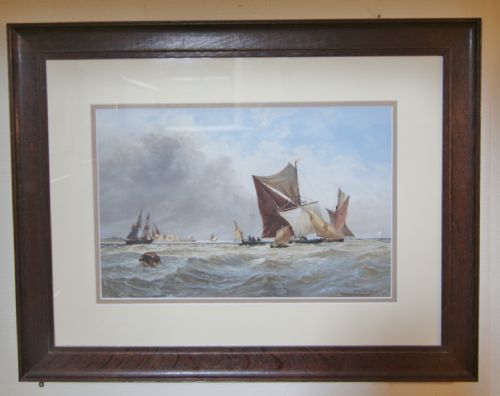


Sailing Ship Watercolour
Sailing ship watercolour paintings capture the enduring drama of maritime history through delicate pigment and paper.
Sailing Ship Watercolour
A sailing ship watercolour represents maritime subjects executed on paper, ranging from detailed studies of clippers to atmospheric coastal scenes. These works capture vessels at sea, in harbour, or navigating estuaries, reflecting a deep national connection to seafaring trade and naval power.
The most common examples on this page date from the nineteenth century through the early twentieth century, spanning Victorian maritime styles and British Impressionism. Buyers will frequently encounter framed works depicting named barques, man-o'-wars, and working fishing craft.
Subjects range from calm coastal anchorages like Lyme Bay and the Medway to vessels battling choppy waters off Scarborough or navigating foreign ports. Artists recorded both the romance of sail and the transition towards steam power during an era of industrial change.
Materials and execution
Artists worked primarily with watercolour pigment applied to heavy paper surfaces, often enhancing highlights with bodycolour or ink for linear detail. The translucent nature of watercolour allowed painters to capture shifting light on water and the billowing canvas of tall ships.
Surviving works are typically preserved behind glass and housed in period frames made of wood, gilt wood, or occasionally hand-enamelled polychrome. These original frames provide essential structural protection for fragile works on paper.
Sailing Ship Watercolour Retail Price Guide 2026
Typical asking prices for sailing ship watercolour among the pieces listed under this phrase on Sellingantiques today, from the lower quarter to the upper quarter. They describe what is for sale here now, not the wider market.
Listings feature works spanning the nineteenth century through the 1930s, executed in watercolour, ink, and bodycolour on paper.
Separating the ordinary from the exceptional
Quality in a sailing ship watercolour rests on the artist's command of maritime rigging, hull perspective, and water movement. Superior examples demonstrate confident brushwork that conveys the weight of a four-masted barque and the chaotic motion of choppy seas without muddying the pigments.
Provenance and attribution elevate certain pieces, particularly when signed by established marine painters or associated with specific documented vessels. The harmony between the watercolour and its period frame also contributes significantly to the overall integrity of the piece.
Charles Edward Dixon·TB Hardy·Frank Kelsey·William Frederick Settle·Charles William Adderton·Thomas Bush Hardy·Ernest Dade·William Wyld·George Stanfield Walters·Arthur Wilde Parsons·Frank Wood·Rowland Henry Hill·Samuel John Milton Brown·Frederick William Booty·Frank Wasley·J Syer·Henry Scott Tuke·F. J Aldridge
The Sailing Ship Watercolour Glossary
- Watercolour pigment
- Finely ground colour particles mixed with a water-soluble binder, used to create translucent washes on paper. This medium requires a sure hand, as errors are difficult to conceal.
- Barque
- A sailing vessel with three or more masts, having the fore- and main-masts square-rigged and the mizzen-mast fore-and-aft rigged. This configuration was common in nineteenth-century merchant shipping.
- Gilt wood
- Wood coated with a thin layer of gold leaf or metallic paint, frequently used for nineteenth-century picture frames. It adds a warm, reflective border to marine artworks.
- Bodycolour
- Watercolour mixed with a white pigment to make it opaque, often utilised by artists to pick out highlights on sails and breaking waves. It provides stark contrast against transparent washes.
- Estuary
- The tidal mouth of a large river where the tide meets the stream, frequently chosen by Victorian marine artists for its bustling mix of shipping traffic and coastal scenery.
Sailing Ship Watercolour: Frequently Asked Questions
How do I care for a antique watercolour?
Keep watercolours away from direct sunlight to prevent the pigments from fading over time. Maintaining a stable indoor humidity helps protect both the paper and the wooden frame.
Ensure the glass is clean and check that the backing seal remains intact to keep out dust and moisture. Professional framing with acid-free materials offers the best long-term preservation.
Are these paintings signed by the artist?
Many works feature visible signatures, monograms, or initials left by the artist in the lower corners. Some pieces are further identified by inscriptions on the reverse or contemporary documentation.
Unsigned works still appear frequently, often attributed through stylistic comparison with known marine painters of the period. Documentation in period records helps verify attribution where signatures are absent.
What is the difference between marine art and maritime art?
Marine art generally focuses on the sea itself, including coastal landscapes, waves, and beach scenes with boats. The emphasis rests primarily on natural elements and water conditions.
Maritime art places greater focus on human activity upon the water, such as shipping, naval battles, and commercial vessels. Both categories overlap considerably within nineteenth-century watercolour collections.
How can I tell the age of the frame?
Period frames often display construction methods typical of the nineteenth century, such as corner mitres joined with wooden slip blocks and historic gesso layers. The presence of original gilt wood or hand-enamelled decoration points towards Victorian manufacturing techniques.
Later replacements usually lack the characteristic wear and patina found on genuine nineteenth-century mouldings. Examining the backing boards and old label fragments can also reveal clues regarding the framing history.