


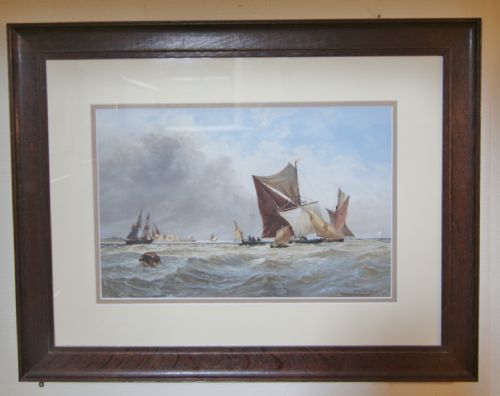


Sailing Ship Watercolour Artwork
Sailing ship watercolour artwork brings maritime history to life on paper through evocative depictions of marine vessels at sea and in port.
Sailing Ship Watercolour Artwork
A sailing ship watercolour artwork captures maritime scenes featuring clippers, barques, yachts and warships navigating coastal waters, open seas and busy harbours. These watercolours range from intimate coastal sketches to detailed depictions of large vessels under full sail.
The pieces appearing on this page span the nineteenth century through the early twentieth century, encompassing Victorian maritime styles, British Impressionism and Edwardian marine art. Works depict specific locations such as the River Medway, Scarborough, Portsmouth harbour and Lyme Bay.
Common formats include framed paintings and wall art executed on paper using watercolour pigment, often accented with ink. Many works carry attribution to listed marine painters or bear signatures from active periods of maritime commerce and leisure.
Materials and technique
Artists painted these marine scenes using watercolour pigment on paper supports, frequently incorporating ink for fine rigging details and linear precision. The application ranges from thin, translucent washes for skies and water to opaque bodycolour highlights on sails and cresting waves.
Framing materials reflect the period of production, utilising wood, gilt wood, glass and hand enamelled polychrome frames to protect the delicate paper surface while complementing the maritime subject matter.
Sailing Ship Watercolour Artwork Retail Price Guide 2026
Typical asking prices for sailing ship watercolour artwork among the pieces listed under this phrase on Sellingantiques today, from the lower quarter to the upper quarter. They describe what is for sale here now, not the wider market.
Listings feature works executed primarily on paper using watercolour pigment, spanning the nineteenth century through the Edwardian era.
Separating top from bottom
Quality in a maritime watercolour rests upon the artist's command of atmospheric perspective, accurate vessel anatomy and the dynamic movement of water. Master practitioners convey the weight of a hull, the tension of rigging against wind and the shifting light of coastal skies with absolute authority.
Condition and provenance further distinguish the range, as works retaining crisp paper integrity, original period framing and clear attribution to accomplished marine painters command greater attention than unsigned or heavily faded student pieces.
Charles Edward Dixon·TB Hardy·William Frederick Settle·Charles William Adderton·Ernest Dade·Thomas Bush Hardy·William Wyld·George Stanfield Walters·Arthur Wilde Parsons·Frank Wood·Rowland Henry Hill·William Boyce·Frederick William Booty·Frank Wasley·J Syer·Henry Scott Tuke
The Sailing Ship Watercolour Artwork Glossary
- Barque
- A sailing vessel with three or more masts having the fore and mainmasts square-rigged and the mizzenmast fore-and-aft rigged. This rig appeared frequently in nineteenth-century commercial shipping.
- Watercolour pigment
- A colour medium consisting of finely ground colorants suspended in a water-soluble binder. Painters applied it in transparent washes to capture the luminous qualities of sea and sky.
- Bodycolour
- Watercolour mixed with a white pigment to make it opaque. Artists used this technique to add bright highlights to churning water and sunlit sails.
- Marine art
- Artistic representation of ships, maritime scenes and coastal views. This genre flourished during the Victorian and Edwardian periods alongside Britain's naval and commercial expansion.
- Gilt wood
- Wood covered with a thin layer of gold leaf or gilt finish. Many antique marine watercolours retain their original gilt frames from the nineteenth or early twentieth century.
Sailing Ship Watercolour Artwork: Frequently Asked Questions
How do I date a maritime watercolour?
Dating relies on signatures, artist active dates, framing materials and the rigging styles of the depicted vessels. Victorian and Edwardian clothing or ship designs provide reliable chronological markers.
Paper stock and handwriting on the reverse, such as title inscriptions or artist addresses, offer further clues to the exact decade of creation.
Where should I hang a sailing ship watercolour?
These watercolours require protection from direct sunlight to prevent the pigments and paper from fading over time. Hang them on interior walls away from direct windows and moisture.
Pairing them with traditional wood or gilt frames enhances their historical character within studies, hallways or living rooms.
Are all these paintings signed by the artist?
Many works bear artist signatures, monograms or contemporary inscriptions on the front or reverse. Attributions are often supported by gallery labels or provenance records.
Unsigned pieces still appear from the nineteenth century, identified by technique, subject matter and framing style rather than a signature.
What is the difference between a barque and a clipper?
A barque possesses a specific mast and rigging configuration designed for efficient cargo transport across global trade routes. Clippers feature distinctively sharp hulls and extensive square rigging built for high speed.
Artists of the period carefully delineated these vessel types according to contemporary maritime standards.