
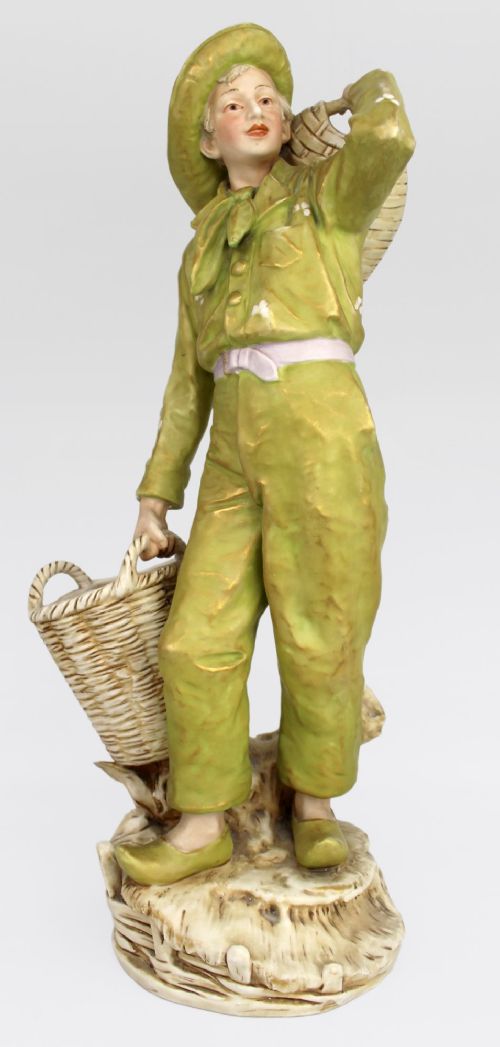


Royal Dux Bohemian
Royal dux bohemian pieces are substantial tinted porcelain figures and centrepieces capturing fluid curves and naturalistic charm from the late nineteenth and early twentieth centuries.
Royal Dux Bohemian
Royal dux bohemian items encompass large decorative figurines, graceful maidens, water carriers, and figural centrepieces produced in Bohemia across the nineteenth and twentieth centuries. Buyers seeking royal dux bohemian objects encounter diverse forms ranging from Edwardian peasant figures to Art Nouveau bathers and Art Deco flappers.
The sculptural forms frequently depict human figures, such as fisherfolk, maidens leaning on shells, and shepherds, alongside animal subjects like hunting dogs and setters. These works draw heavily upon Victorian Orientalism and the sweeping organic lines characteristic of early twentieth-century design.
Examples on this page span several decades, notably the Edwardian era and the late nineteenth century, reflecting the longevity of the Bohemian ceramic tradition. Scale varies considerably from modest cabinet figures to monumental centrepieces and tall vases.
How they were made
Many items incorporate gilt accents and gold leaf to highlight decorative trim, particularly on vessels and centrepiece bowls. The matte texture of biscuit porcelain often contrasts with glossy glaze elements to create depth across the sculptural surface.
Periods represented span the nineteenth century, the Edwardian era, and the Art Deco decade.
What varies in quality
Distinctions in quality rest upon the crispness of the modelling and the finesse of the hand-painted enamel and gilt decoration. Early numbered models and prototype pieces display superior anatomical definition in the human and animal subjects.
The complexity of the form dictates standard, with large figural groups and monumental centrepieces demanding advanced technical skill during the firing process. Finer examples retain delicate surface details on garments and hair without distortion from the kiln.
H Schubert·Alois Hampel·Eichwald
The Royal Dux Bohemian Glossary
- Biscuit porcelain
- Unglazed ceramic fired once to produce a matte, porous finish resembling marble. This surface allows for crisp anatomical detail on figural sculptures.
- Art Nouveau
- A decorative style prevalent in the late nineteenth and early twentieth centuries characterised by flowing, organic lines. Figures from this period often incorporate wave motifs and stylised floral elements.
- Centrepiece
- A large decorative vessel or figural group designed for the middle of a dining table. These pieces often take the form of large shells held by water nymphs or maidens.
- Vide poche
- A small shallow dish or tray intended for emptying pockets of small items. In porcelain, these frequently integrate a figural element such as a maiden leaning on a shell.
- Turn-Teplitz
- The Bohemian region associated with ceramic production where many of these works originated. It denotes the geographical hub of the factories.
Royal Dux Bohemian: Frequently Asked Questions
What periods do royal dux bohemian pieces come from?
The pieces span the late nineteenth century through the Edwardian period, 1910s, and into the 1920s and 1930s. Styles shift from Victorian Orientalism and traditional pastoral figures to flowing Art Nouveau forms and geometric Art Deco designs.
Production continued across these decades, allowing collectors to trace changes in ceramic modelling and decorative tastes through distinct model numbers and stylistic markers.
How were royal dux bohemian figures used originally?
These ceramic works served primarily as decorative ornaments for drawing rooms, display cabinets, and dining tables. Centrepieces functioned as ornamental bowls for fruit or flowers during formal meals.
Figurines and large figural groups were placed on mantelpieces and pedestals to demonstrate domestic refinement and an appreciation for Continental porcelain art.
How do I identify Art Nouveau royal dux bohemian items?
Art Nouveau examples typically feature asymmetric compositions, naturalistic water nymphs, maidens leaning on shells, and whiplash curves. The human figures display soft, flowing drapery and elongated postures.
These pieces often utilise soft pastel glazes combined with matte biscuit porcelain surfaces to emphasise organic textures.
Are animal subjects common in royal dux bohemian porcelain?
Animal models form a distinct category within the output, featuring hunting dogs, setters, and game. These sculptures capture realistic postures, often paired with human figures in sporting or pastoral scenes.
The attention to anatomical detail distinguishes these canine and wildlife models from purely decorative wares.