
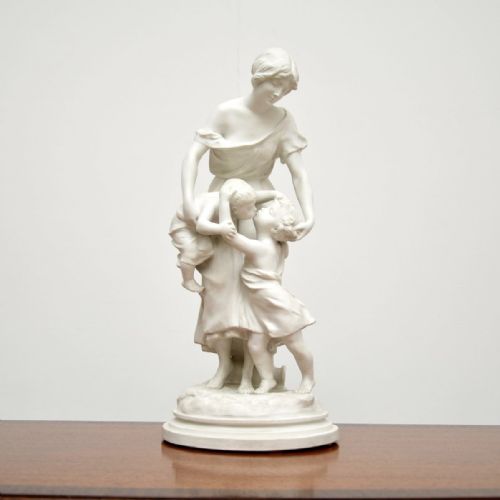


Matte Porcelain Statues
Matte porcelain statues capture the unglazed or bisected surface of ceramic figures, prized for their delicate detail and sculptural depth.
Matte Porcelain Statues
Matte porcelain statues encompass figures and sculptural groups originating from the nineteenth century and the Edwardian era. These pieces range from Victorian Orientalism and Art Nouveau creations to traditional figurine forms depicting children, animal companions, and pastoral workers.
How they were made
Makers utilised porcelain, ceramic, and specialised biscuit or Parian porcelain to achieve an unglazed matte finish that closely mimics carved marble. This technique allows intricate details, from facial expressions to textile folds, to remain sharp without the softening effect of a glossy glaze.
Listings feature works from the nineteenth century, 1870, 1880, 1910, and the Edwardian period.
What varies in quality
Quality rests in the crispness of the modelling and the finesse with which the unglazed surface retains fine lines and anatomical definition. Pieces designed by named modellers or produced as prototypes exhibit superior artistic intent and sculptural presence.
Scale and complexity also define the upper tier, with large figures and multi-figure groups requiring greater technical mastery during the firing process to prevent warping in the kiln.
Royal Dux Bohemia·H Schubert·John Durham·Copeland
The Matte Porcelain Statues Glossary
- Biscuit Porcelain
- Unbleached and unglazed porcelain fired once to create a matte, porous surface resembling marble. This finish was widely favoured by nineteenth-century manufacturers for sculptural figures.
- Parian Porcelain
- A fine-grained type of biscuit porcelain developed in the nineteenth century specifically for statuary. It takes its name from Parian marble due to its similar appearance and texture.
- Art Nouveau
- An international style of art and architecture prevalent in the late nineteenth and early Edwardian periods. It is characterised by organic lines, flowing plant forms, and dynamic asymmetry.
- Victorian Orientalism
- An artistic movement reflecting nineteenth-century European fascination with Eastern cultures. Works in this style often depict subjects and attire inspired by Middle Eastern and Asian aesthetics.
Matte Porcelain Statues: Frequently Asked Questions
What is biscuit porcelain?
Biscuit porcelain is fired ceramic material left unglazed to produce a matte, tactile surface. This finish highlights the sculptural work of the modeller without the reflective sheen of traditional glazes.
Manufacturers often used this medium for portrait busts and classical statuary during the nineteenth century.
How do I clean matte surfaces?
Clean unglazed porcelain gently with a dry, soft brush to remove dust from crevices. Avoid water and chemical cleaners, as the porous matte surface can absorb liquids and trap moisture.
Handle pieces carefully by sturdy sections to prevent damage to delicate fingers, props, or painted details.
Are these figures glazed?
Most pieces featured here utilise unglazed porcelain, biscuit, or Parian porcelain to achieve a soft, matte appearance. This deliberate lack of glaze distinguishes them from standard tableware and glossy decorative ceramics.
Some examples incorporate minimal enamel or paint applied selectively over the matte body.
When were these statues made?
The pieces span the nineteenth century and the Edwardian era, including works dated around 1862, 1870, 1880, and 1910. These dates reflect both high Victorian production and later Art Nouveau manufacturing.
Stylistic cues and maker marks help establish the precise manufacturing period of each individual sculpture.