



Rosewood Stacking Tables
Rosewood stacking tables are sets of graduated occasional tables that slide neatly beneath one another, offering versatile surface space with minimal floor footprint.
Rosewood Stacking Tables
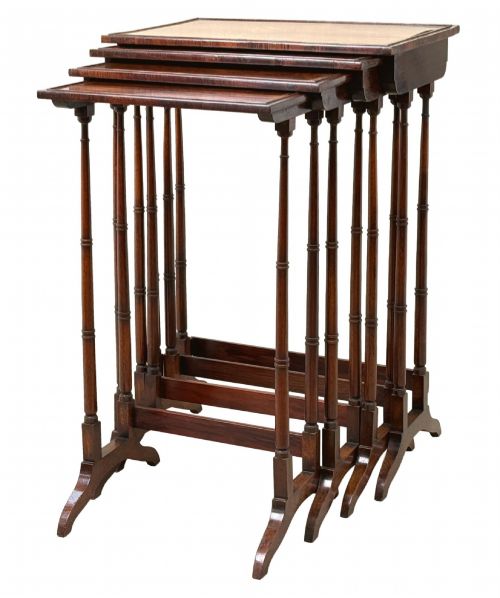
When searching for rosewood stacking tables, buyers encounter sets of graduated tables designed to slide neatly beneath one another to save space. These pieces range from four-table quartetto sets to nests of three designed for occasional use.
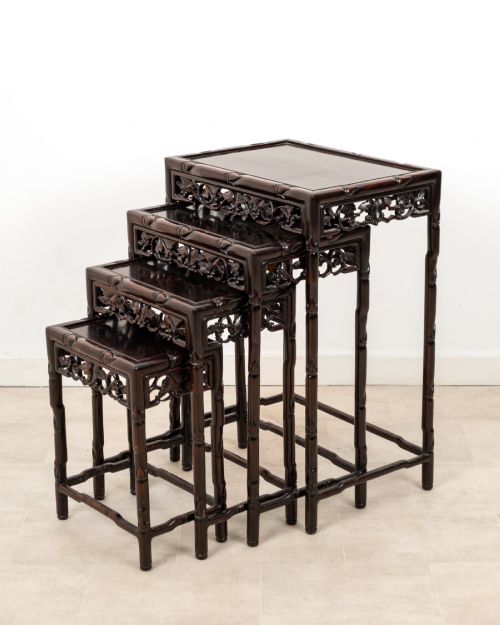
The selections available span multiple distinct eras and regional traditions, featuring 19th-century Regency examples alongside Chinese Qing Dynasty hongmu nests and early 20th-century French Art Nouveau pieces. French iterations appear by notable makers such as Émile Gallé.
Most examples function as side or coffee tables that separate for serving tea or displaying objects, returning to a single compact footprint when not in use. The forms vary from traditional Georgian and Regency designs to carved Chinese export items and geometric Art Deco shapes.
Materials and construction
Makers utilise dense timbers, predominantly rosewood, hardwood, and hongmu, to ensure the structural integrity required for slender legs and thin tabletops. Wood veneer also appears across specific decorative periods to achieve distinct surface patterns.
Construction relies on precise joinery to allow the smaller tables to glide smoothly into the frame of the next larger table without binding. Carved detailing and subtle shaping define the stylistic output of both English Regency workshops and Chinese export carvers.
These tables serve as early flat-pack furniture ancestors, solving the Victorian puzzle of how to host four tea drinkers without turning the parlour into an obstacle course.
Factors of quality
Quality reveals itself in the precision of the graduated fit and the stability of the legs when the tables stand independently. Superior examples maintain structural tightness without excessive looseness in the joints after decades of sliding in and out.
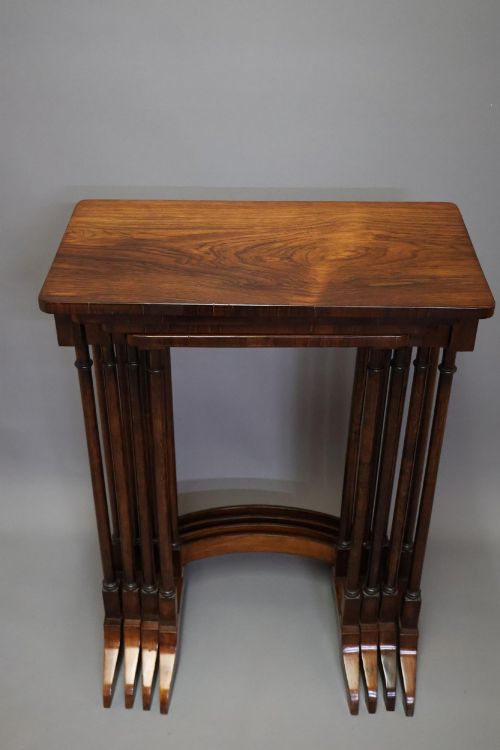
The choice of timber grain and the crispness of any carved ornamentation separate standard production from finer cabinet work. Grain matching across the tabletops and the depth of the rosewood colour contribute to the overall visual balance of the set.
Émile Gallé
The Rosewood Stacking Tables Glossary
- Quartetto
- A set of four graduated occasional tables designed to nest together. This term frequently appears in Regency cabinet making.
- Hongmu
- A category of dense, heavy Asian hardwoods often translated as red wood. It appears frequently in Chinese Qing Dynasty nests.
- Veneer
- A thin layer of superior wood applied over a secondary timber base. This technique allows for decorative grain patterns on the tabletop surfaces.
Rosewood Stacking Tables: Frequently Asked Questions
How do I care for rosewood stacking tables?
Keep the wood away from direct heat sources and strong sunlight to prevent the rosewood from drying out or fading over time. Dust regularly with a soft, dry cloth and avoid silicone-based polishes.
Lift each table rather than dragging it across the floor to protect the lower stretcher rails and joints from unnecessary strain. Ensure the tables are completely dry if used for serving drinks to prevent water rings on the polished surface.
Can these tables support heavy items?
These tables are built for occasional use, such as holding books, cups, or small decorative lamps, rather than heavy weight-bearing tasks. The slender legs and tiered construction prioritise space-saving elegance over robust industrial strength.
Distribute weight evenly across the centre of the tabletop rather than placing heavy objects near the outer edges. Take particular care with the smallest table in a nest, as its reduced scale limits its load capacity further.
What is the difference between a quartetto and a nest?
A quartetto specifically denotes a set of four graduated tables designed to slide together, a term common in Regency furniture classification. A nest is the broader category that includes sets of three or four tables from various periods and origins.
Both terms describe the same fundamental space-saving concept of hierarchical storage. Checking the number of tiers in the set clarifies the exact configuration regardless of the historical terminology used.
How do I identify a Regency set?
Regency sets typically feature rich rosewood grain, slender turned or column supports, and understated classical proportions inspired by ancient designs. These pieces often carry the designation of quartetto tables in historical records.
Examine the construction methods and foot styles for characteristics typical of early nineteenth-century English cabinet making. Comparing the joinery and timber weight against known period examples helps confirm the era.