
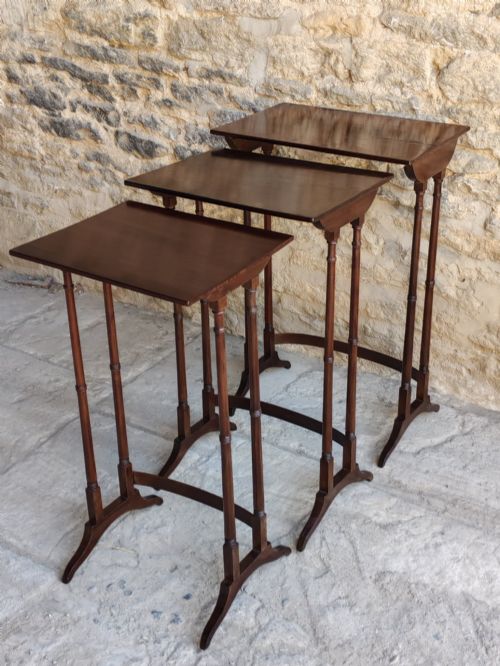
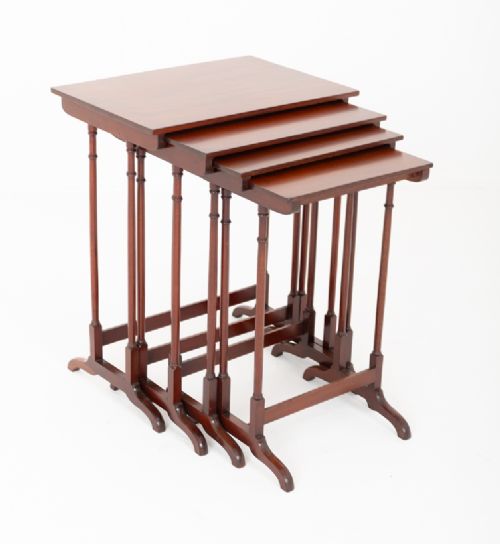
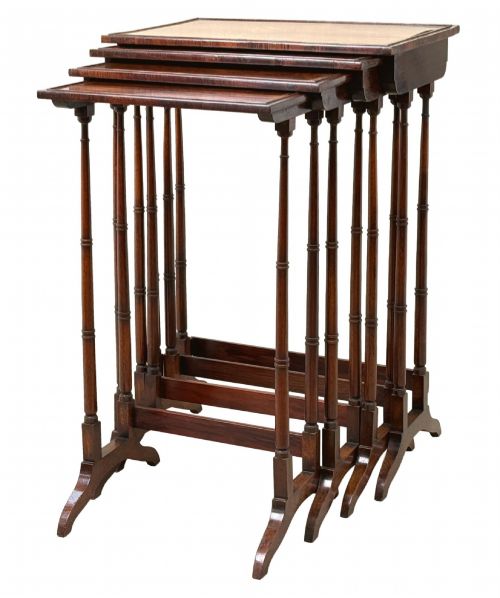

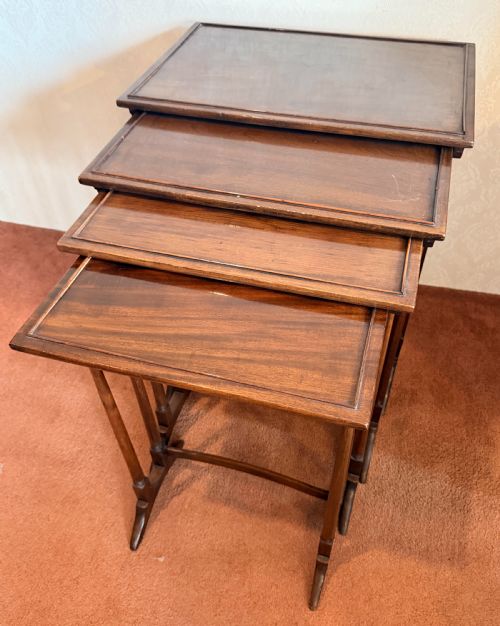
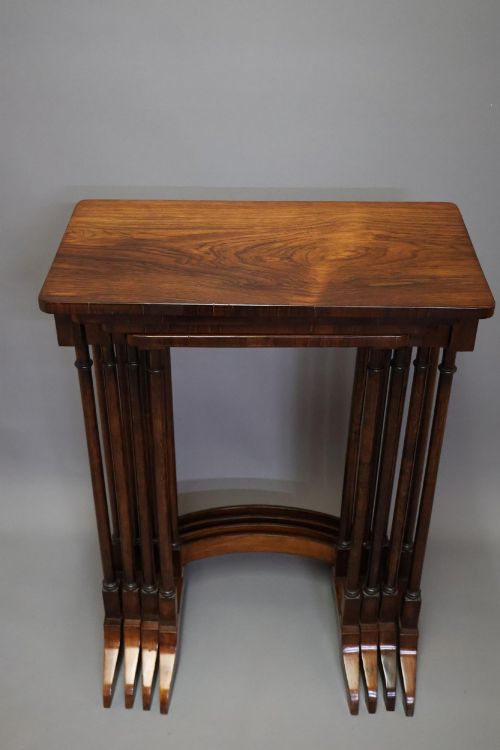


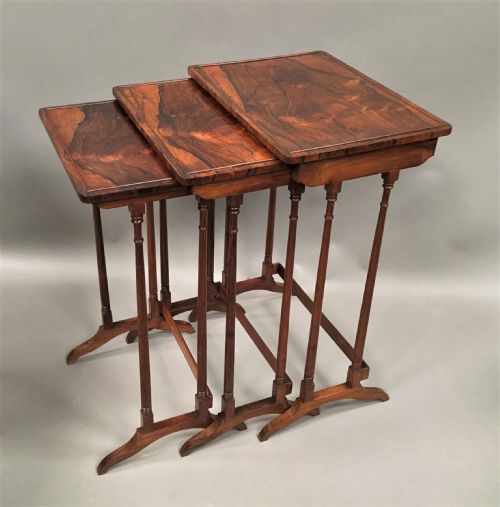

Regency Occasional Table Set
These regency occasional table set examples are graduated stacking pieces designed to save space, offering clever surface area when needed.
Regency Occasional Table Set
A regency occasional table set comprises graduated stacking tables, often called a quartetto, designed to pull out independently for use and slide together to save space. You will frequently encounter sets of three or four tables, predominantly in mahogany or rosewood, spanning the Regency period through to later revivals.
The form appears in several stylistic interpretations across the inventory, ranging in appearance from strict period proportion to Chinoiserie decorated lacquer and Georgian style revivals. Surviving examples demonstrate how these functional surfaces adapted from the early nineteenth century onward into twentieth century Edwardian interiors.
How they were made
Cabinet makers utilised dense hardwoods such as mahogany and rosewood for their strength and fine grain, allowing slender turnings and stable joints on small frames. Satinwood and ebony feature as contrasting decorative elements, while lacquer and gold leaf appear on Chinoiserie decorated surfaces.
Construction relies on precise graduated sizing so each smaller table slides neatly beneath the next larger one without binding. Simulated faux rosewood finishes also occur alongside solid timber construction, reflecting period economy and decorative preference.
What varies in quality
Quality rests primarily on the choice of timber and the crispness of the turning on the legs and supports. Finer sets display richly figured rosewood veneers or carefully selected mahogany with stable, well fitted joints across all graduated tiers.
Decorative execution separates standard production from exceptional pieces, particularly in the precision of Chinoiserie lacquer work or inlaid satinwood details. The harmony of proportions when the tables sit nested together indicates the original maker's skill.
W&C Wilkinson London·Gillows
The Regency Occasional Table Set Glossary
- Quartetto
- A set of four graduated occasional tables designed to fit one beneath another. This term appears frequently in nineteenth century descriptions of nesting tables.
- Nest of tables
- A group of graduated tables that stack into a single footprint. They served various domestic purposes from the Regency era onwards.
- Chinoiserie
- European decorative style reflecting Chinese artistic motifs. Pieces utilising this style often feature lacquer and gold leaf decoration.
- Simulated rosewood
- Painted or stained wood mimicking the grain and coloration of genuine rosewood. This technique was used to achieve a decorative surface on alternative timbers.
Regency Occasional Table Set: Frequently Asked Questions
Were these tables used for coffee?
While modern buyers often use them as low coffee or lamp tables, nineteenth century drawing rooms utilised them as occasional surfaces for needlework, books, or tea service. Their lightweight construction meant servants or family members could easily move them about the room.
As domestic habits shifted toward lower seating in subsequent decades, the height and proportion made them suitable for modern coffee table placement while retaining their original stacking function.
How do I tell Regency from revival periods?
Authentic Regency pieces date from the early nineteenth century, displaying timber patination, hand-turned framing, and construction methods specific to that era. Revival pieces from the Edwardian period or the nineteen-twenties often employ machine-finished elements or slightly different secondary woods.
Examining the underside of the tabletops and the wear patterns on the feet helps distinguish genuine period pieces from later Georgian style copies.
Why do some sets have three tables and others four?
Sets were manufactured in both trios and quartets depending on the maker's design and the intended scale of the furniture. Quartetto sets specifically denote four graduated tables designed to nest together.
Both configurations served the same space-saving purpose in period drawing rooms, though four-tier sets required greater precision in graduated sizing to maintain a compact stacked profile.